Elizabeth Home for Girls
309 East 12th Street | also 307 East 12th Street | East Village | built 1920
Open on the map6 entries

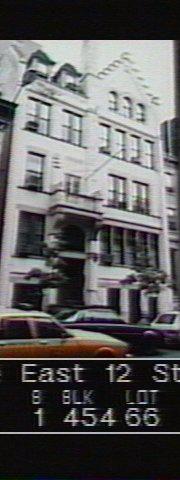
The city photographed every building for its tax records around 1940 and again in the 1980s. NYC Municipal Archives.
Written with AI from the source each entry cites, then fact-checked.
- 1891
The Wheeler family buys 307 East 12th Street and gives it to the Children's Aid Society for a girls' home
In July 1891 Emily Wheeler bought the property at 307 East 12th Street and passed it to the Children's Aid Society. The donors were Mary B. Wheeler, Emily B. Wheeler and Mary B. Ceccarini, giving in memory of Elizabeth Davenport Wheeler. The Society's annual reports of 1889 and 1890 had stressed the need for more room for its girls' home, which had opened at 27 St. Mark's Place in 1863.
- 1892
The Elizabeth Home opens with typing, sewing and dressmaking rooms for homeless girls
At the formal opening on December 13, 1892, the New York Times called the building a home and training school for destitute girls. The basement held dining rooms, kitchen and laundry; the first floor had typewriting and sewing-machine classrooms; the third floor held a dressmaking workroom; the roof could be used for gardening. Grace Dodge told the dedication audience that dressmaking and housekeeping skills mattered most, and Elizabeth S. Hurley, a Civil War widow, was named superintendent.
Source: Daytonian in Manhattan
- 1892
Calvert Vaux's last Children's Aid Society building fits a stepped gable onto a 40-foot lot
Vaux & Radford designed the home as the last of more than a dozen buildings Calvert Vaux created for the Children's Aid Society, and the only one built just for girls. Because the midblock site was only 40 feet wide, the Landmarks Commission says, the design is more restrained than his others. The facade reads as two houses: a stepped gable on the east, a mansard roof with two dormers on the west, and an off-center entrance under a balustraded balcony.
“The Elizabeth Home for Girls, the last of this group designed by Vaux has the picturesque characteristics common to Vaux's other designs…”
- 1911
A resident slaps a stranger who greeted her on Broadway, and a judge fines him $10
Gertrude Williams, a cashier from Birmingham, Alabama, lodged in the home in 1911. On the evening of April 25, after leaving the subway at Times Square, she noticed a man following her. When Charles Stewart said hello at 39th Street, she slapped him and a policeman arrested him. He claimed mistaken identity, the judge fined him $10, and Williams fainted as she left the courtroom.
Source: Daytonian in Manhattan
- 1935
Police lead naturopath Benedict Lust out of his school here, charged with granting chiropractic degrees
After the Children's Aid Society left in 1930, Benedict Lust opened his American School of Naturopathy and Chiropractic in the building. One of his water cures had patients sit for eight hours under a running shower without eating. In 1935 police escorted Lust out of 307 East 12th Street, along with the dean, Sinai Gershanek, and the secretary, Mark B. Thompson, on a charge of unlawfully granting chiropractic degrees.
Source: Daytonian in Manhattan
- 1946
The Florence Crittenton League buys the old Children's Aid buildings and reopens them as Barrett House
In 1946 the Florence Crittenton League, a shelter group founded by Charles N. Crittenton in 1883, bought the former Children's Aid Society buildings on East 12th Street. After remodeling, it reopened the building in 1948 as Barrett House, a private shelter for girls aged 16 to 21. Courts, clinics and private agencies referred most residents, and the Landmarks Commission says the aim was to offer therapies that kept them out of the House of Detention.
Nearby
- Elizabeth Home for Girls307 East 12th Street | 5 entries
- Elizabeth Home for Girls307 East 12th Street | 5 entries
- Elizabeth Home for Girls307 East 12th Street | 5 entries
- John's of 12th Street302 East 12th Street | 3 entries
- 311 East 11th Street2 entries
- Ukrainian Congress Committee of America203 2nd Avenue | 6 entries