315 East 10th Street
East Village | built 1848
Open on the map4 entries

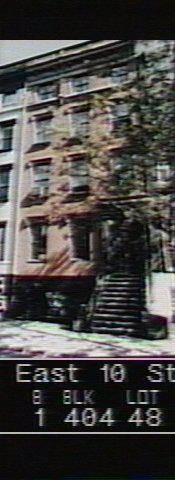
The city photographed every building for its tax records around 1940 and again in the 1980s. NYC Municipal Archives.
Written with AI from the source each entry cites, then fact-checked.
- 1847
A Greek Revival house at 315 East 10th Street faces Tompkins Square
Around 1847 builders James C. Whitlock and Franklin Baylies start work on four Greek Revival houses on East 10th Street opposite the newly landscaped Tompkins Square. Each is 25 feet wide and four stories tall above an English basement. Robert Hogan buys No. 315 in 1848, apparently as an investment, and the next year an advertisement offers it for sale as a house finished in modern style.
Source: Daytonian in Manhattan
- 1860
The Sisters of Charity convert the house into a girls' school
John Conway, a butcher, buys the house after its first owners, and his wife Catharine dies there in 1855. His family leaves in 1860, and the Sisters of Charity acquire the property and turn it into a school. By 1881 the sisters also hold the adjoining No. 313 and run the two houses as St. Bridget's Academy, which has 115 girls enrolled that year.
Source: Daytonian in Manhattan
- 1892
Architect Franklin Baylies remodels the school's twin facades
In 1892 architect Franklin Baylies is hired to remodel the exteriors of the two houses that make up St. Bridget's Academy. He adds Gothic Revival touches such as square drip moldings over the windows and quatrefoil ornament on the entrance entablatures. A new cast-metal cornice and a heavy parapet crown the facades, and paired columns on the top floor balance the two fronts.
Source: Daytonian in Manhattan
- 1920
A Russian emigre society buys the former school for a clubhouse
In June 1920 the property of the former St. Bridget's Academy is reported resold to the Independent Stryjer Benevolent Society. The interior is converted into a clubhouse for the Russian Erudition Society, known as Nauka, with a restaurant and a large meeting hall. The Russian Consolidated Mutual Aid Society later meets here, and the Daytonian describes its members as White Russians who want to keep pre-revolutionary Russian culture alive.
Source: Daytonian in Manhattan
Further reading
- Catholic Girls and White Russians -- 315 East 10th StreetDaytonian in Manhattan
- 315 East 10th StreetVillage Preservation: East Village Building Blocks
Nearby
- St. Brigid's Academy313 East 10th Street | 4 entries
- 317 East 10th Street3 entries
- 311 East 10th Street1 entry
- 319 East 10th Street3 entries
- 321 East 10th Street2 entries
- 309 East 10th Street2 entries