Anthology Film Archives
32 2nd Avenue | East Village | built 1919
Open on the map11 entries

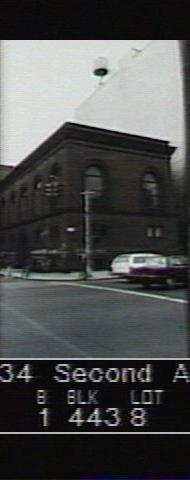
The city photographed every building for its tax records around 1940 and again in the 1980s. NYC Municipal Archives.
Written with AI from the source each entry cites, then fact-checked.
- 1913
Alfred Hopkins wins the courthouse commission with a ten-story jail-and-court design
Chief Magistrate William McAdoo picked the corner of Second Avenue and 2nd Street in April 1913 and expected a building of three or four stories. When Alfred Hopkins's design won in December, it rose ten stories on a bigger budget of $350,000. Hopkins had toured 20 European prisons and planned rooftop exercise space for prisoners and cells with three walls and one barred front.
Source: Daytonian in Manhattan
- 1917
Hopkins's courthouse plans are cut back after four years of delay
By September 1916 the Board of Estimate had cut the courthouse appropriation to $150,000, and no construction had begun. On December 22, 1917, four years after he won the job, Alfred Hopkins's revised plans were announced, with eight stories removed and many of the modern prison features dropped. The result was a much smaller building, faced in brick rather than the stone of his first design.
Source: Daytonian in Manhattan
- 1919
A new magistrate's courthouse and jail opens on Second Avenue
The Renaissance Revival building, designed by Alfred Hopkins, opened on April 30, 1919, as the Manhattan Third District Magistrate's Courthouse and Jail, also known as the New Essex Market Courthouse. It served the courts for decades before being sold to a film archive in 1979.
Source: Wikipedia
- 1919
A magistrate sends a quarreling couple home from the new courthouse
Soon after the courthouse opened, Lizzie Berman came before Magistrate Marsh with a baby in her arms and said her husband Henry hit her. Henry answered that she cooked him no supper because she chatted with the neighbors all day. Marsh told them to stop fighting with a baby to care for, and the Evening World reported that Lizzie walked out in front while Henry trailed at a safe distance.
Source: Daytonian in Manhattan
- 1920
A woman who packed up a stranger's apartment is sent to Bellevue
On October 8, 1920, Magistrate William A. Sweetser heard the case of Rachael Toback, 50, charged with unlawful entry. She had gone into Harry Abrams's East Houston Street apartment while the family was out, packed their belongings and hired moving vans, and the Abramses returned in time to stop the workers. Her relatives said repeated moves had unsettled her mind, and the judge committed her to Bellevue Hospital for observation.
Source: Daytonian in Manhattan
- 1923
Gangster Kid Dropper is shot dead outside the courthouse
Racketeer Nathan 'Kid Dropper' Kaplan is assassinated by rival Louis Cohen right outside the courthouse doors as police escort him to a waiting car. The brazen daylight shooting draws citywide attention to gang warfare over the era's rackets.
Source: Daytonian in Manhattan
- 1948
A prisoner escapes ten minutes after the courthouse reopens
Overcrowding at the Mulberry Street court led to the old courthouse reopening on July 26, 1948, while renovations were still underway. Ten minutes later, Joseph Ametrano, 60 and accused of stealing a tire from a parked car's trunk, vanished. Detective Jacob Rosenfeld had left him in the fingerprint room while he checked papers upstairs, and by the time he returned there was no trace of his prisoner.
Source: Daytonian in Manhattan
- 1969
The Millennium Film Workshop leaves the building for East Fourth Street
The Film Project, set up by St. Mark's Church in 1966 with Ken Jacobs as its first director, moved into this building and renamed itself the Millennium Film Workshop. Two years later, in 1969, it left for its permanent home at 66 East Fourth Street.
- 1979
Anthology Film Archives acquires the former courthouse building
After outgrowing rented quarters in SoHo, Anthology Film Archives, the avant-garde film archive founded a decade earlier by Jonas Mekas, P. Adams Sitney, Jerome Hill, Stan Brakhage and Peter Kubelka, buys the vacant Second Avenue courthouse for its permanent home.
Source: Wikipedia
- 1988
Anthology Film Archives opens in the renovated courthouse
Founded on November 30, 1970, by Jonas Mekas, P. Adams Sitney, Peter Kubelka, Stan Brakhage and Jerome Hill, Anthology first screened films at the Public Theater and then at 80 Wooster Street in SoHo. It bought the old courthouse in 1979 and, after a $1.45 million renovation, opened here on October 12, 1988, as a home for avant-garde and independent film.
Source: Wikipedia
- 2004
The building appears as Doctor Octopus's lab in Spider-Man 2
Filmmakers use Anthology Film Archives' distinctive facade as the exterior of a supervillain's laboratory in the blockbuster Spider-Man 2, introducing the former courthouse to a new audience.
Source: Wikipedia
Further reading
- Anthology Film ArchivesWikipedia
- The 3rd District Magistrates Courthouse -- No. 32 Second AveDaytonian in Manhattan
- 43-45 East 2nd Street; 32-34 Second AvenueVillage Preservation: East Village Building Blocks
Nearby
- 51 East 2nd Street1 entry
- Hare Krishna Temple (Matchless Gifts)26 2nd Avenue | 6 entries
- 36 East 2nd Street2 entries
- 41 2nd Avenue2 entries
- Cathedral of the Holy Virgin Protection59 East 2nd Street | 5 entries
- 32 East 2nd Street2 entries