Dyer House
325 Canal Street | SoHo | built 1819
Open on the map4 entries

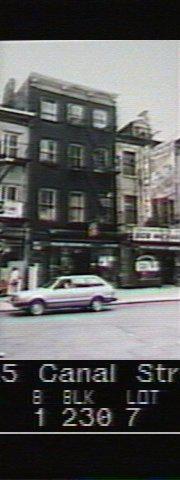
The city photographed every building for its tax records around 1940 and again in the 1980s. NYC Municipal Archives.
Written with AI from the source each entry cites, then fact-checked.
- 1819
John Dyer builds one of the first brick houses on newly covered Canal Street
Canal Street took its name from a narrow drainage ditch down its middle, finished in 1811 and so foul-smelling and mosquito-ridden that it was roofed over in 1819. The widened roadway drew new housing right away, and merchant John Dyer's three-and-a-half-story Federal house, finished before 1820, was among the earliest. It was renumbered 325 when the street's numbers changed in 1860.
Source: Daytonian in Manhattan
- 1872
Burglars clean out Colmer's fur stock at 325 Canal, and he offers $800 with no questions asked
On the night of December 1, 1872, thieves stole the stock of the Colmer fur business, which shared the upper floors with a hat maker. Three days later the owner ran a newspaper notice promising $800 for the return of all the furs, with a proportional reward for any part and no questions asked. The sum equals more than $16,500 in present-day money.
Source: Daytonian in Manhattan
- 1877
A cast-iron storefront and a new top floor turn the old Dyer house into a garment-trade loft
In 1877 the aging Federal house was remodeled as a modern commercial building, receiving a cast-iron storefront and a roof raised to make a full extra floor. The investment paid off, and the building soon filled with garment makers. By the late 1890s one shirt firm here had a workforce of 35 men, 15 women and 7 girls under 21, all working 59 hours a week.
Source: Daytonian in Manhattan
- 1957
Hobbyists buy parts for a home-built speed alarm from Gyro Electronics at 325 Canal
By mid-century Canal Street was filling with plastics and electronics shops, and 325 became a supplier for home tinkerers. Pocket Radio Craft sold a three-tube pocket radio kit by mail in 1949 for $9.95, and Gyro Electronics stayed through the 1950s. Popular Science's August 1957 project for building a speed alarm told readers to get the parts at Gyro's Canal Street shop.
Source: Daytonian in Manhattan
Further reading
- The Sadly Abused 1819 Dyer House - 325 Canal StreetDaytonian in Manhattan
Nearby
- Michael Quinn House327 Canal Street | 4 entries
- 329 Canal Street1 entry
- 323 Canal Street4 entries
- Isaac Lawrence row house321 Canal Street | 3 entries
- 319 REAR-A Canal Street1 entry
- 8 Greene Street1 entry