Michael Quinn House
327 Canal Street | SoHo | built 1819
Open on the map4 entries

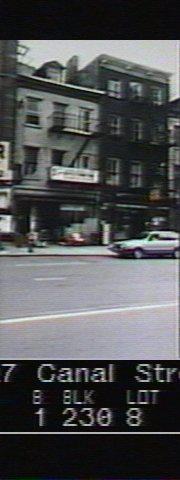
The city photographed every building for its tax records around 1940 and again in the 1980s. NYC Municipal Archives.
Written with AI from the source each entry cites, then fact-checked.
- 1819
Michael Quinn buys a brand-new Federal house from developer Isaac Lawrence at 327 Canal
Around the time the marshy Lispenard's Meadows were drained and a sewer laid under Canal Street in 1819, Michael Quinn bought this newly built house from Isaac Lawrence. It was one of eight nearly identical brick rowhouses Lawrence put up, each three stories with stone lintels and a single dormer. A shop probably occupied the ground floor from the start.
Source: Daytonian in Manhattan
- 1859
A wig shop above 327 Canal advertises for an apprentice girl, preferably an orphan
By the 1850s the upper floors held businesses too, including a human-hair wig shop, possibly Kolosky & Ober. On April 26, 1859 it ran a New York Herald notice seeking a girl for ornamental hair and wig work, plus a younger girl as general helper who could be bound as an apprentice. The ad stated a preference for an orphan.
Source: Daytonian in Manhattan
- 1885
Dealer in fancy goods at 327 Canal is seated on the Ferdinand Ward jury after mistaking Ward for Henry Ward Beecher
Ferdinand Ward, the financier accused of looting the Marine Bank, faced a trial whose jury selection dragged on for days. On October 26, 1885, Simon Weil, whose fancy-goods business was at 327 Canal, said he had read of 'Henry Ward' and, asked which one, named Henry Ward Beecher. The Sun reported that his ignorance settled it, and he took the twelfth seat.
Source: Daytonian in Manhattan
- 1900
Paint-factory explosion blows out the rear wall of 327 Canal's second floor and burns two men
Around 8 a.m. on August 16, 1900, an explosion shook the second-floor workshop of the Hirschberg Company, which made flammable paints and enamels. Owner Herman Hirschberg and porter Sigmund Goldberg, whose clothes caught fire, fled to the street. Hirschberg was later found at a drugstore and taken to St. Vincent's Hospital. The blast destroyed the rear wall of the floor, with losses of about $3,000, and the firm closed in 1902.
Source: Daytonian in Manhattan
Further reading
- The Michael Quinn House -- No. 327 Canal StreetDaytonian in Manhattan
Nearby
- Dyer House325 Canal Street | 4 entries
- 329 Canal Street1 entry
- 323 Canal Street4 entries
- Isaac Lawrence row house321 Canal Street | 3 entries
- 8 Greene Street1 entry
- 319 REAR-A Canal Street1 entry