St. Bartholomew's Church
325 Park Avenue | also 105 East 50th Street, 109 East 50th Street, 321 Park Avenue | East Midtown | built 1918
Open on the map15 entries

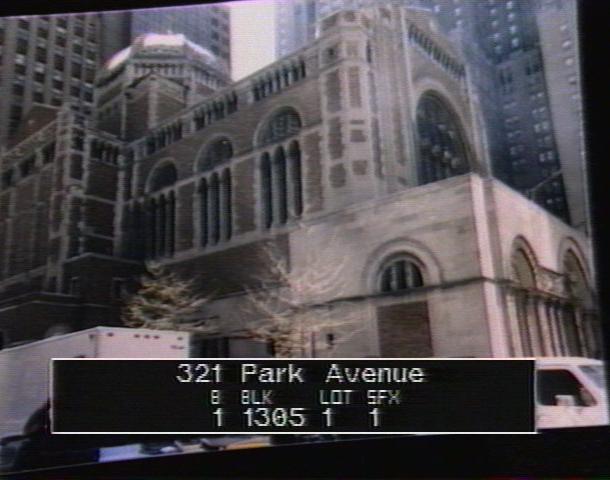
The city photographed every building for its tax records around 1940 and again in the 1980s. NYC Municipal Archives.
Written with AI from the source each entry cites, then fact-checked.
- 1917
Alice Vanderbilt braves the rain as the cornerstone goes in for Goodhue's church
On May 1, 1917, about 300 parishioners stood in the rain on the Park Avenue lot, where old brewery buildings had just been cleared, to watch the cornerstone set. Sealed inside were an Episcopal Prayer Book, a copy of the plans, a parish history and 1917 coins from a penny to a $20 gold piece. Alice Vanderbilt, whose memorial porch would be rebuilt into the design, was among those present.
Source: Daytonian in Manhattan
- 1918
St. Bartholomew's consecrates Bertram Goodhue's church on Park Avenue
Founded in 1835, the parish moved to Park Avenue into a Byzantine-inspired church by Bertram Goodhue, built in 1916 and 1917 and consecrated in 1918. After Goodhue's death in 1924 his associates replaced a planned spire with the dome, and the church was finished in 1930 at a cost of $5.4 million.
Source: Wikipedia
- 1923
St. Bartholomew's pays off its last $155,000 and the Park Avenue church is consecrated
Although worshippers had used the building since 1918, it could not be consecrated while any debt remained. On May 1, 1923, the final $155,000 was cleared, and the ceremony drew several bishops and many clergymen. At the 1918 opening the rector had admitted that the dome and cloisters were still unbuilt.
Source: Daytonian in Manhattan
- 1923
Rector Leighton Parks shocks Alice Vanderbilt with a modernist sermon, and she leaves the parish
On December 16, 1923, Rev. Leighton Parks took off his surplice and stole before preaching, then questioned the virgin birth and the bodily resurrection and said he would welcome a heresy trial. Alice Vanderbilt, whose family had given the porch and was so central that the church was called the Vanderbilt Church, quit after about fifty years as a member. The Times reported her departure on February 27, 1924.
Source: Daytonian in Manhattan
- 1927
The Times describes the new community house, with a 60-foot pool and a women's floor for bridge
Begun in 1926 under Goodhue's associates Mayers, Murray & Phillip, the community house offered members, at a dollar a month, a swimming pool and gymnasium on the ground floor and a stage for amateur theatricals above. A women's floor had parlors where cards were allowed but gambling was not, while the men's floor held billiard tables and a grill room. The fifth floor was for children, with a kindergarten and Boy Scout quarters.
Source: Daytonian in Manhattan
- 1930
St. Bartholomew's marks the completion of its mosaics and organ
On October 5, 1930, twelve years after the sanctuary opened only partly finished, St. Bartholomew's marked the completion of Hildreth Meiere's mosaics, new sculptures by Lee Lawrie, and a 1,825-pipe organ from the Skinner Organ Company. Nearly two dozen stained-glass windows still awaited installation.
Source: Daytonian in Manhattan
- 1932
Rector Robert Norwood sees a figure of Christ in the sanctuary marble, and crowds follow
After preaching on the resurrection on February 20, 1932, Rev. Robert Norwood noticed what looked like a small white figure rising in the veining of the brownish marble on the sanctuary wall. The Times described it on February 23 as about a foot and a half tall. On February 24 the paper reported that people had streamed into the church all day to look at it in silence.
Source: Daytonian in Manhattan
- 1932
Rector Robert Norwood dies at 58, and more than 2,200 mourners fill the church
Norwood, who had preached to full congregations of more than 2,000 and was described by the Times as one of the most forceful pulpit speakers, died of a cerebral hemorrhage on September 29, 1932. His funeral on October 1 packed the building with over 2,200 people from every walk of life, including clergy of many denominations; latecomers stood at the back.
Source: Daytonian in Manhattan
- 1944
Twenty-two memorial stained-glass windows are dedicated
The Rev. Dr. George Paull T. Sargent announced in December 1942 that funds had been given for fifteen windows. By the dedication on November 19, 1944, there were twenty-two. The Sheldon family gave the chapel windows and an altar cross in memory of Adelaide Sheldon, Mrs. Henry White gave the rose window for her daughter Lila Vanderbilt Field, and another window honored the mother of organist David McK. Williams.
Source: Daytonian in Manhattan
- 1967
The Landmarks Commission designates the church over the vestry's objection
New York City's Landmarks Preservation Commission designated St. Bartholomew's Park Avenue complex in 1967 despite opposition from the rector and vestry, who worried the protection would block future redevelopment of the site. The designation set the stage for the fight over the adjoining community house that reached the Supreme Court in 1991.
Source: Wikipedia
- 1984
A nine-hour Landmarks hearing weighs St. Bartholomew's plan for a 59-story tower
After a corporation offered the church $100 million for its land in 1980, rector Thomas D. Bowers pushed to replace the Community House with a 59-story office building to fund work with the poor and elderly. The Landmarks Preservation Commission heard dozens of witnesses on January 31, 1984, in a session of nearly nine hours that the Times's David Dunlap ranked among the decade's major landmark fights. The commission rejected the plan, and the church sued.
Source: Daytonian in Manhattan
- 1991
The Supreme Court refuses the church's bid to build a tower
The city designated St. Bartholomew's a landmark in 1967 over the church leadership's objections. In the 1980s the parish fought in court to use its air rights for an office tower, and in 1991 the U.S. Supreme Court declined to hear its appeal, leaving the landmark protections in place.
Source: Wikipedia
- 1993
Lillian Gish's ashes are interred beside her sister Dorothy's at St. Bartholomew's
The silent-film star Lillian Gish died on February 27, 1993, at 99, of heart failure. After her cremation, her ashes were placed next to her sister Dorothy's at St. Bartholomew's. Most of her multimillion-dollar estate went to found the Dorothy and Lillian Gish Prize Trust.
Source: Wikipedia
- 2010
The remake of the film Arthur shoots its wedding scene in the church
In the 1981 comedy Arthur, Dudley Moore's character was to marry Susan Johnson at St. Bart's. When the film was remade, the wedding scene was shot inside the church itself in July 2010.
“The infamous wedding scene in the remake of the same film was also filmed at St. Bart's in July 2010.”
Source: Wikipedia
- 2017
The church finally completes Bertram Goodhue's long-delayed dome
Bertram Goodhue's 1916 rendering for St. Bartholomew's included a massive dome over the crossing, but funding shortfalls left it and other details unfinished when the church opened in 1918. After establishing the St. Bartholomew's Preservation Foundation in 1992 to fund repairs to the building, the congregation finally completed the dome in September 2017.
Source: Daytonian in Manhattan
Further reading
- St. Bartholomew's Episcopal Church (Manhattan)Wikipedia
- St. Bartholomew's Church - 109 East 50th StreetDaytonian in Manhattan
Nearby
- 345 Park Avenue9 entries
- General Electric Building570 Lexington Avenue | 10 entries
- Waldorf Astoria New York301 Park Avenue | 17 entries
- The Benjamin Hotel557 Lexington Avenue | 11 entries
- The Summit Hotel569 Lexington Avenue | 10 entries
- Seagram Building375 Park Avenue | 21 entries