Seagram Building
375 Park Avenue | also 101 East 52nd Street, 98 East 53rd Street, 99 East 52nd Street | East Midtown | built 1958
Open on the map21 entries

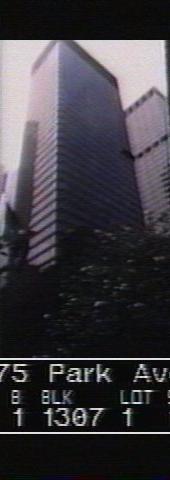
The city photographed every building for its tax records around 1940 and again in the 1980s. NYC Municipal Archives.
Written with AI from the source each entry cites, then fact-checked.
- 1919
The Montana Apartments rise on the site of Steinway's piano factory
By the 1860s the east side of Park Avenue between 52nd and 53rd streets held Steinway & Sons' five-story brick finishing factory. In 1919 work began on the Montana Apartments, a neo-Romanesque building by Rouse & Goldstone faced in brick and stone, which replaced the factory. Tenements stood on East 53rd Street and rowhouses on East 52nd, the rest of the block Seagram later cleared for its tower.
- 1951
Seagram pays $4 million for a Park Avenue block-front, then buys more land next door
In 1951 the Seagram Company paid $4 million for 50,950 square feet on the east side of Park Avenue between 52nd and 53rd streets, a parcel that included the Montana Apartments. Once the architects were chosen, it bought another 9,000 square feet of adjacent land for $900,000. By the company's announcement in 1954, the goal was to finish by 1957, the centennial of the House of Seagram.
- 1954
Phyllis Lambert picks Mies van der Rohe to design her father's tower
Phyllis Lambert, daughter of Seagram chief Samuel Bronfman, turned down the company's first design for its headquarters and in November 1954 chose Ludwig Mies van der Rohe as architect. Philip Johnson joined as co-architect because Mies was not licensed in New York State. The bronze-clad tower opened on May 22, 1958, set back behind a granite plaza.
Source: Wikipedia
- 1955
Wreckers clear the Montana Apartments and neighboring buildings
When the new plans were filed in March 1955, the site still held the Montana Apartment Building on Park Avenue, a nine-story apartment building facing 53rd Street, plus a five-story tenement and a row of four-story buildings along East 52nd. Demolition ran from June 1955 to March 1956, and construction started soon afterward.
- 1955
The architects' institute and state turn Mies away, and he goes home to Chicago
While the demolition proceeded, Mies van der Rohe applied for membership in the American Institute of Architects' New York chapter and was rejected in December 1955. The state also refused him a license to practice unless he produced proof of his education. Offended, Mies returned to Chicago, leaving Philip Johnson in full control of the design. He rejoined the project in June 1956 after getting his New York license.
“Mies applied for membership in the American Institute of Architects' (AIA) New York division, but was rejected in December 1955…”
Source: Wikipedia
- 1956
Truckers strike over idling tickets while bolted steel wins a Quiet City Award
Steel erection began in May 1956 with about 700 workers fitting more than 5,000 pieces of steel together. A Midtown no-idling rule got some truckers ticketed while delivering beams, so they briefly struck until the rule was changed. To cut noise, the steel was bolted rather than riveted, and the work earned a Quiet City Award from the city.
“…some truckers were ticketed while delivering steel beams to the work site, prompting them to strike temporarily until the rule was changed…”
Source: Wikipedia
- 1958
Mies van der Rohe's Seagram Building officially opens
Ludwig Mies van der Rohe designs the 38-story bronze-clad tower with Philip Johnson handling the entrance canopies, elevators, lighting, and restaurant interiors. It is the first office building in the world to use extruded bronze on its facade and the first New York skyscraper with full-height plate glass windows.
Source: Wikipedia
- 1958
Mark Rothko paints murals meant to unsettle Four Seasons diners
Commissioned to decorate Philip Johnson's Four Seasons Restaurant inside the tower, Mark Rothko later says his dark, brooding canvases were meant to sicken the restaurant's wealthy patrons. The restaurant space also displays other art, including Pablo Picasso's 1919 painted curtain Le Tricorne, made for the Ballets Russes.
Source: Wikipedia
- 1959
The Four Seasons restaurant opens inside the Seagram Building
The Four Seasons opened in the building in 1959, with art including Picasso's painted stage curtain Le Tricorne. On October 3, 1989, the city designated the building's exterior, lobby and the restaurant's interior as landmarks.
Source: Wikipedia
- 1962
375 donors pay $1,000 each to dine with President Kennedy at the Four Seasons
Before heading to Madison Square Garden for his birthday salute, President John F. Kennedy attended a dinner in his honor at the Four Seasons, which had opened only three years earlier. The New York Times described it as glittering, and its headline noted that 375 guests had each donated $1,000 to attend.
Source: The New York Times
- 1963
Courts uphold a bigger tax bill, reasoning that the tower's prestige has value
The city assessed the Seagram Building on its high construction cost, a figure above what its rents would justify, and the company fought the bill. In 1963 the Appellate Division sided with the city's Tax Commission, reasoning that the building served the owner's business while also advertising it and adding to its prestige. The Court of Appeals affirmed that decision in 1964.
“The Appelate Division's decision was affirmed by the Court of Appeals in 1964.”
- 1968
An Easter Island moai head stands on the plaza to draw attention to the island's artifacts
The World Monuments Fund placed a moai head on the Seagram plaza in 1968 to call attention to Easter Island's artifacts, which were considered endangered. It was one of a string of displays on the pink granite plaza, which also hosted an Olmec head in 1965, Barnett Newman's Broken Obelisk in 1967 and Louise Nevelson's Atmospheres and Environment XII in 1971.
Source: Wikipedia
- 1971
William Whyte films the plaza to study how New Yorkers use small public spaces
In 1971 the sociologist William H. Whyte made the plaza the setting of a planning study. His film, The Social Life of Small Urban Spaces, made with the Municipal Art Society, records how people socialized there day to day. Whyte praised the plaza for letting visitors choose to sit or lie on its ledges and steps despite their plain design.
Source: Wikipedia
- 1973
Tom Margittai and Paul Kovi take over the Four Seasons
Tom Margittai, a Restaurant Associates vice president, and Paul Kovi, the restaurant's director, bought the Four Seasons in 1973. They hired the chef Seppi Renggli, turned the former bar into the simpler Grill Room, and ran a full-page advertisement by George Lois in The New York Times on May 15, 1974. By 1975 Joseph Baum said they had restored its elegance.
“Restaurant Associates vice president Tom Margittai and Four Seasons director Paul Kovi acquired the Four Seasons in 1973…”
Source: Wikipedia
- 1989
The city designates the Seagram Building's exterior and lobby landmarks
New York's Landmarks Preservation Commission protects the tower's bronze facade, its pink granite plaza, and the interior lobby. The building is later added to the National Register of Historic Places on February 24, 2006.
Source: Wikipedia
- 1993
State's top court upholds the Four Seasons landmark over the landlord's objections
The New York State Court of Appeals ruled 5 to 0 that the Landmarks Preservation Commission was within its authority in designating the Four Seasons interior. The landlord, the Teachers Insurance and Annuity Association, argued the designation would cost it money because the space could not be put to any other use. The court also said the commission could protect the interior's fittings, from the staircases and railings to the sculptures, bar, pool and ceiling panels. The commission's chairwoman said it was the first time the state's highest court had addressed an interior landmark designation.
Source: Internet Archive
- 1998
Four Seasons renews its lease for 17 years and reveals why it sought landmark status
The restaurant signed a 17-year renewal on 17,000 square feet in October 1998. The New York Times then reported that its former owners, Tom Margittai and Paul Kovi, had applied for their own landmark designation days after the landlord sought one for the exterior, partly to strengthen their hand in lease talks. The landlord was surprised and dismayed, and fought the interior designation all the way to the state's top court.
Source: Internet Archive
- 2003
Vivendi hires Christie's to sell the Seagram art collection, including the Picasso curtain
Vivendi Universal, which had bought Seagram from the Bronfman family, picked Christie's to sell the modern art that hung in the tower's offices and public spaces. Experts valued it at about $15 million. It included a 1957 Rothko, a Miro and works by Larry Rivers, and Vivendi asked Phillips to sell about 700 photographs. The prospect of selling Picasso's Le Tricorne curtain troubled preservationists and architects because they saw it as part of the building.
Source: Internet Archive
- 2014
Picasso's Le Tricorne curtain is bound for the New-York Historical Society
A deal ended the dispute over Picasso's 19-by-20-foot stage curtain, painted in 1919 for the Ballets Russes, which had hung in the Four Seasons corridor since 1959. Owner Aby Rosen said he needed to remove it to fix a leaking steam pipe, while the New York Landmarks Conservancy, which owned it, feared it was too fragile. Rosen agreed to pay to remove and restore the curtain and send it to the New-York Historical Society. Phyllis Lambert said it broke her heart.
Source: Internet Archive
- 2015
Landmarks panel rejects Aby Rosen's plan to alter the Four Seasons interior
The Landmarks Preservation Commission voted that the Four Seasons interior should not be changed, except for a new carpet. It rejected removal of the partition of bronze and crackled glass that separates the Grill Room's bar from its dining area, and making the upper walnut panels operable. Eighteen speakers opposed the changes, including Phyllis Lambert and Edgar Bronfman Jr. Owner Aby Rosen, who said he was spending $20 million on the restoration, remained undeterred.
Source: Internet Archive
- 2016
The Four Seasons' furnishings sell for $4.1 million in a 15-hour auction in the Pool Room
The Wright auction house sold the restaurant's contents in the Pool Room against a high estimate of $1.33 million. The first lot, a bronze logo sign, fetched $96,000, and a telephone bidder paid $10,000 for four china dishes. Owner Julian Niccolini circulated with cotton candy, a house signature, while a few items were donated to the Metropolitan Museum.
Source: Internet Archive
Further reading
- Seagram BuildingWikipedia
Nearby
- Selene100 East 53rd Street | 3 entries
- 399 Park Avenue7 entries
- 345 Park Avenue9 entries
- Racquet and Tennis Club370 Park Avenue | 11 entries
- 599 Lexington Avenue7 entries
- The Brook Club111 East 54th Street | 9 entries