AT&T Long Lines Building
33 Thomas Street | Tribeca
Open on the map16 entries

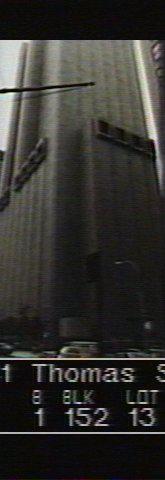
The city photographed every building for its tax records around 1940 and again in the 1980s. NYC Municipal Archives.
Written with AI from the source each entry cites, then fact-checked.
- 1969
Warnecke's plans make the tower a two-week shelter for 1,500 people
Plans by John Carl Warnecke & Associates described a fortified tower meant to protect long-distance telephone equipment and its staff from atomic attack. They called for food, water and recreation space for 1,500 people and 250,000 gallons of fuel for generators, enough to run the tower as a self-contained city for two weeks if outside power failed. The blueprints also show three subterranean levels, including a cable vault where lines likely entered from under the streets.
Source: theintercept.com
- 1969
AT&T begins a windowless Tribeca tower for long-distance calls, drawn up under the name Project X
Construction started in 1969 on a 29-floor tower in lower Manhattan that would house AT&T's long-distance switching equipment. The architects, John Carl Warnecke & Associates, labeled their drawings Project X and also called it the Broadway Building. Their plans described a skyscraper for machines, built with three basement levels to protect equipment and about 1,500 staff, with food, water and fuel for two weeks after an atomic attack.
Source: theintercept.com
- 1974
John Carl Warnecke, who designed Kennedy's gravesite, finishes the telephone tower
John Carl Warnecke was among the most prominent American architects from the 1960s to the 1980s. President Kennedy's administration hired him in 1962 to restructure buildings on Lafayette Square, and after the assassination he was asked to design the eternal flame and gravesite at Arlington. He also built a close working relationship with the telephone industry, designing AT&T buildings in Williamsburg, Brooklyn, and Bedminster, New Jersey, besides this one.
Source: theintercept.com
- 1974
The 550-foot Long Lines Building is finished with no windows and walls of Swedish granite
Completed in 1974, the tower rises about 550 feet with no windows at all. Its walls are precast concrete panels faced with textured Swedish granite, and six large projections from the base hold air ducts, stairs and elevators. Floors are about 18 feet apart and were built to carry heavy equipment loads. The writer William H. Whyte claimed it has the tallest blank wall in the world.
Source: Wikipedia
- 1982
A Times walking tour of Tribeca starts at the Long Lines tower, one of the neighborhood's few good modern buildings
A New York Times tour of Tribeca, published on October 8, 1982, starts at Thomas Street with the AT&T Long Lines Building, completed in 1974 by John Carl Warnecke & Associates. The writer judged it the only one of the phone company's several windowless equipment buildings that succeeds architecturally. He praised its warm granite sheathing and said that, though it resembles a huge machine, it fits its surroundings better than any other skyscraper nearby.
Source: The New York Times
- 1983
A 1983 deed leaves Verizon's predecessor three floors and a basement level in the tower
A deed and declaration filed with the city in 1983 split the building's ownership: it records that the predecessor of Verizon kept three floors and a basement level. The city's Department of Finance later said that predecessor holds an easement on that space and pays utility taxes, while it treats AT&T as owner of the whole building. A technician told The Intercept in 2016 that a handful of Verizon employees still worked inside.
Source: theintercept.com
- 1984
The Bell System breakup turns the Long Lines Department into AT&T Communications
The tower was a core part of AT&T's Long Lines Department, home to solid-state switching equipment that needed tight security and plenty of room. When the Bell System was broken up in 1984, the department became AT&T Communications. Today the building is commonly known by its street address, 33 Thomas Street.
Source: Wikipedia
- 1989
Urbanist William H. Whyte names the Long Lines tower the tallest blank wall
A New York Times column of February 20, 1989 reviewed City: Rediscovering the Center, in which William H. Whyte, author of The Organization Man, gathered the best and worst of New York street life. Among his superlatives, the AT&T Long Lines building took the title of tallest blank wall, while the Bloomingdale's entrance at 59th Street and Lexington Avenue was one of the worst entrances anywhere. Whyte had spent nearly 20 years analyzing the city's streets.
Source: The New York Times
- 1991
A power-switching failure at the building blocks millions of calls and disrupts air traffic control
Consolidated Edison asked AT&T to run the building on its own generators, a switch made successfully before. This time the routine check of the power plants was skipped because of scheduled training, and one plant drained its batteries before anyone caught the alarms. The failure disabled AT&T's switch, blocked more than five million calls and cut FAA private lines, disrupting air traffic control at 398 airports across the northeastern United States.
Source: Wikipedia
- 1994
A 1994 Times article counts the tower in AT&T's network that directs 175 million calls a day
The Intercept later cited a 1994 New York Times article reporting that 33 Thomas Street belonged to AT&T's Worldwide Intelligent Network, which directed an average of 175 million calls daily. Thomas Saunders, an AT&T engineer who retired in 2004, told the outlet that the building held at least three 4ESS switches. One handled domestic long-distance traffic and another served as an international gateway.
Source: theintercept.com
- 2001
AT&T moves services displaced from the World Trade Center into 33 Thomas Street
When the original 1 World Trade Center was destroyed on September 11, 2001, AT&T had to rehouse services that occupied about 11,600 square feet there. 33 Thomas Street was one of several buildings that took them in, along with 811 Tenth Avenue and 75 Broad Street. AT&T had already finished shifting its switching equipment here from its older Long Lines headquarters at 32 Sixth Avenue, a few blocks away, in 1999.
Source: Wikipedia
- 2009
Verizon announces it will retire its Broadway 4ESS tandem switch at 33 Thomas Street
A December 8, 2009 Verizon letter to carriers, citing a public notice of November 9, 2009, said the Broadway 4ESS tandem switch at 33 Thomas Street would be retired and removed once its traffic moved to a 5ESS tandem at 204 Second Avenue. Carriers had to order new trunk groups by June 1, 2010, and all traffic had to be moved by August 31, 2010. The letter listed nine Manhattan end-office sites served by the old tandem, including 375 Pearl Street, 104 Broad Street and 140 West Street.
Source: Internet Archive
- 2011
An NSA visitor guide for TITANPOINTE says to ring the buzzer, sign in and avoid agency clothing
A secret NSA travel guide dated April 2011, among the Snowden documents, advised employees visiting the site code-named TITANPOINTE to ring the buzzer, sign in and wait for an escort, and to coordinate the trip with AT&T and the FBI. Staff carrying equipment were to arrange a cover vehicle via the FBI and to wear nothing bearing NSA insignia. In 2016 The Intercept found a buzzer at the entrance of 33 Thomas Street and a sign-in sheet at a lobby desk guarded around the clock.
Source: theintercept.com
- 2012
NSA papers call TITANPOINTE the program's New York site and describe monitoring a UN connection
NSA documents from 2012 and 2013 list TITANPOINTE as one of three core sites for BLARNEY, a surveillance program begun in the early 1970s, and call it the program's site in New York City. An April 2012 memo describes BLARNEY engineers working to tap a link that served the United Nations mission in New York, with the spying aimed at the email address of the UN general who led the Syria monitoring mission. The Intercept says that case may have involved 33 Thomas Street.
Source: theintercept.com
- 2016
The Intercept ties the tower to an NSA surveillance site code-named TITANPOINTE
The Intercept published an investigation by Ryan Gallagher and Henrik Moltke concluding that NSA staff worked inside the tower, at a site the agency called TITANPOINTE. Their evidence combined documents from Edward Snowden with the building's plans, property records and conversations with ex-AT&T engineers. A companion short film about the tower, Project X, by Moltke and Laura Poitras, began screening at the IFC Center two days later.
Source: theintercept.com
- 2018
A follow-up investigation finds NSA internet-surveillance rooms in eight AT&T buildings in major cities
In 2018 Gallagher and Moltke published a second investigation, The Wiretap Rooms. It named eight AT&T buildings across big U.S. cities where the NSA conducted mass internet surveillance under the FAIRVIEW program. The investigation followed the outlet's 2016 reporting on 33 Thomas Street. Meanwhile the building continues to operate as a telephone exchange, with part of its space given over to highly secure data centers.
Source: Wikipedia
Further reading
- 33 Thomas StreetWikipedia
Nearby
- 85 Worth Street2 entries
- 65 Worth Street5 entries
- 79 Worth Street5 entries
- David S. Brown Store8 Thomas Street | 4 entries
- 325-333 Broadway Building325 Broadway | 12 entries
- 319 Broadway (one of the Thomas Twins)319 Broadway | 7 entries