325-333 Broadway Building
325 Broadway | also 90 Worth Street | Tribeca | built 1864
Open on the map12 entries

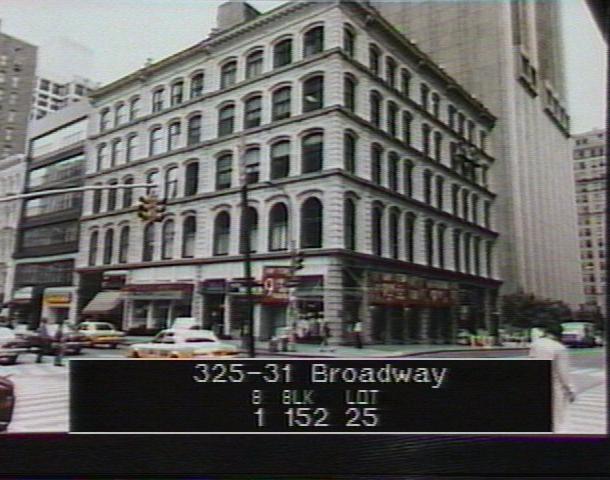
The city photographed every building for its tax records around 1940 and again in the 1980s. NYC Municipal Archives.
Written with AI from the source each entry cites, then fact-checked.
- 1827
A hatter keeps shop on the ground floor of a house at the future 333 Broadway corner
In 1827 the hatter Nathaniel B. Hinton had his shop on the ground floor of a house at 333 Broadway, the Worth Street corner that the marble block later covered. The address sat across from City Hall Park, in a neighborhood where wealthy New Yorkers displaced from the Wall Street area had been settling since the 1820s. Their money soon drew theaters, hotels and shops, Hinton's among them. This house was an earlier building on the site.
- 1847
Henry Barclay builds five-story store-and-loft buildings on Broadway lots that include No. 325
Real estate investor Henry Barclay got back the lots at 321, 323 and 325 Broadway in 1835 and put up three five-story store-and-loft buildings on them in the 1840s. In the early 1850s Stoddart & Co. Pianos kept its showroom on the ground floor of No. 325, with merchants, a milliner and a jeweler on the floors above. In 1847 Barclay also bought the five-story building on the corner lot at 333. No. 325 and No. 333 were earlier buildings on the site of the marble block.
- 1864
Henry Barclay replaces older stores with three marble-fronted lofts for the dry goods trade
In 1863 Barclay decided to put up three large store-and-loft buildings with marble fronts, finished in 1864 and standing at 325-333 Broadway. To do it he tore down two five-story buildings only about fifteen years old, a measure of how profitable new space for dry goods merchants had become. Civil War demand for military uniforms and blankets, plus duties on imported clothing, had pushed American textile production up.
- 1864
The marble facade strips its arcades of ornament and cuts small triangular notches into the spandrels
The three buildings follow the palazzo mode that the A.T. Stewart store had brought to Broadway, but with unusual restraint. The facade reads as flat layered planes, with taut segmental arches stripped of nearly all decoration and small triangular recesses where spandrel panels would normally sit. The Landmarks Preservation Commission took these touches as a sign that the unidentified designer knew avant-garde European ideas.
“…small triangular recesses for conventional recessed panels on the spandrels between the arches…”
- 1864
Dry goods importers and shirt dealers fill the new building, and Wanamaker's wholesale arm follows
When the buildings were finished in 1864, No. 325 held the importers Ogden & Blewett and the tailors' trimmings dealers Draper, Hyde & Sturges. Knisely Myers & Co. and Morrison Son & Hoyt, both selling men's shirts, took No. 327, while wholesale clothiers occupied 329-333. No. 325 later housed the wholesale arm of John Wanamaker's Philadelphia department store, from the late 1870s into the early 1880s.
- 1882
Remington's distributor, a future 327 Broadway tenant, wins Mark Twain's endorsement for the typewriter
In 1882 Wyckoff, Seamans & Benedict took over distribution of the Remington typewriter and began a hard-driving marketing campaign that landed an endorsement from Samuel Clemens, who wrote as Mark Twain. The firm also opened a typing school under the Remington name, at a time when the YWCA's first class of young women had found jobs within days of finishing. It later made this building its headquarters.
“…securing the endorsement of Samuel Clemens (Mark Twain) for the device and opening sales offices in several cities in the United States and abroad…”
- 1892
The Remington typewriter company runs its executive offices and sales headquarters from 327 Broadway
By 1892 Wyckoff, Seamans & Benedict used No. 327 Broadway as its executive offices and main selling headquarters, overseeing more than twenty branch offices in American and European cities. King's Handbook of New York that year described the marble building as plain but substantial, and noted that the company's factory in Ilion, New York, was turning out over a hundred machines a day. The firm renamed itself the Remington Typewriter Company in 1905.
- 1899
A rival typewriter maker, Blickensderfer, takes the whole building at No. 325 next door to Remington
In 1899 the Blickensderfer Manufacturing Company took over all of No. 325 and announced the move in The School Journal. Besides its own typewriters, it sold the Tucker Card Index System and other filing systems. Next door at No. 327, Wyckoff, Seamans & Benedict was selling the Remington, and a 1900 issue of Education magazine ran the two firms' advertisements side by side.
Source: Daytonian in Manhattan
- 1910
Remington leases the neighboring buildings and cuts fireproof openings to join three buildings into one
Around 1910-11 Remington took over the leases on Nos. 325 and 329-333 Broadway and filed plans for fireproof openings linking the three buildings, which gave them the extra exits the building code required. Functionally 325 and 327 became a single building that Remington occupied alone until 1917, when it moved to 374 Broadway. In 1927 the company merged with Rand Kardex to form the Remington Rand Corporation.
“Remington acquired the leases for Nos. 325 and 329- 333 Broadway and filed plans to create fireproof openings between the three buildings…”
- 1946
Iselin-Jefferson buys the buildings and joins them into one, staying until 1958
In 1946 the textile selling firm Iselin-Jefferson purchased 325-327 and 329-333 Broadway and had further openings cut through the party walls, so the three buildings became one structure. Dan River Mills acquired the company in 1956, along with a financial subsidiary with offices at 325 Broadway. Both businesses stayed in the building until 1958.
“…it purchased 325-327 and 329-333 Broadway and had additional openings cut between the buildings, joining them into one structure…”
- 1960
The city Labor Department leases rooms at 325 Broadway where jobless workers practice typing
Throughout the 1960s the city's Department of Labor rented rooms in No. 325, where unemployed workers could practice typing to improve their chances of finding jobs. The Daytonian in Manhattan blog notes the irony: this was the building where the Remington Typewriter Company had once kept its main offices, and where the Blickensderfer firm had sold typewriters.
Source: Daytonian in Manhattan
- 2002
The Landmarks Preservation Commission designates the building over its owner's objection
On August 13, 2002 the commission designated the 325-333 Broadway Building a city landmark, calling it a rare survivor among the Renaissance-style commercial palaces that once lined Broadway south of Franklin Street. Five witnesses, including representatives of Community Board 1, the Historic Districts Council and the Municipal Art Society, spoke for designation at the hearings in late 2001. The building's owner testified against it.
Nearby
- 319 Broadway (one of the Thomas Twins)319 Broadway | 7 entries
- 85 Worth Street2 entries
- 315 Broadway Building315 Broadway | 8 entries
- David S. Brown Store8 Thomas Street | 4 entries
- 311 Broadway Building311 Broadway | 12 entries
- AT&T Long Lines Building33 Thomas Street | 16 entries