Police Athletic League Building (Grammar School 47)
34 1/2 East 12th Street | also 34 East 12th Street | Greenwich Village | built 1955
Open on the map7 entries

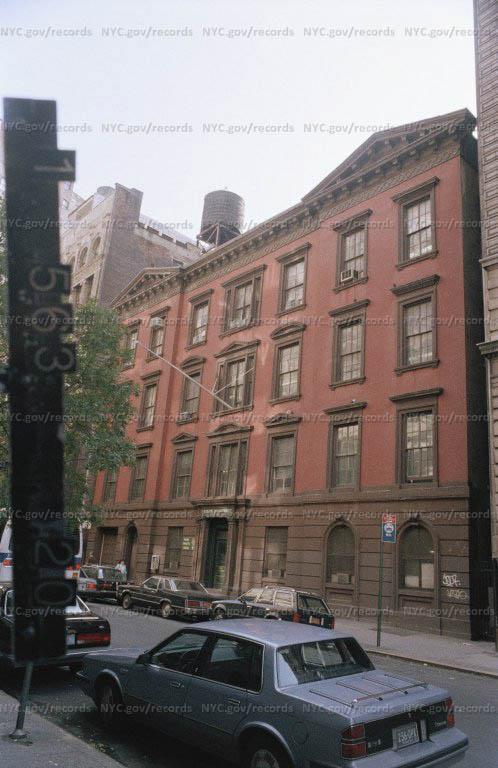
The city photographed every building for its tax records around 1940 and again in the 1980s. NYC Municipal Archives.
Written with AI from the source each entry cites, then fact-checked.
- 1854
The Board of Education buys a vacant East 12th Street lot for a girls-only grammar school
In 1854 the city's Board of Education paid $22,500 to George W. and Ann Maria Tucker for a vacant 9,664-square-foot lot on East 12th Street. The Board wanted another school for the 15th Ward and wanted its new grammar school to be for girls only. Early the next year it approved plans by architect Thomas R. Jackson and set aside $29,500 for construction.
“…purchase a 9,664 square foot vacant lot on East 12th Street from George W. and Ann Maria Tucker for $22,500.”
- 1855
Thomas R. Jackson designs Grammar School 47 in an austere Anglo-Italianate style
Jackson, born in London in 1826 and trained in Richard Upjohn's office, also designed Tammany Hall, Wallack's Theatre and the Academy of Music. For Grammar School 47 he chose a plain Anglo-Italianate look with a rusticated base and a columned entrance. Mason William B. Rhoades and the carpenters Powers & Schoonmaker built it, and it was finished and occupied before the end of 1855.
- 1856
Teacher Lydia Wadleigh founds the 12th Street Advanced School for Girls inside the schoolhouse
Lydia F. Wadleigh, one of Grammar School 47's first teachers and a pioneer of higher education for women, started the 12th Street Advanced School for Girls in 1856 despite bitter opposition. Its curriculum fell short of the standard at the city's Free Academy for boys, and the Board of Education never gave it free-academy status. Wadleigh died in 1888.
“Wadleigh founded the 12th Street Advanced School for Girls in 1856.”
- 1897
The building becomes Girls' High School, the city's first official public girls' high school
In 1897 the Board of Education set up its first official public girls' high school and housed it in the old schoolhouse that held Wadleigh's advanced school. The school was renamed Wadleigh High School in 1900 in honor of Lydia Wadleigh. In 1902 it moved to a new building on West 115th Street in Harlem, which is itself a New York City landmark.
“In 1897, the Board of Education finally established the city's first official public high school for girls and located it in the building…”
- 1902
Girls' Technical High School opens in the building as Wadleigh moves to Harlem
As Wadleigh High School prepared to leave in the summer of 1902, the Board of Education approved a commercial high school for girls, which began that September in the same building as Girls' Technical High School. Its name changed to Washington Irving High School in 1906. It stayed on East 12th Street until it moved to a new home on Irving Place in 1913.
“…authorized the establishment of a commercial high school for girls, which opened that September at that location as Girls' Technical High School.”
- 1958
The Police Athletic League takes over the old schoolhouse
After the last school left, the Board of Education used the building for its building bureau and later its plant operations and maintenance office. In 1958 control passed to the Juvenile Aid Bureau of the Police Department and to the Police Athletic League. The League began in 1914 as the Junior Police Corps, started by Captain John Sweeney, and was incorporated as an independent nonprofit in 1941.
“…remaining in that capacity until it was turned over to the Police Department's Juvenile Aid Bureau and the Police Athletic League in 1958.”
- 1998
The Landmarks Preservation Commission designates the old schoolhouse a landmark
The Commission held its hearing on July 14, 1998, and designated the Police Athletic League Building on September 15. Two witnesses spoke in favor, one for the New York City Police Department and one for the Union Square Community Coalition, and no one opposed. The commission called it one of the oldest surviving school buildings in Manhattan, still home to the League's administrative offices.
“Two witnesses, representing the New York City Police Department and the Union Square Community Coalition, respectively, spoke in favor of the designation.”
Further reading
- A lovely 1855 schoolhouse in Greenwich VillageEphemeral New York
Nearby
- Former Public School 4799 University Place | 2 entries
- Walcutt & Leeds Building53 East 11th Street | 5 entries
- 37 East 12th Street5 entries
- 94 University Place5 entries
- Mittelstaedt House86 University Place | 4 entries
- 88 University Place3 entries