Walcutt & Leeds Building
53 East 11th Street | Greenwich Village | built 1930
Open on the map5 entries

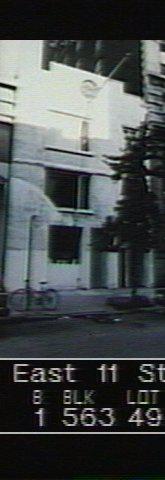
The city photographed every building for its tax records around 1940 and again in the 1980s. NYC Municipal Archives.
Written with AI from the source each entry cites, then fact-checked.
- 1896
Walcutt & Leeds starts making phonograph records at 53 East 11th Street
Cleveland Walcutt and Edward F. Leeds formed their record firm here in February 1896 to make and sell cylinder records and supplies. The company recorded the Irish tenor George J. Gaskin extensively, with Frank P. Banta at the piano. The American Graphophone Company, which sued over patents, won an injunction in January 1898; by then the firm had been duplicating cylinders since November 1896 on devices made by Edison and the National Phonograph Company. When it dissolved in 1899, Leeds joined L. Reade Catlin to form Leeds & Catlin.
“It was formed in February 1896 by Cleveland Walcutt and Edward F. Leeds at 53 E. 11th St. in New York City.”
Source: Wikipedia
- 1897
A boiling-wax explosion in the record factory blows out the windows of the school behind it
On June 15, 1897, Cleveland Walcutt and Dr. J. W. Metcalf were testing chemicals for a better record cylinder in a third-floor room when a nine-foot cauldron of boiling wax exploded. The blast ripped up the room and scalded both men. It also shattered windows at Ward School No. 47 directly behind the factory and threw the janitor across a classroom where girls were decorating for graduation. Once the fire was out, the children were marched back in and lessons resumed.
Source: Daytonian in Manhattan
- 1948
Photographer Robert Frank takes an apartment in the old factory building
Robert Frank rented an apartment here in 1948. He was born in Zurich in 1924, emigrated to the United States a year earlier, and found work as a fashion photographer for Harper's Bazaar. He left in 1949 to travel through South America and Europe. Critic Sean O'Hagan later called his 1958 book The Americans possibly the most influential photography book of its century.
Source: Daytonian in Manhattan
- 1967
Barney Rosset buys the Renata Theater and turns it into the Evergreen Theater
Oscar Zurer bought the building in 1963 and opened the 157-seat Renata Theatre on October 8, 1964. The New York Times reported on August 31, 1967 that Barney Rosset, president of Grove Press, had bought it for $170,000 and leased it to the press for ten years, renaming it the Evergreen after the press's review. It opened on October 16, 1967, with Michael McClure's The Beard, and in January 1968 Rosset announced that it would show both plays and films.
Source: Daytonian in Manhattan
- 1967
Grove Press runs its campaign for I Am Curious (Yellow) from the building
Village Preservation dates Grove Press's move to 53 East 11th Street from 80 University Place to around 1967. From here Rosset pushed to show the Swedish film I Am Curious (Yellow) across the country, and its sexual frankness and political content brought obscenity charges. The film drew New York society to the theater, Jackie Kennedy among them, and the tour, citing a Grove history, says it earned $14 million for Grove and Evergreen but led the company into financial decline.
Source: Village Preservation
Further reading
- The Heavily Remodeled Walcutt & Leeds Building - 53 East 11th StreetDaytonian in Manhattan
Nearby
- Police Athletic League Building (Grammar School 47)34 1/2 East 12th Street | 7 entries
- Former Public School 4799 University Place | 2 entries
- Albert Apartments23 East 10th Street | 3 entries
- Mittelstaedt House86 University Place | 4 entries
- The Lancaster39 East 10th Street | 6 entries
- 94 University Place5 entries