355 Bleecker Street
West Village | built 1830
Open on the map6 entries

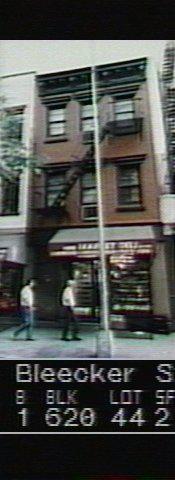
The city photographed every building for its tax records around 1940 and again in the 1980s. NYC Municipal Archives.
Written with AI from the source each entry cites, then fact-checked.
- 1829
A church leases the block front to a hatter on condition he build six brick houses at once
In 1829 the Greenwich Reformed Dutch Church leased the rest of its Bleecker Street block front for twenty-one years to James Haslet, a hatter. His lease required him to put up six good brick or stone buildings of at least two stories right away and barred factories. The six houses were finished in 1829-30 in Flemish bond with peaked roofs, and No. 355 stood at the south end of the row.
- 1830
Tailor Frederick Pattillow makes the new house his home and shop for nearly twenty years
The southernmost house of the Haslet row, then numbered 337, became home to Frederick Pattillow, born in 1788, and his family. He was a tailor and moved his shop into the ground floor. The Pattillows took in boarders, among them a widow in 1836 and a moulder named Francis Squire. They left in 1849, when the house sold for $3,850.
Source: Daytonian in Manhattan
- 1875
Architect Henry Grube raises the attic to a full story for undertaker Peter Asmussen
Peter Asmussen bought the building around 1867 and rented the store to a string of cigar shop owners. In 1875 he hired architect Henry Grube to enlarge it along with No. 361, which he also owned and where he ran his undertaking business. Grube raised the attic to a full story and added matching Italianate cornices, along with pressed metal lintels above the windows.
Source: Daytonian in Manhattan
- 1888
John F. Asmussen moves the family undertaking business into the former cigar shop
Peter Asmussen retired and sold the building in 1888 to John Frederick Asmussen, presumably his brother and longtime partner in undertaking. Born in Schleswig-Holstein in 1838, John served as the sexton at St. John's Evangelical Church, on Christopher Street. He moved the funeral business into the ground floor and lived above with his wife Mary and sons. His son Charles took over when he retired in 1902.
Source: Daytonian in Manhattan
- 1928
Artist Hans Stengel's funeral is held at the Nusskern funeral parlor after his suicide
Hans Stengel, a widely known artist and writer, died by suicide on January 29, 1928. The New York Times announced that his funeral would take place at the establishment of J. K. Nusskern at 355 Bleecker Street. Nusskern had taken over the Asmussen funeral parlor by the time of World War I, and the business continued here into the 1940s.
Source: Daytonian in Manhattan
- 1960
A top-floor tenant appeals rent hikes and the state blocks his eviction
Fernando Funaro, whose family had lived in the six top-floor rooms since at least 1936, appealed to the State Rent Administration in December 1960. He said he paid $50 a month from 1939 to 1951, then $57.50, then $75 from 1958. The landlord answered by filing an eviction order, but the state revoked it. Funaro lived there with his wife, adult daughter and her husband, and an eight-year-old girl.
Source: Daytonian in Manhattan
Further reading
- The 1830 Frederick Pattillow House -- 355 Bleecker StreetDaytonian in Manhattan
- Then & Now photos: 355 Bleecker StreetVillage Preservation: Greenwich Village Then & Now
Nearby
- 357 Bleecker Street1 entry
- 361 Bleecker Street6 entries
- 92 Charles Street1 entry
- 363 Bleecker Street2 entries
- 94 Charles Street1 entry
- Levi Onderdonk House90 Charles Street | 3 entries