361 Bleecker Street
West Village | built 1901
Open on the map6 entries

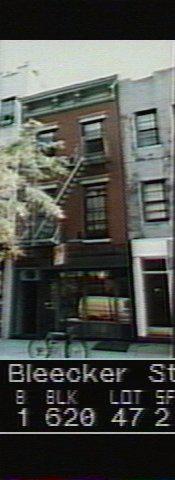
The city photographed every building for its tax records around 1940 and again in the 1980s. NYC Municipal Archives.
Written with AI from the source each entry cites, then fact-checked.
- 1830
Hatter James Haslet builds six brick houses here on land leased from a church
In 1829 the Reformed Dutch Church leased the rest of this Bleecker Street blockfront to James Haslet, a hatter, for 21 years. The lease required him to put up six permanent brick or stone buildings of at least two stories and ruled out a factory. The row went up in 1829-30, laid in Flemish bond with peaked roofs, and No. 361 was one of the six. By 1851 its occupants included a bootseller and a bootmaker.
- 1836
Shoemakers run a shop on the ground floor from 1836 until about 1857
By 1836 Peter P. Ramsey and his family lived upstairs while his shoemaking shop filled the ground floor, with another shoemaker, Stephen Keeler, living in the house. The arrangement of owner and live-in worker continued: Alfred Brush took over the house and store by 1850. Brush also served on the city council in 1855 and 1856. A new shoe-store owner arrived around 1857.
Source: Daytonian in Manhattan
- 1867
Undertaker Peter Asmussen moves his funeral business and family into No. 361
Around 1867 Peter Asmussen bought the house, which had held a confectionery shop since 1864. He moved his undertaking shop into the ground floor and settled his family above. Asmussen was also sexton of St. John's Lutheran Church on Christopher Street. John Asmussen, presumably his brother, joined the business by 1873 and moved in with his wife and eight children.
Source: Daytonian in Manhattan
- 1954
Elektra Records moves into the ground floor and becomes a gathering spot for folk musicians
In 1954 Jac Holzman closed his Record Loft shop and moved Elektra, which he had founded in 1950, to larger offices here. The label was by then concentrating on making records rather than selling them. According to a book on the folk revival, the rooms became a place where folk musicians gathered, and Theodore Bikel recalled the cheap wine and beer and the guitars and banjos at those sessions.
Source: Daytonian in Manhattan
- 1959
Sculptor Alfred Van Loen lives here and teaches carving classes in his studio
By 1959 the German-born sculptor Alfred Van Loen lived and worked at No. 361. Born in 1924, he had studied at the Royal Academy in Amsterdam and taught at Vassar, Hunter College and Columbia. He also ran classes in his studio here; The Villager announced the fall and winter schedule in November 1959, on Mondays and Wednesdays. He worked as a direct carver, cutting straight into the material.
Source: Daytonian in Manhattan
- 1973
The Kelter-Malce antiques shop takes over the whole building until 1992
By 1973 Jolie Kelter and Michael Malce had turned the entire building into an antiques shop selling quilts, folk art and garden furniture, and they lived upstairs at first. The New York Times called them a walking encyclopedia of 19th- and 20th-century decorative arts. They closed the store in the spring of 1992 and carried on from an 1850 Italianate town house on Jane Street.
Source: Daytonian in Manhattan
Further reading
- The 1830 Peter P. Ramsey House - 361 Bleecker StreetDaytonian in Manhattan
- Then & Now photos: 361 Bleecker StreetVillage Preservation: Greenwich Village Then & Now
Nearby
- 363 Bleecker Street2 entries
- 357 Bleecker Street1 entry
- 94 Charles Street1 entry
- 365 Bleecker Street2 entries
- 92 Charles Street1 entry
- 355 Bleecker Street6 entries