13th Regiment Armory
357 Marcus Garvey Boulevard | also 367 Marcus Garvey Boulevard | Bedford-Stuyvesant | built 1930
Open on the map8 entries

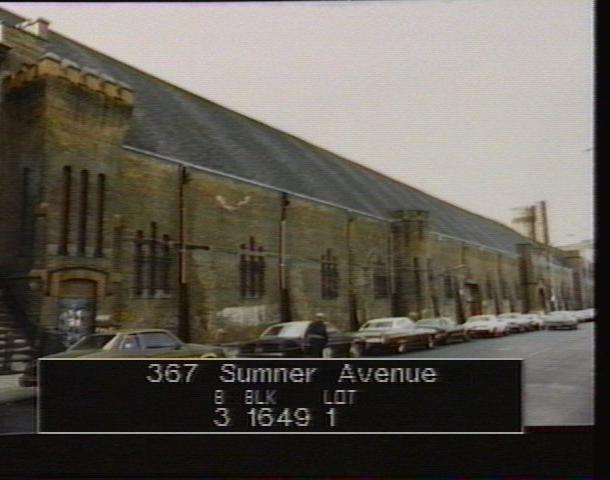
The city photographed every building for its tax records around 1940 and again in the 1980s. NYC Municipal Archives.
Written with AI from the source each entry cites, then fact-checked.
- 1894
The 13th Regiment Armory opens at more than twice its original budget after a cost scandal
The 13th Regiment won a $300,000 award in 1890 for a new armory, but the price climbed to $400,000 and finally to nearly $700,000, paid by Kings County. The Brooklyn Daily Eagle called the overruns a scandal, and the New York Times grouped it with two other Brooklyn armories facing the same problem. The building opened on April 23, 1894, but there was too little money left for sidewalks and fences, and by September the roof was leaking.
“The armory ultimately cost nearly $700,000, more than twice its original outlay, which was paid by the Kings County government.”
Source: Wikipedia
- 1894
Rudolph L. Daus designs the 13th Regiment Armory with two round 200-foot towers and a vaulted drill shed
Rudolph L. Daus, who had designed the Lincoln Club on Putnam Avenue in 1889, was the architect, and Fay Kellogg worked on the plans early in her career. The administration building is fronted by a large arched sally port with a tower on each side, both about 200 feet tall. A barrel-vaulted drill shed 300 by 200 feet stands to the east, and Harper's Weekly said the design recalled feudal France of the thirteenth century.
Source: Wikipedia
- 1903
A wall at the 13th Regiment Armory falls on seven men and kills two
In 1903 a wall at the armory collapsed onto seven men, and two of them died. The building had opened only nine years earlier on a trimmed budget, and its drill hall had already been cut down in size to save money.
“…in 1903, a wall at the 13th Regiment Armory fell on seven men, killing two of them…”
Source: Wikipedia
- 1906
The Parfitt Brothers enlarge the armory's drill hall, which had proved too small for training
Because the drill hall had been downsized to fit the budget, it soon fell short as a training space. It was extended in 1906, with the architectural work done by the Parfitt Brothers.
“…it soon became insufficient for training, and was extended in 1906. The architectural work for this was done by the Parfitt Brothers.”
Source: Wikipedia
- 1921
A memorial naming every World War I soldier stationed at the armory is erected in its yard
A large memorial made by the L. Riene Co. was put up in 1921 in the armory's southwest yard. It bears the name of every soldier stationed at the armory during the First World War, with the casualties listed first, at the top.
“In 1921, a large memorial made by L. Riene Co. was erected in the southwest yard with the names of all the soldiers who had been stationed in the armory…”
Source: Wikipedia
- 1953
The armory hosts the 48th annual session of the Baptist Congress
Besides drilling soldiers, the armory served civilian groups over the years, including school track meets, Sunday school competitions and singing contests. From June 22 to 28, 1953, the Sunday School Congress and Baptist Training Union used it for the 48th annual session of the Baptist Congress.
“On June 22–28, 1953, the building was used for the 48th annual session of the Baptist Congress by the Sunday School Congress and Baptist Training Union.”
Source: Wikipedia
- 1974
The 13th Regiment is deactivated after a plan to close its armory is called racist by a black veterans' group
The Thirteenth Regiment was deactivated in 1974. The closure plan had been announced in 1971 as a budget cut, and a black veterans' group called it racist, since the armory stood in a mostly black and Hispanic neighborhood. In 1972 a methadone treatment center proposed for the site drew opposition from residents, who wanted attention to health, housing, recreation and schools instead.
Source: Wikipedia
- 1987
The armory is converted into a men's homeless shelter, now called Pamoja House
By the 1980s the city's shelters were overcrowded, so it started opening new ones inside armories. From 1987 or 1988 the 13th Regiment Armory housed a men's shelter, now called Pamoja House, the Swahili word for "together." The company rooms serve as dormitories, and Memorial Hall is the mess. In 1992 a judge ordered the capacity cut from 550 men to 200.
Source: Wikipedia
Further reading
- 13th Regiment ArmoryWikipedia
Nearby
- Macon Library361 Lewis Avenue | 7 entries
- Our Lady of Victory Church599 Throop Avenue | 4 entries
- Bed-Stuy Aquarium408 Tompkins Avenue | 3 entries
- Billie Holiday Theatre1380 Fulton Street | 2 entries
- Herbert Von King Cultural Arts Center670 Lafayette Avenue | 6 entries
- 679 Lafayette Avenue House679 Lafayette Avenue | 6 entries