679 Lafayette Avenue House
679 Lafayette Avenue | also 677 Lafayette Avenue | Bedford-Stuyvesant | built 1931
Open on the map6 entries

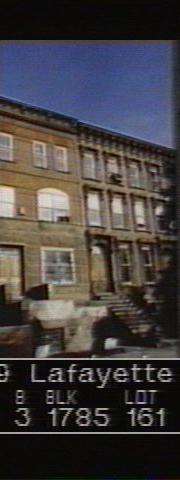
The city photographed every building for its tax records around 1940 and again in the 1980s. NYC Municipal Archives.
Written with AI from the source each entry cites, then fact-checked.
- 1883
William Lemken, a hotel and liquor man, is recorded living at 679 Lafayette Avenue
The Brooklyn directory placed Lemken at 679 by May 1, 1883, though the 1880 atlas showed the lot still vacant. In various years he was listed in the hotel and liquor business at 202 South Street in New York City. His family owned the house until 1900.
- 1883
The house is a three-story neo-Grec brownstone with a shell-motif doorway and a bracketed cornice
The report calls 679 a very fine example of neo-Grec design, built between 1880 and 1883 beside its twin at 678. It stands three stories above a high basement, with an arched doorway flanked by grooved pilasters and shell-motif brackets. A wooden roof cornice on brackets crowns the facade, and the stoop once had cast-iron handrails with ornate newel posts.
- 1885
William Lemken has a magnolia seedling sent from North Carolina and plants it in his front yard
According to the 1970 landmark report, Lemken had the seedling sent up from North Carolina about 85 years before, around 1885, and planted it in the front yard of his house. The report says Magnolia grandiflora rarely flourishes much north of Philadelphia. The tree survived far longer than expected and became a neighborhood symbol and a focus of community pride.
“…the seedling which Mr. William Lemken had sent up from North Carolina some 85 years ago, to plant in the front yard of his house…”
- 1970
Hattie Carthan and schoolchildren raise $7,000 selling paper magnolia leaves to build a wall for the tree
By the time of the 1970 report, Carthan, known as the tree lady, had taken the magnolia under her care about seventeen years earlier. When a protective wall was needed and would cost $20,000, she aimed first for $5,000. Children from two neighborhood schools sold paper magnolia leaves in a raffle with three prizes, and the sales brought in $7,000. The Horticultural Society in New York offered to match the sum.
- 1970
The Commission designates the magnolia at 679 Lafayette Avenue a landmark amid a fight over a housing project
After hearings on February 3 and March 3, 1970, the Commission designated the tree on May 12. The dispute was over a wall meant to protect it, as houses at 677 to 680 were to be demolished for a 120-unit housing project. Opponents feared the work would harm the tree and wanted some houses kept as a cultural center. The Commission chose a protective plan with rules for the demolition work.
“…these houses must be demolished in order to permit the erection of a 120-unit housing project…”
- 1977
The Landmarks Preservation Commission designates 679 Lafayette Avenue, the house in front of which the magnolia grows
On July 12, 1977, the Commission designated the house as a landmark, seven years after it landmarked the tree. The report places the tree directly in front of No. 679, the easternmost of three houses that had sheltered it for many years. That protection, it says, let the magnolia reach its great size.
“…directly in front of this house, the easternmost of the three houses which have protected the tree for many years…”
Nearby
- 678 Lafayette Avenue House678 Lafayette Avenue | 4 entries
- 677 Lafayette Avenue House677 Lafayette Avenue | 3 entries
- Herbert Von King Cultural Arts Center670 Lafayette Avenue | 6 entries
- St. George's Protestant Episcopal Church800 Marcy Avenue | 5 entries
- Boys' High School832 Marcy Avenue | 6 entries
- 13th Regiment Armory357 Marcus Garvey Boulevard | 8 entries