Potter Building
36 Park Row | also 38 Park Row, 145 Nassau Street, 6 Beekman Street | Financial District | built 1886
Open on the map12 entries

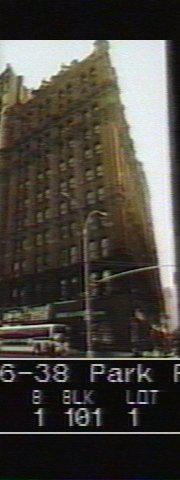
The city photographed every building for its tax records around 1940 and again in the 1980s. NYC Municipal Archives.
Written with AI from the source each entry cites, then fact-checked.
- 1767
The Brick Presbyterian Church stands on the future Potter Building lot
The lot at Park Row and Beekman Street that later held the Potter Building was the site of the Brick Presbyterian Church, a building by John McComb Sr. that the Landmarks Preservation Commission dates to 1767. When the congregation built a new church uptown, the site was split into two lots, and the building put up on the northern one housed the New York Times, and the southern lot was bought by Orlando B. Potter. This entry concerns an earlier building on the lot.
“The Potter Building's lot, at Park Row and Beekman Street, had been the location of the Brick Presbyterian Church (1767, John McComb, Sr.)…”
- 1857
Orlando B. Potter buys the southern lot of the old church site and puts up the building that became the World's home
In 1857 Orlando B. Potter and two Boston friends, John and Uriah Ritchie, bought the southern of the two lots for about $350,000. On it they erected a five-story Italianate stone building, first known as the Park Building, which became the home of the New York World, a newspaper founded in 1860. Potter became its sole owner in 1867. This was the earlier building on the lot that burned in 1882.
- 1882
A fire destroys the New York World's headquarters on the site
At about 10 p.m. on January 31, 1882, a fire broke out in the World building, home of the New York World newspaper, supposedly fanned by a draft from the nearby Temple Court Building. Within hours it destroyed much of the block, killed six people, and caused more than $400,000 in damage. Observers said the building had become notorious nationwide for how quickly it burned.
Source: Wikipedia
- 1883
Foundation work starts on Potter's fireproof office building, with a test furnace planned on the site
After the 1882 fire Potter announced an eleven-story building that was to be absolutely fireproof, but costs held up construction until the following year. In April 1883 the Real Estate Record and Guide reported that foundation work had begun. The magazine added that a furnace would be set up at the site to try out the building materials Potter was weighing, and that architect Norris G. Starkweather's plans had been adopted.
“A furnace will be put up on the premises to test the various building materials that Mr. Potter has under consideration.”
- 1885
Architect Norris G. Starkweather dies before the Potter Building is finished
Starkweather, born in Vermont in 1818, had practiced as an architect in Philadelphia, Baltimore and Washington, designing churches, villas and institutions, before arriving in New York by mid-1880. In 1881 his firm Starkweather & Gibbs had its office in Potter's World Building at 37 Park Row, the building that burned the next year. Besides the Potter Building, only two other New York commissions by him are known, both with Charles Gibbs. He died in December 1885 and was buried in Bridgeport, Connecticut, before the building was done.
- 1885
Critics split over the new Potter Building, one calling it coarse and another praising its height and mix of materials
While the building was going up, the Record and Guide's critic wrote in 1885 that it was coarse, pretentious and overloaded, and that its emphasis on vertical lines made it look spindling. Carpentry and Building took the opposite view that year, calling it among the most conspicuous new buildings in lower New York because of its height and its mix of iron, brick and terra cotta. The landmark report notes that opinion was mixed on most prominent tall buildings of the period.
“…which is coarse, pretentious, overloaded and intensely vulgar…”
- 1886
Orlando B. Potter completes the fireproof Potter Building
Real estate developer Orlando B. Potter replaced the burned building with an 11-story iron-framed structure designed by Norris G. Starkweather, using the most advanced fireproofing of the day, including rolled iron beams, cast iron columns, tile arches, and terracotta. A bricklayers' strike in 1884 and a painters' and carpenters' strike in 1885 slowed the work. It was finished in June 1886, with costs reaching $1.2 million.
Source: Wikipedia
- 1892
Newspapers, insurers, and Otis Elevator fill the building's 200 offices
An 1892 guidebook said newspapers, magazines, insurance companies, and lawyers occupied 200 offices in the Potter Building. Newspaper tenants included The Press and the New York Observer, and other tenants included the Mutual Reserve Fund Life Association and the Otis Elevator Company. Potter himself used the top floor, where his New York Architectural Terra Cotta Company also kept offices.
Source: Wikipedia
- 1894
Orlando B. Potter dies suddenly, thought to be the richest New Yorker to die without a will
Orlando Bronson Potter, the Massachusetts lawyer who commissioned the building, died suddenly in January 1894. He had been president of the Grover & Baker Sewing Machine Company until 1876, served in Congress in 1883-85 and sat on the Rapid Transit Commission from 1890 to 1894. His Manhattan real estate holdings were estimated at six million dollars when he died. Potter was thought to be the wealthiest man in the city to die intestate.
- 1973
Pace College buys the Potter Building for a planned Park Row office tower
In 1973 the 38 Park Row Corporation, which had owned the building since 1954, sold the Potter Building to Pace College. The college wanted to demolish four neighboring buildings to make room for a large office tower on Park Row. That scheme fell through, and in 1979 Pace sold the Potter Building to a joint venture involving the East River Savings Bank.
“…sold to Pace College, which intended to demolish four adjacent buildings for the construction of a large office tower on Park Row…”
- 1979
The office building is converted into apartments
The Potter Building began as an office building with many tenants from the media and legal professions. It was converted into apartments between 1979 and 1981. Its original Queen Anne and neo-Grec design, with a C-shaped plan around a light court facing Beekman Street, remains largely intact.
Source: Wikipedia
- 1996
The city designates the Potter Building a landmark
New York City designated the Potter Building a city landmark on September 17, 1996. The building is also a contributing property to the Fulton-Nassau Historic District, a National Register of Historic Places district created in 2005.
Source: Wikipedia
Further reading
- Potter BuildingWikipedia
Nearby
- New York Times Building (41 Park Row)39 Park Row | 11 entries
- Morse Building140 Nassau Street | 4 entries
- American Tract Society Building150 Nassau Street | 6 entries
- Temple Court5 Beekman Street | 13 entries
- Temple Court8 Theater Alley | 1 entry
- 8 Spruce Street6 entries