New York Times Building (41 Park Row)
39 Park Row | also 147 Nassau Street, 42 Park Row, 40 Park Row | Financial District | built 1900
Open on the map11 entries

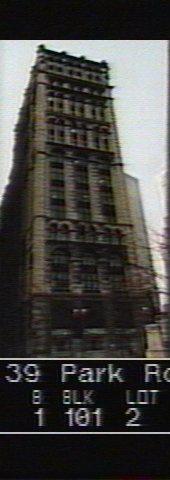
The city photographed every building for its tax records around 1940 and again in the 1980s. NYC Municipal Archives.
Written with AI from the source each entry cites, then fact-checked.
- 1856
Times partners buy the old Brick Presbyterian Church site at auction
By 1856 the Times had outgrown its rented quarters at Nassau and Beekman Streets. That year Edward B. Wesley joined two investors, Frederick P. James and Henry Keep, and bought the old Brick Church site at auction. In 1857 Henry Raymond and George Jones purchased James's and Keep's two-thirds interest in the northern part of the block, with Wesley keeping one-third, and then put up a new Times Building there.
“Wesley, and two investors, Frederick P. James and Henry Keep, took the opportunity to acquire the old Brick Church site when it went up at auction that year.”
- 1858
The New York Times moves into a purpose-built home at 41 Park Row
The Times, founded in 1851, moved in 1858 into a five-story Romanesque Revival building at 41 Park Row, designed by Thomas R. Jackson. Cofounders Henry Jarvis Raymond and George Jones had bought out other investors' shares in the project. It was the first New York City newspaper to work from a building put up expressly for its own use.
Source: Wikipedia
- 1871
The Times obtains the comptroller's books that expose the Tweed Ring
After Henry Raymond's death in 1869, George Jones kept up the paper's campaign against municipal corruption under Boss William Tweed. In August 1871 the Times got copies of the city comptroller's books, which showed how enormous the plunder had been. The paper was then housed in its five-story building of 1857 at 41 Park Row, whose floor framing was later reused in the present one.
“In August 1871, the Times managed to secure copies of the New York City Comptroller's books which made abundantly clear "the enormity of the plunder…”
- 1888
The Times uses the word skyscraper for the first time, describing its own building's expansion
In an article of June 13, 1888, the Times itself used the word skyscraper for the first time, writing about the enlargement of its headquarters at 41 Park Row. When the new building was nearly done in January 1889, the Real Estate Record and Guide called it the finest commercial building in New York.
“The first use of the word "skyscraper" by the Times itself was in an article published on June 13, 1888…”
Source: Wikipedia
- 1889
George B. Post builds a taller Times headquarters around the old one
A larger Romanesque Revival building designed by George B. Post rose around the Times' 1858 home while the paper kept operating in its old quarters. Builders shored up the existing floors with wood, cut holes for the new iron columns, and took down the old walls in stages. The 13-story replacement was finished in 1889.
Source: Wikipedia
- 1902
A basement fire kills two men beside the subway excavation
Two men died in a basement fire at 41 Park Row in November 1902, while the building was still the Times headquarters. The blaze began at a wooden partition that had been put up for construction of the city's first subway line, which ran next to the building's basement under Park Row. Plans for alterations to the building were filed the following year but not carried out.
“In November 1902, two men were killed in a fire in 41 Park Row's basement.”
Source: Wikipedia
- 1903
The Times leaves Park Row for its new Times Square tower
The Times published from 41 Park Row until 1903, when it moved to One Times Square on Longacre Square, soon renamed Times Square. Robert Maynicke designed a four-story expansion of the Park Row building in 1904-1905, bringing it to 16 stories. It is the last remaining former newspaper headquarters on Printing House Square.
Source: Wikipedia
- 1904
Robert Maynicke removes the mansard roof and adds four stories
Between 1903 and 1905 architect Robert Maynicke enlarged George B. Post's building. The mansard roof came down and four new stories went up, producing a sixteen-story office building. The former ground-floor offices, where the Times had published, were converted to retail use.
“…the mansard was taken down, and four new stories were added to the designs of Robert Maynicke.”
- 1951
Pace University buys the former Times headquarters
Pace University bought 41 Park Row in 1951, and the building has housed its classrooms and offices ever since. It became a New York City landmark in 1999 and a contributing property to the Fulton-Nassau Historic District in 2005.
Source: Wikipedia
- 1999
The Landmarks Commission designates the former Times Building on its third review
The Landmarks Preservation Commission designated the former New York Times Building a city landmark on March 16, 1999. It had come before the commission in 1966 as a possible individual landmark, and again in 1980 within a proposed Civic Center Historic District. Three preservation groups spoke in favor at the December 1998 hearing, and at the reopened hearing in February 1999 Pace University, the owner, said it did not oppose designation.
- 2019
Pace finishes a restoration that adds back a Spruce Street entrance
Pace University announced in February 2017 that it would renovate 41 Park Row, and architect FXFowle's work was completed in January 2019. It restored the lower floors and added an entrance on Spruce Street to replace one removed during the 1950s renovations; the Spruce Street door is now the main entrance. Before 2019 the main entrance had been on Park Row, and between 2017 and 2019 the first floor was converted to an art gallery and student commons.
Source: Wikipedia
Further reading
Nearby
- Potter Building36 Park Row | 12 entries
- American Tract Society Building150 Nassau Street | 6 entries
- Morse Building140 Nassau Street | 4 entries
- Temple Court5 Beekman Street | 13 entries
- 8 Spruce Street6 entries
- Temple Court8 Theater Alley | 1 entry