Jonas and Henrietta Phillips House
36 West 12th Street | Greenwich Village | built 1860
Open on the map4 entries

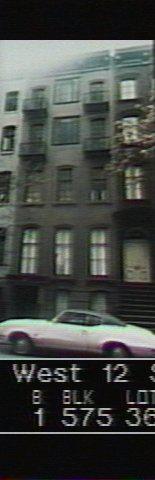
The city photographed every building for its tax records around 1940 and again in the 1980s. NYC Municipal Archives.
Written with AI from the source each entry cites, then fact-checked.
- 1863
Jonas Phillips, a former acting mayor, buys the house for his family
Jonas N. Phillips, a former ship chandler turned city surveyor who was president of the Common Council in 1856 and acting mayor of New York in 1857, bought 36 West 12th Street with his second wife, Henrietta, in 1863. The family held a high place in the city's Sephardic Jewish community. In January 1864, his daughter Rachel Rosalie wrote in her diary of being introduced to President and Mrs. Lincoln at the White House.
Source: Daytonian in Manhattan
- 1924
Future Pulitzer winner Margaret Leech rents an apartment here
Margaret Leech, a Vassar graduate working for Conde Nast, took an apartment at 36 West 12th Street in 1924. Her novel The Feathered Nest, which was published in 1928, was written while she lived here. That year she married Ralph Pulitzer, publisher Joseph Pulitzer's eldest son, and moved to a mansion. She later won the Pulitzer Prize for History in 1942 and again in 1960.
Source: Daytonian in Manhattan
- 1943
Cook James Beard moves into a rear apartment with a closet for a kitchen
James Beard, then a fledgling cook, moved into a rear second-floor apartment at 36 West 12th Street in 1943, where the kitchen was a converted closet with no sink. Fearing that being known as gay could ruin him professionally, he later rented the empty first-floor apartment for his companion Gino Cofacci. Cofacci took the bedroom there, while Beard used the rest as an office and kept his official bedroom upstairs. Beard moved away around 1957.
Source: Daytonian in Manhattan
- 1992
A restoration returns No. 36 to its 1860 appearance
In 1918, owner Arthur Townsend had the stoop removed and big studio windows put in for artist tenants, a common conversion for Greenwich Village rowhouses then. A restoration begun in 1985 and finished in 1992 undid those changes, refabricating the stoop and its ironwork and replacing the top-floor studio windows with careful reproductions of the 1860 originals.
Source: Daytonian in Manhattan
Further reading
- The 1860 Jonas and Henrietta Phillips House - 36 West 12th StreetDaytonian in Manhattan
- Then & Now photos: 36 West 12th StreetVillage Preservation: Greenwich Village Then & Now
Nearby
- Henry Morehouse Taber House42 West 12th Street | 4 entries
- NYU Casa Italiana Zerilli-Marimo24 West 12th Street | 3 entries
- The Little Half House35 West 12th Street | 2 entries
- 50 West 12th Street4 entries
- Dr. Oliver White House52 West 12th Street | 4 entries
- The Ardea31 West 12th Street | 3 entries