Henry Morehouse Taber House
42 West 12th Street | Greenwich Village | built 1860
Open on the map4 entries

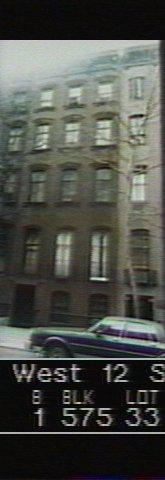
The city photographed every building for its tax records around 1940 and again in the 1980s. NYC Municipal Archives.
Written with AI from the source each entry cites, then fact-checked.
- 1860
Frederick P. James replaces six rowhouses with brownstones, and Henry Taber buys No. 42
In 1860 banker Frederick P. James demolishes six rowhouses built by Alphonse Loubat in 1844 and replaces them with four-story brownstone-faced homes, including this one. He sells No. 42 to cotton broker Henry Morehouse Taber, a descendant of three Mayflower passengers, who moves in with his wife Mary Elizabeth and their young son.
Source: Daytonian in Manhattan
- 1892
Henry Taber's grand jury accusations help spark the Lexow inquiry
As foreman of a grand jury in April 1892, Henry Morehouse Taber says at least $7,000,000 a year is collected from gambling dens, saloons, and brothels and distributed among members of the police department. His accusations and the grand jury's findings lead to the state's Lexow Committee investigation, which puts high-level police officials on trial in 1894.
Source: Daytonian in Manhattan
- 1912
A concert in the house raises $100 for Titanic survivors
By 1902 the house, which Henry Taber's daughter Mary inherited after his death in 1897, is run as a high-end boarding house. A month after the Titanic sinks, a concert at the home of resident Florence de B. Allen raises $100 for survivors, with nine musicians volunteering their services.
Source: Daytonian in Manhattan
- 2009
The house sells for $15.1 million and is restored as a single-family home
The house sells for $15.1 million in 2009 to a buyer hidden behind an LLC, which press reports link to Tom Cruise, though the listing agent denies any connection in 2013. A renovation recreates the stoop and entrance removed when the house was converted to bachelor apartments in 1919.
Source: Daytonian in Manhattan
Further reading
- The 1860 Henry Morehouse Taber House - 42 West 12th StreetDaytonian in Manhattan
- Then & Now photos: 42 West 12th StreetVillage Preservation: Greenwich Village Then & Now
Nearby
- Jonas and Henrietta Phillips House36 West 12th Street | 4 entries
- 50 West 12th Street4 entries
- Dr. Oliver White House52 West 12th Street | 4 entries
- John Williams Morgan House39 West 11th Street | 5 entries
- NYU Casa Italiana Zerilli-Marimo24 West 12th Street | 3 entries
- The Little Half House35 West 12th Street | 2 entries