The Waverly
375 Avenue of the Americas | also 136 Waverly Place, 375A Avenue of the Americas | West Village | built 1928
Open on the map5 entries

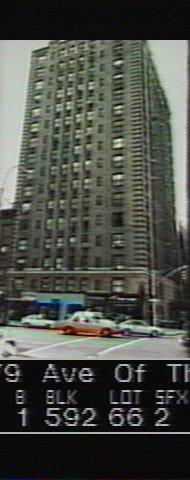
The city photographed every building for its tax records around 1940 and again in the 1980s. NYC Municipal Archives.
Written with AI from the source each entry cites, then fact-checked.
- 1854
The Greenwich Savings Bank builds a three-story brownstone bank on this corner
In 1854 the Greenwich Savings Bank built an Anglo-Italianate bank where Sixth Avenue meets Waverly Place, on the southwest corner, which The New York Times later called a dignified three-story brownstone (the landmarks report dates it to the early 1850s). The bank moved out in 1892 and the New York Bank Note Company took over. It was an earlier building on this site, torn down in 1928 to make way for the apartment house that stands here now.
Source: Daytonian in Manhattan
- 1928
Walter S. Schneider designs a sixteen-story apartment house for the old bank site
Wreckers began tearing down the old bank in February 1928, and the Citadel Construction Company hired architect Walter S. Schneider to design The Waverly, a sixteen-story apartment house. He used brick with cast-stone, medieval-style ornament at the entrance, contrasting brick bands that imitate quoins, and Aztec-inspired terra-cotta motifs on the top two floors. Advertisements offered three- and four-room apartments with dining alcoves and electric refrigerators from $900 a year.
Source: Daytonian in Manhattan
- 1929
Film actress Phyllis Haver marries a Waverly resident, with Mayor Walker officiating
William Seeman, a Cornell graduate and an executive of the wholesale grocery firm Seeman Brothers, was among the building's first residents. On April 24, 1929, he married film actress Phyllis Haver at the home of cartoonist Rube Goldberg, with Mayor James Walker presiding. Paul Whiteman's band marched to the house amid fireworks, and about 60 guests attended. The couple planned to make their home at 136 Waverly Place after a trip to Europe.
Source: Daytonian in Manhattan
- 1943
A resident and three other men are arrested over defective cartridges shipped to the Soviet Union
Gerard Mosiello, whom The New York Times described as a convicted burglar, lived in the building. He and three other men set up a company to sell ammunition to the Soviets, and on June 28, 1943, all four were arrested on fraud charges. The case concerned a shipment of 3,072,000 .45-caliber cartridges, 38 percent of which were found dangerously defective. One of his neighbors was Joseph Sarafite, a prosecutor who became head of the district attorney's Rackets Bureau in 1944.
Source: Daytonian in Manhattan
- 1969
Fraser's Restaurant opens here and turns up in gay travel guides
Fraser's Restaurant appeared here around 1969. Bob Damron's Address Book, a directory of gay and gay-friendly businesses, listed it, and the 1969 New York City Gay Scene Guide recommended it as a place for dinner before a night of visiting the bars. The restaurant remained here at least through 1971.
Source: Daytonian in Manhattan
Further reading
- William S. Schneider's 1928 136 Waverly PlaceDaytonian in Manhattan
Nearby
- 373 Avenue of the Americas1 entry
- Rectory of St. Joseph's Church371 Avenue of the Americas | 2 entries
- Gerken Saloon Building385 Avenue of the Americas | 5 entries
- St. Joseph's Church365 Avenue of the Americas | 10 entries
- 387 Avenue of the Americas1 entry
- 389 Avenue of the Americas2 entries