Racquet and Tennis Club
370 Park Avenue | also 374 Park Avenue, 360 Park Avenue | Midtown | built 1918
Open on the map11 entries

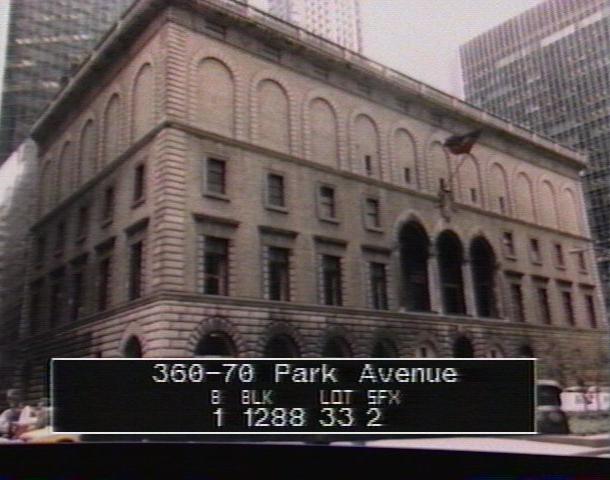
The city photographed every building for its tax records around 1940 and again in the 1980s. NYC Municipal Archives.
Written with AI from the source each entry cites, then fact-checked.
- 1915
Robert W. Goelet buys the last Park Avenue parcels from a New York Central affiliate
Robert W. Goelet, a Harvard graduate of 1902 and a member of the club, inherited most of the land between 52nd and 53rd Streets from his father. In 1915 he bought the rest from the New York State Realty and Terminal Company, a New York Central affiliate. In 1916 he offered the site to the club.
- 1916
Members vote to accept Robert Goelet's proposal for a new Park Avenue clubhouse
Club members voted on June 27, 1916 to take up a proposal from fellow member Robert W. Goelet for a new home on Park Avenue. Goelet had inherited most of the lots from his father and bought the rest in 1915 from a New York Central affiliate. The members also formed a syndicate to hold the club's West 43rd Street property until it could be sold at a good price.
- 1918
Racquets appear in the capitals and frieze of the clubhouse
William Symmes Richardson's palazzo-style design hides jokes about the club's sport: the Corinthian capitals of the second-floor loggia contain racquets in their foliage, and a terra-cotta frieze repeats the motif. Large blind arches on the fourth story mark where the courts sit, and arches beside the entrance open onto shops, an innovative feature at the time. Marc Eidlitz and Son built it.
- 1918
The club moves into its new Park Avenue home, with a Maxfield Parrish mural on loan
The club officially moved into the McKim, Mead & White building on April 15, 1918, and observers counted it among the best clubhouses in the city. With its larger quarters the club built up a library devoted entirely to sporting books and a collection of sporting art. For a number of years the clubhouse also displayed Maxfield Parrish's mural Old King Cole, lent by member Vincent Astor; it now hangs in the St. Regis Hotel.
- 1922
A member's bachelor party leads to a Prohibition arrest, and the club's antique bar is removed
In the early years of Prohibition, a polo-playing member named Rene LaMontagne threw a bachelor party at the club. Authorities charged him with selling 316 cases of scotch, 500 of gin and thousands of gallons of rye and wine, and he spent four months in jail. The 60-foot antique bar that had stood in the earlier 43rd Street clubhouse was removed.
Source: Daytonian in Manhattan
- 1930
World champion Pierre Etchebaster arrives to be the club's professional
The French court-tennis champion emigrated to New York in 1930 to become the club's professional, two years after winning the world title in London. He held the championship for a record 26 years, until retiring at 60 in 1954. He split his time between the Park Avenue courts, a summer post at Piping Rock Club and spring lessons in Aiken, South Carolina.
Source: Wikipedia
- 1953
The New Yorker profiles Pierre Etchebaster, the club's world-champion court-tennis professional
In 1953 The New Yorker visited Pierre Etchebaster, a Basque from Saint-Jean-de-Luz who had been head court-tennis professional at the club since 1928. He had just kept the world title by beating Alastair B. Martin, twenty-two years younger, seven sets to two. Etchebaster said about 250 members played court tennis regularly, and the magazine noted that only eight courts were available in the country.
Source: The New Yorker
- 1958
Lever House and the Seagram Building lead modernist critics to praise the clubhouse
After World War II, Park Avenue's apartment houses gave way to office towers. When Lever House (1950-52) and the Seagram Building (1954-58) rose beside the club, critics of the modern movement took a second look at its Italian Renaissance design and praised its subtlety as a complement to the glass buildings. Reyner Banham called the club, Seagram and Lever a conversation about style, with the club stating the traditional case.
- 1978
The club sells its air rights to the developer of the Park Avenue Plaza tower
In 1978 the club sold the air rights above its Park Avenue building to the developer of Park Avenue Plaza, a glass-sheathed tower that stands directly behind the clubhouse. The city made the clubhouse a landmark in 1979, and the National Register of Historic Places added it on July 21, 1983.
“The club sold its air rights on Park Avenue to the developer of the Park Avenue Plaza skyscraper in 1978.”
Source: Wikipedia
- 1979
The Landmarks Commission designates the clubhouse as the club voices reservations
After three public hearings in July, September and November 1978, at which five witnesses spoke in favor and none against, the commission designated the building on May 8, 1979. The club told the commission it had reservations about designation. The landmark site is Block 1288, Lot 33.
- 1987
The club refuses to let a woman court-tennis player practice there
In 1987 court tennis player Evelyn David, preparing for the women's world championships in England, asked to use the club's Park Avenue courts. She lived a few blocks away but rode a bus every weekend to Tuxedo, New York, for the nearest courts. The club turned her down even though she proposed to play in the early morning, ahead of the members, and a member told The New York Times she would have to keep commuting.
Source: Daytonian in Manhattan
Further reading
- Racquet and Tennis ClubWikipedia
Nearby
- Park Avenue Plaza55 East 52nd Street | 9 entries
- CBS Studio Building49 East 52nd Street | 9 entries
- Lever House390 Park Avenue | 12 entries
- DuMont Building515 Madison Avenue | 4 entries
- Hotel Elysée60 East 54th Street | 9 entries
- Seagram Building375 Park Avenue | 21 entries