New York Life Building
378 Park Avenue South | also 372 Park Avenue South, 45 Madison Avenue, 370 Park Avenue South | NoMad | built 1928
Open on the map17 entries

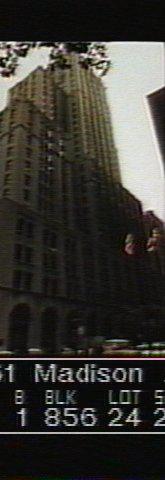
The city photographed every building for its tax records around 1940 and again in the 1980s. NYC Municipal Archives.
Written with AI from the source each entry cites, then fact-checked.
- 1874
P. T. Barnum opens his Roman Hippodrome on the vacant depot site
The ground where the New York Life tower now stands had held a small New York and Harlem Railroad depot until the railroad moved its operations uptown in 1871. P. T. Barnum leased the vacant site in 1874 and turned it into an open oval arena 270 feet long, with banked seating, called the Great Roman Hippodrome. This was an earlier structure on the lot, long before the insurance company arrived.
Source: Wikipedia
- 1877
Gilmore's Garden stages the first Westminster Kennel Club dog show
In 1876 bandleader Patrick Gilmore leased the old Barnum arena and renamed it Gilmore's Garden. It hosted flower shows, beauty contests, concerts, temperance and revival meetings and walking marathons, and in 1877 it staged the first Westminster Kennel Club dog show, then billed as the First Annual N.Y. Bench Show. Because competitive boxing was technically illegal, boxing there was promoted as exhibitions or illustrated lectures. This arena stood on the lot before the present building.
“…presented flower shows, beauty contests, music concerts, temperance and revival meetings, walking marathons, and the first Westminster Kennel Club Dog Show…”
Source: Wikipedia
- 1890
Stanford White's Madison Square Garden, with a Giralda-style tower, opens on the site
An earlier building on this site, the second Madison Square Garden, was designed by Stanford White for a syndicate that included J. P. Morgan, Andrew Carnegie and P. T. Barnum. A tower modeled on the Giralda of Seville rose 32 stories and carried a statue of Diana by Augustus Saint-Gaudens. The main hall measured 200 by 350 feet with seats for 8,000, and the building also held a theater, a concert hall and a roof garden.
Source: Wikipedia
- 1906
Architect Stanford White is shot dead in the Garden's rooftop restaurant by Harry K. Thaw
In 1906 White, who had designed the Garden and kept an apartment there, was murdered in its rooftop restaurant by the millionaire Harry Kendall Thaw. Thaw's motive was White's affair with his wife, the actress Evelyn Nesbit. The sensational coverage made his trial one of the first so-called Trials of the Century. The Garden stood at 26th Street and Madison Avenue, where New York Life later built.
Source: Wikipedia
- 1917
New York Life takes over Madison Square Garden by foreclosure
New York Life had assumed the mortgage on Madison Square Garden in 1912, four years after Metropolitan Life finished its tower across the park. The arena kept losing money and went bankrupt in 1917, and the insurer acquired the property by foreclosing on that mortgage. The company then owned the site it would later clear for its own headquarters.
“After years of operating at a loss, Madison Square Garden finally declared bankruptcy in 1917, and New York Life acquired the property through foreclosure of the mortgage.”
- 1923
A board committee studies moving New York Life to the Garden site
Early in 1923 New York Life formed a committee to weigh whether the Madison Square Garden site could become its future home. Operations had outgrown the headquarters at 346 Broadway, forcing some departments into rented space elsewhere. By the end of the year the committee reported that the Garden site was acceptable for a new home office, though it urged the company to explore other locations anyway.
“By the end of the year, the committee concluded that the Madison Square Garden site was an acceptable location for the new home office…”
- 1924
Cass Gilbert proposes a 28-story building for the Garden's site
In February 1924 architect Cass Gilbert showed the board a 28-story plan, with sixteen floors to be built at once and structural provisions for twelve more later. By April he had offered a 21-story block with a low two-story tower. After the board approved a scheme in mid-May, a preliminary filing with the Department of Buildings showed 28 stories overall: a 21-story base under a seven-story tower, no light courts, and five basement levels with a subway entrance.
- 1925
The Garden is demolished and only the Diana statue proves salvageable
Demolition of the old Madison Square Garden began in May 1925 to clear the site for New York Life. The company's board had weighed reusing parts of the old building, among them its tower, the Diana statue and some terracotta ornament, but only the statue proved salvageable, and it never went onto the new building. The magazine American Architect covered the teardown in depth in December 1925, since taking apart so prominent a building offered a rare chance to study how its masonry and steel had held up.
“…only the statue was salvageable. It was not reinstalled on the New York Life building.”
- 1926
New York Life orders Cass Gilbert to redesign its tower after the state insurance regulator objects
Gilbert's first scheme for a solid block with no light courts drew criticism on cost from the New York State Department of Insurance, and the company's board told him to redesign it in May 1926. A new plan was approved in early August: a 34-story limestone tower with setbacks, topped by a gilded pyramid holding six more floors. Starrett Brothers was general contractor, and foundation work finished later that month.
- 1928
Armored cars carry $675 million in securities to the new headquarters
New York Life began moving into 51 Madison Avenue in November 1928. The company shifted 75 million documents covering $6.85 billion in policies, along with another $675 million in securities, and protected the securities with 100 armored cars carrying machine guns. The new basement vault, planned with help from Federal Reserve Bank of New York and Treasury engineers, had a time lock and an 800-pound steel door.
“An additional $675 million in securities was transported to the new structure, protected by 100 armored cars with machine guns.”
Source: Wikipedia
- 1928
The tower is dedicated, with President Coolidge pressing a button at the White House
New York Life moved in during November 1928, transferring 75 million documents tied to $6.85 billion in policies, with securities guarded by 100 armored cars. The building was officially opened on December 12, 1928, when President Calvin Coolidge, a company board member, pressed a button at the White House. It cost $23.35 million, and company president Darwin P. Kingsley called it a majestic cathedral of insurance.
Source: Wikipedia
- 1932
The Diana statue from the old Garden is shipped to Philadelphia
New York Life's directors considered keeping some parts of the old Garden, Diana included, but judged that impractical. The insurer nonetheless held on to the statue for several years afterward. In 1932 it shipped Diana to the Philadelphia Museum of Art.
“For several years, New York Life retained ownership of the Diana statue, finally shipping it to the Philadelphia Museum of Art in 1932.”
Source: Wikipedia
- 1962
The 1928 tower becomes the South Building when an annex opens at 63 Madison Avenue
Between 1958 and 1962 New York Life built an annex at 63 Madison Avenue, designed by Carson & Lundin and known as the North Building. From then on, the original 1928 tower at 51 Madison Avenue was called the South Building.
- 1967
The corroded gilded copper pyramid is replaced with gold-dipped ceramic tiles
The tower's pyramid was first covered in gold leaf over copper, but the copper corroded, and the whole roof was replaced in 1966-67. Carson, Lundin & Shaw substituted gilded ceramic tiles, and the roof was renovated again in 1995. Today it consists of about 25,000 clay tiles made by Ludowici and dipped in 22-karat gold. A lantern rises another 57 feet above it and serves as the ventilation outlet.
Source: Wikipedia
- 1985
Nightly lighting of the tower roof begins for the company's 140th anniversary
In 1985 New York Life began lighting the tower roof at night to mark the 140th anniversary of its founding. The lit crown is the building's eight-sided pyramidal roof, topped by a cast-bronze lantern, and the whole structure reaches a total of 617 feet. The tower is a steel-framed structure faced in granite at the base and Indiana limestone above.
- 1994
A major exterior rehabilitation readies the tower for the 150th anniversary
In 1994, ahead of New York Life's 150th anniversary, the company carried out a major rehabilitation of the building's exterior. New gold-toned ceramic tile went onto the tower roof, and the masonry was cleaned and repainted. The work followed earlier upgrades that added new roofs on the 26th, 34th and 35th floor setbacks in 1992 and cooling towers on the western 26th-floor setback in 1991.
- 2000
The Landmarks Preservation Commission designates the New York Life Building a city landmark
After a public hearing on June 20, 2000, the Landmarks Preservation Commission designated the building on October 24, 2000. Six witnesses spoke in favor, among them the company's chief executive, and no one opposed. The commission described it as the final grand headquarters an insurer put up in Manhattan, and a link between historical-revival skyscrapers and Art Deco towers.
Further reading
- New York Life BuildingWikipedia
Nearby
- Appellate Division Courthouse27 Madison Avenue | 14 entries
- Hotel Giraffe365 Park Avenue South | 2 entries
- The Madison Parq66 Madison Avenue | 1 entry
- Metropolitan Life North Building11 Madison Avenue | 14 entries
- Jazz Standard116 East 27th Street | 4 entries
- Emmet Building95 Madison Avenue | 7 entries