Appellate Division Courthouse
27 Madison Avenue | also 41 East 25th Street | NoMad | built 1899
Open on the map14 entries

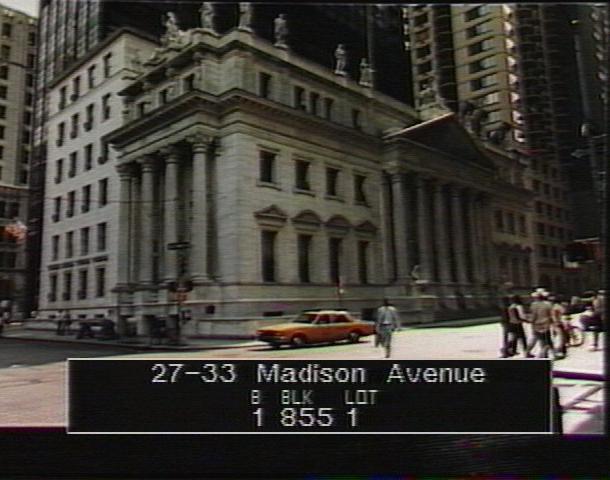
The city photographed every building for its tax records around 1940 and again in the 1980s. NYC Municipal Archives.
Written with AI from the source each entry cites, then fact-checked.
- 1895
Justices weigh a Sixth Avenue depot site against Madison Avenue and 25th Street for a permanent courthouse
In 1895 the Appellate Division's justices wanted a permanent courthouse and first looked at the Sixth Avenue streetcar depot site between 43rd and 44th Streets. They also considered the corner of Madison Avenue and 25th Street, which was no more than a half-hour walk from the homes of four of the justices, though the city comptroller thought it rather expensive. The Madison Avenue site was acquired through eminent domain after commissioners valued the lots in April 1896.
Source: Wikipedia
- 1896
The houses of Congressman Henry C. Miner and Edward H. Peaslee make way for the courthouse
The justices first eyed the Sixth Avenue streetcar depot, then the corner of Madison Avenue and 25th Street, where Henry C. Miner and Edward H. Peaslee had houses. Commissioners valued Miner's lot at $283,000 and Peaslee's at $87,500 in April 1896. The city comptroller complained that the total of roughly $370,000 suggested cronyism because Miner sat in Congress, but the taking went ahead through eminent domain.
Source: Wikipedia
- 1896
Architect James Brown Lord and sixteen sculptors plan a courthouse where statues are part of the design
Lord, whose earlier work was mostly houses, drew a Palladian courthouse in 1896 and consulted the National Sculpture Society on its statuary. He engaged sixteen sculptors, and a four-man committee of Lord, Daniel Chester French, Charles Niehaus and Frederick Ruckstull supervised the harmony of the figures. The Landmarks Preservation Commission calls it the first major New York example of the movement to integrate the arts, and perhaps the only building in the city with so complete a program of architecture, sculpture and painting.
- 1899
Ten muralists, with John La Farge as referee, paint the courthouse interior
The National Society of Mural Painters supplied ten artists: Willard Metcalf, H. Siddons Mowbray, Robert Reid and Charles Y. Turner for the main hall, and Edwin Blashfield, Kenyon Cox, Joseph Lauber, George W. Maynard, Edward Simmons and Henry O. Walker for the courtroom. They chose John La Farge, the country's best-known muralist, to arbitrate, and agreed on a common figure scale, color system and background.
“The artists formed a committee with Lord and selected America's most prominent muralist, John LaFarge, as arbiter…”
- 1900
The First Department takes possession of its new courthouse on January 2, 1900
Lord showed guests through the nearly finished interior on December 20, 1899, and the court moved its furnishings from rented space at 111 Fifth Avenue by month's end. At 1:00 p.m. on January 2, 1900, the First Department formally took possession, with a speech from each of its seven justices. The building cost $633,768 against a $700,000 budget, with $211,300 of that spent on decoration.
“…formally took possession of the new courthouse at 1:00 p.m. on January 2, 1900, with speeches from each…”
Source: Wikipedia
- 1900
The courthouse finishes under its $700,000 budget, with decoration alone costing $211,300
The Appellate Division courthouse came in at $633,768, under the $700,000 that had been budgeted. Other municipal projects of the era, including the Hall of Records and several bridges, went well over budget. Architect James Brown Lord defended the $211,300 spent on decoration alone by arguing that art on public buildings was priceless to the city.
“The courthouse had cost $633,768, less than the $700,000 that had been budgeted for the project.”
Source: Wikipedia
- 1936
Mayor La Guardia proposes turning the courthouse into an art center, then a health museum
Overcrowding led to plans to move the court by 1936, and Mayor Fiorello La Guardia suggested converting the courthouse into a municipal art center with theatrical performances. The state bought a site at 99 Park Avenue and filed plans in 1938, but the money went to the Belt Parkway instead. In June 1939 La Guardia floated a public health museum. The replacement courthouse was never built.
Source: Wikipedia
- 1955
A statue of Mohammed is removed from the courthouse roof at the request of Islamic leaders
Nine figures of great lawgivers still stand on the parapet, including Zoroaster, Alfred the Great, Lycurgus, Solon, Louis IX, Manu, Justinian, Confucius and Moses, with Justice, Power and Study at the center. A tenth, Mohammed, was taken down in 1955. The Landmarks Preservation Commission's interior report records that it came down at the request of Islamic religious leaders.
“A statue of Mohammed was removed in 1955 at the request of Islamic religious leaders.”
- 1966
The Landmarks Commission designates the courthouse and promises not to block its expansion
The commission designated the building a landmark in 1966, excluding a five-story addition at 31-33 Madison Avenue. Court clerk Hyman Gamso wrote that the justices were pleased, but noted a seven-story extension planned on the vacant land to the east and asked that designation not delay it. The commission said it would cooperate fully, and praised a building on which one third of the cost went to decoration.
- 1970
The city leases the courthouse's unused air rights to the Merchandise Mart developer
In April 1970 the city's real-estate commissioner, Ira Duchan, leased the unused air rights over 100,000 square feet of the courthouse site to Samuel Rudin, developer of the neighboring New York Merchandise Mart. It was the city's first lease of the air rights over a structure it owned. Rudin agreed to pay $3.45 million over 75 years and then subleased the courthouse back to the city.
Source: Wikipedia
- 1982
The chief justice moves a bust of Charles O'Conor from the lobby to the basement
In 1982 the First Department's chief justice, Francis T. Murphy, had a bust of the 19th-century lawyer Charles O'Conor moved from the courthouse lobby to its basement. Murphy had learned that O'Conor actively opposed freeing enslaved people in New York State. The building was deteriorating at the time, and the city spent money in the early 1980s on renovating its sculptures and ceiling dome.
Source: Wikipedia
- 1990
A Holocaust memorial by Harriet Feigenbaum is dedicated on the annex wall
Chief Justice Francis T. Murphy proposed a Holocaust memorial for the courthouse in 1986, and sixty-two artists entered a design competition. Harriet Feigenbaum was chosen in 1988, and her memorial was dedicated on May 22, 1990, at a cost of $200,000. It sits at the far northern end of the annex's facade.
Source: Wikipedia
- 2023
Shahzia Sikander's bronze figure NOW goes up on the courthouse for a Madison Square Park exhibition
For Havah...to breathe, air, life, commissioned by the Madison Square Park Conservancy, Shahzia Sikander placed NOW on the courthouse and Witness in the park. She said she drew on legal figures such as Justice Ruth Bader Ginsburg. Some religious groups objected, calling the golden horned figure satanic or demonic, and the Center for Art Law used the episode to discuss artists' rights in public art.
Source: itsartlaw.org
- 2024
A nameplate for Judge Constance Baker Motley replaces Roger Taney's in the courtroom dome
In September 2024 the court installed a nameplate for civil rights champion and U.S. District Judge Constance Baker Motley in the stained-glass dome of its landmarked courtroom. Her name replaced that of Roger B. Taney, the Supreme Court chief justice who wrote the Dred Scott decision. Taney's name was relocated to the law library, with a sign explaining the change.
Source: amny.com
Further reading
Nearby
- Metropolitan Life North Building11 Madison Avenue | 14 entries
- New York Life Building378 Park Avenue South | 17 entries
- Metropolitan Life Insurance Company Tower5 Madison Avenue | 12 entries
- Shake Shack (Madison Square Park)2 Madison Avenue | 4 entries
- Metropolitan Life Insurance Company Tower1 Madison Avenue | 8 entries
- The Grand Madison225 5th Avenue | 3 entries