HB381
381 Broadway | also 68 White Street | Tribeca | built 1852
Open on the map3 entries

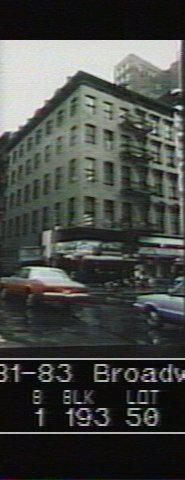
The city photographed every building for its tax records around 1940 and again in the 1980s. NYC Municipal Archives.
Written with AI from the source each entry cites, then fact-checked.
- 1853
Daguerreotypist Martin M. Lawrence opens a grand photographic gallery at 381 Broadway
Martin M. Lawrence, known for oversized 'mammoth' daguerreotypes and allegorical compositions, opened his new studios at 381 Broadway, on the White Street corner, on March 15, 1853. His opening notice billed it as one of the most extensive and splendid daguerreotype galleries in the world and invited the public to view the framed set of 25 pictures that had won him the first premium and a prize medal at the 1851 London exhibition. A trade journal described a richly furnished third-floor reception room and two large skylit operating rooms on the fifth floor. Lawrence competed with Mathew Brady and Jeremiah Gurney, the other leaders of Broadway's new portrait trade.
Source: Daytonian in Manhattan
- 1886
The Clark estate has the Jardine brothers rebuild 383 Broadway as an exact copy of Snook's corner building
John B. Snook designed the corner building at 381 Broadway in 1851 for Richard S. Clark, a five-story Italianate store with a cast-iron storefront. After Clark's death, his estate hired the brothers David and John Jardine to replace the old brick building next door at No. 383, with instructions to match the corner building exactly. Finished in 1886, about 35 years after its twin, the new half made the two read as a single structure. Eugene P. Peyser, a menswear dealer, opened a branch in its store that October.
Source: Daytonian in Manhattan
- 1918
A lieutenant holds a sergeant in an upstairs office at 381 Broadway and questions him as a German spy
In early 1918, First Lieutenant Seymour Worrall Hyde of the woolen firm A. G. Hyde & Sons ordered a sergeant who had failed to salute him into a taxi and took him to the firm's counting rooms at 381 Broadway. Hyde kept him in an upstairs office from ten in the morning until six at night, summoned two privates from Camp Upton as guards and questioned him as a German spy. The sergeant later testified that Hyde had him dictate answers into a phonograph and strip off his shirt so he could listen to his heart. Authorities diagnosed a nervous breakdown and committed Hyde for treatment.
Source: Daytonian in Manhattan
Nearby
- Grosvenor Buildings385 Broadway | 3 entries
- Grosvenor Building66 White Street | 4 entries
- 391 Broadway3 entries
- 62 White Street2 entries
- 60 White Street3 entries
- 393 Broadway3 entries