Gorham Building
386 5th Avenue | also 6 West 36th Street, 390 5th Avenue | Midtown | built 1906
Open on the map7 entries

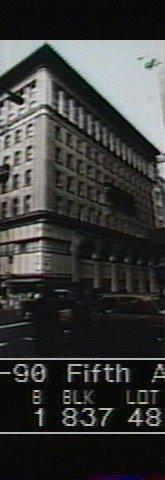
The city photographed every building for its tax records around 1940 and again in the 1980s. NYC Municipal Archives.
Written with AI from the source each entry cites, then fact-checked.
- 1902
A hotel called the Lenox occupies the corner before Gorham leases the site
Before the Gorham Building, the southwest corner of Fifth Avenue and 36th Street held a hotel that had been named the Shelburn and was called the Lenox by 1902. William Waldorf Astor had acquired the site in 1890. In December 1902 Gorham's president, Edward Holbrook, leased the corner, much of which was owned by John Jacob Astor IV, and hired McKim, Mead & White to design a new store on the lot.
Source: Wikipedia
- 1905
Gorham and Tiffany open Stanford White buildings on Fifth Avenue within days of each other
In September 1905 the Gorham Company opened its eight-story store on the southwest corner of Fifth Avenue and 36th Street, and Tiffany & Co. opened its new building at 37th Street within days. Stanford White designed both. Gorham's was the plainer, drawing on Florentine models, while Tiffany's followed a Venetian palace. The Gorham building cost $1.25 million, about a tenth of it for bronze trim the company made itself, and sculptor Andrew O'Connor's reliefs of silvermaking scenes sat above the ground-floor arches.
Source: The New York Times
- 1906
Evelyn Nesbit Thaw runs up more than $2,000 in silver purchases from Gorham on credit
In 1906, the year her husband Harry Thaw shot and killed the architect Stanford White, Evelyn Nesbit Thaw bought more than $2,000 of silver from Gorham on credit and gave it away as presents. White, her former lover, had designed Gorham's Fifth Avenue building. Gorham sued her for payment in 1913, and she said she had less than $250 to her name.
Source: The New York Times
- 1924
Russeks opens its women's apparel store in the former Gorham building
On September 25, 1924, the women's clothing firm Russeks opened the building at Fifth Avenue and 36th Street to the public. The New York Times noted that Stanford White had designed it and that Gorham had been its occupant. Russeks had reworked and enlarged the structure to eight floors devoted to selling women's apparel.
Source: The New York Times
- 1959
Russeks announces it will close its Fifth Avenue store after five years of losses
On February 25, 1959, Russeks Fifth Avenue, Inc. announced that it would close the store at the corner of 36th Street that it had run for nearly 35 years. The New York Times headline reported five years of losses and said the company's shops in a hotel and in the suburbs would carry on.
Source: The New York Times
- 1960
Architect Herbert Tannenbaum strips the Gorham building's arches and reliefs for a glass-and-metal base
In 1960 the building's owner ordered architect Herbert Tannenbaum to remove the delicate street-level arches and carved reliefs in a redesign. Tannenbaum said he tried to talk the owner into keeping the original design but was told someone else would get the job if he refused. He produced a modern grid of glass and metal and later said he felt terrible about it, recalling the arches as lovely.
Source: The New York Times
- 2000
Owners propose painting a trompe l'oeil to bring back the Gorham building's lost arches and reliefs
In 2000, two years after the building was landmarked, its owners proposed a restoration done in paint instead of stone. Decorative painter Andrew Tedesco planned to paint 80 outdoor signboards, each 4 by 8 feet, showing the missing arches and reliefs, to be mounted over the 1960 metal grid. A full stone restoration was budgeted at $7 million. Community Board 5 backed the idea 29 to 0, while preservation groups were cautious.
Source: The New York Times
Further reading
- 390 Fifth AvenueWikipedia
Nearby
- The Langham, New York, Fifth Avenue400 5th Avenue | 6 entries
- Stewart Building402 5th Avenue | 4 entries
- Tiffany and Company Building401 5th Avenue | 11 entries
- B. Altman and Company Building365 5th Avenue | 8 entries
- Empire State Building350 5th Avenue | 18 entries
- B. Altman & Company Department Store188 Madison Avenue | 9 entries