Tiffany and Company Building
401 5th Avenue | also 2 East 37th Street, 397 5th Avenue | Midtown | built 1906
Open on the map11 entries

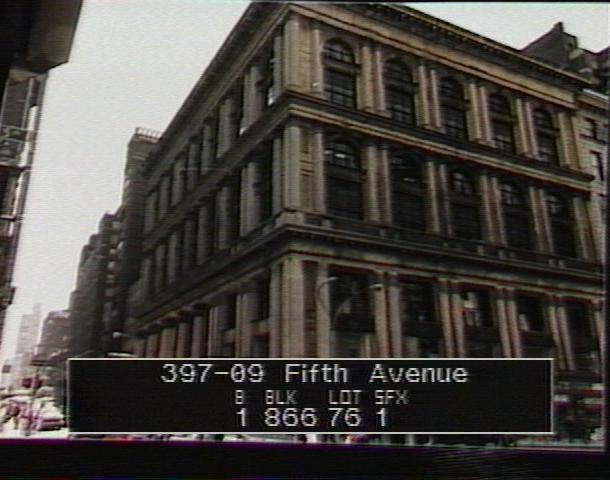
The city photographed every building for its tax records around 1940 and again in the 1980s. NYC Municipal Archives.
Written with AI from the source each entry cites, then fact-checked.
- 1903
Tiffany's new president announces the move to 37th Street and Fifth Avenue
In April 1903 Charles T. Cook, who had succeeded Charles Lewis Tiffany as president, announced that the firm would build at the southeast corner of Fifth Avenue and 37th Street, with McKim, Mead & White as architects. By Tiffany tradition he told them to build him a palace. Stanford White chose the sixteenth-century Palazzo Grimani in Venice as the model.
- 1903
A foundation wall collapses during excavation and kills a laborer
As workers excavated the site in October 1903, the foundation walls collapsed and one laborer was killed. A month earlier McKim, Mead & White had filed plans for a seven-story store, and the contractor Charles T. Wills Company had been hired that October. The cornerstone followed in March 1904.
Source: Wikipedia
- 1905
Stanford White's Tiffany Building opens on Fifth Avenue
Architect Stanford White of McKim, Mead & White modeled Tiffany & Co.'s new store on the Palazzo Grimani in Venice, raising a seven-story marble building at Fifth Avenue and 37th Street. It opened September 5, 1905, at a cost of about $600,000 excluding the land, replacing Tiffany's earlier store on Union Square.
Source: Wikipedia
- 1914
Guards at first refuse to let firefighters into the vault during a minor fire
The basement held a safe-deposit vault with walls four feet thick and 2,036 boxes. It was guarded so closely that when a small fire broke out there in 1914, the store's guards at first refused to admit city firefighters. The safe stayed in place after Tiffany moved away in 1940.
Source: Wikipedia
- 1940
Tiffany & Co. moves uptown and the building changes hands repeatedly
Tiffany & Co. left the Fifth Avenue store in 1940 for a new location at 57th Street, ending 35 years at No. 401. The American Red Cross and Textron occupied the building in the 1940s, Allied Stores held the upper floors from 1950 to 1973, and the Unification Church has owned the building since 1977.
Source: Wikipedia
- 1952
Henry Goelet remodels the ground floor, and Lewis Mumford calls for a society to protect buildings
Henry Goelet bought the building in 1951, and in 1952 he had the ground floor lowered slightly and a mezzanine added. The renovation took out ten tons of bronze, the Corinthian capitals on the piers and $1 million of marble. The critic Lewis Mumford objected to the changes and said a Society for the Prevention of Cruelty to Buildings was needed.
Source: Wikipedia
- 1977
Sun Myung Moon's Unification Church buys the building for a reported $2.4 million
Sun Myung Moon of the Unification Church bought the building in 1977 for a reported $2.4 million, promising to restore it as offices for the church's daily newspaper, The News World. It housed English and Spanish editions of the church's dailies and, from 1983, the New York City Tribune. No restoration work was done in the decade that followed.
“In 1977, Sun Myung Moon of the Unification Church bought the Tiffany & Co. Building for a reported $2.4 million.”
Source: Wikipedia
- 1987
The church proposes a 40-story tower over the landmark, then drops the plan in 1990
In 1987 the Unification Church proposed restoring the building and adding a 40-story precast-concrete tower designed by Hardy Holzman Pfeiffer, which would have removed two bays on the top tier for a light court. The church's News World Communications also acquired three neighboring lots. It canceled the plan in 1990 after the Landmarks Preservation Commission rejected a similar tower over the Metropolitan Club.
Source: Wikipedia
- 1988
The former Tiffany store gains city and federal landmark status
The building was named a National Historic Landmark in 1978 and a New York City landmark a decade later in 1988, recognizing Stanford White's Renaissance Revival design nearly five decades after Tiffany & Co. had moved out.
Source: Wikipedia
- 1991
The top floors become television studios where The Ricki Lake Show is taped
When the top floor came up for lease in 1991, its high ceilings were pitched to fashion and video tenants. The Image Group leased 70,000 square feet over four stories. It taped The Ricki Lake Show on the seventh floor and also produced The People's Court in the building.
Source: Wikipedia
- 2003
A restoration uncovers the building's hidden marble columns
A 2003 restoration removed mid-century storefronts that had defaced the ground floor, bringing back the three-story Corinthian marble columns Stanford White had originally designed. Critics had once called the earlier alterations vandalism to the Fifth Avenue facade, which the work aimed to reverse.
Source: Daytonian in Manhattan
Further reading
- Tiffany and Company BuildingWikipedia
- The 1905 Tiffany & Co. Building - 401 Fifth AvenueDaytonian in Manhattan
Nearby
- The Langham, New York, Fifth Avenue400 5th Avenue | 6 entries
- Stewart Building402 5th Avenue | 4 entries
- Gorham Building386 5th Avenue | 7 entries
- 244 Madison Avenue4 entries
- 425 Fifth Avenue425 5th Avenue | 5 entries
- Phelps-Morgan Mansion231 Madison Avenue | 15 entries