Lever House
390 Park Avenue | Midtown | built 1952
Open on the map12 entries

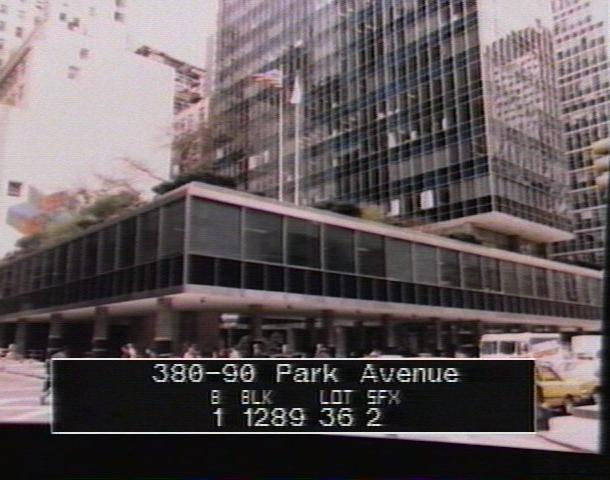
The city photographed every building for its tax records around 1940 and again in the 1980s. NYC Municipal Archives.
Written with AI from the source each entry cites, then fact-checked.
- 1936
Twenty Goelet rowhouses come down for an Art Deco movie theater and shops
In 1936 twenty of the 22 rowhouses that Robert W. Goelet owned on the Park Avenue block between East 53rd and 54th Streets were demolished. A small Art Deco shop building went up along Park Avenue, with the Normandie movie theater facing East 53rd Street. Both were taken down in May 1950, along with two brownstones left on 54th Street, to clear the lot for Lever Brothers' new headquarters. Excavation began that August.
“…twenty rowhouses owned by Robert W. Goelet ... were demolished. In their place were built a small commercial building ... and the Normandie movie theater…”
- 1950
A model of the Lever Brothers tower goes on view in a Museum of Modern Art exhibit
While the foundations on Park Avenue were still being dug, the design for the Lever Brothers headquarters had its first public showing as a model in an exhibition of Skidmore, Owings & Merrill's work at the Museum of Modern Art. New York Times critic Aline B. Louchheim reviewed the show on October 24, 1950, and singled out the Lever tower as the firm's most inventive and remarkable project.
“The design, in the form of a model, was first seen in an exhibit of S.O.M.'s work put on by the Museum of Modern Art…”
- 1952
A rooftop gondola on rails, built to wash the sealed windows, draws more notice than almost anything else
Because every pane in Lever House's glass walls was fixed shut, the architects added a window-cleaning gondola that was lowered from the roof and ran on a miniature railroad track behind the parapet. At first it caught New Yorkers' attention more than any other feature, and every contemporary account of the building described it in detail. Lewis Mumford wrote in The New Yorker that a soap company could hardly ask for better advertising than a crew of cleaners at work in public view.
“…the architects designed a special window cleaning gondola that could be lowered from the roof and which moved on a miniature railroad track…”
- 1952
Frank Lloyd Wright calls Lever House a box on sticks in a lecture to the architects' institute
Soon after the American Institute of Architects gave Lever House its first honor award, Frank Lloyd Wright lectured the same organization and dismissed the tower as "a box on sticks." He saw the International Style as a kind of classicism that had set building back by centuries, and he accused the profession of passing things around on the surface without reaching the spirit of architecture. His own individualistic approach stood at the opposite pole from Gordon Bunshaft's formal one.
- 1952
Natalie de Blois helps guide the Lever House design while Gordon Bunshaft gets the credit
Lever House is usually credited to Gordon Bunshaft, but Natalie de Blois, a senior designer at Skidmore, Owings & Merrill, helped guide it, along with the Pepsi-Cola and Union Carbide headquarters. Firm founder Nathaniel Owings later wrote that many solutions credited to the firm's male stars owed more to her. A colleague said Bunshaft took the credit while she did the work. De Blois died in Chicago in 2013, aged 92.
Source: The New York Times
- 1952
Lever House opens as a glass-walled slab tower on Park Avenue
Skidmore, Owings & Merrill architects Gordon Bunshaft and Natalie de Blois designed Lever House for the Lever Brothers soap company, raising a slender 21-story slab wrapped in a glass curtain wall. It opened April 29, 1952, only the second building in New York to use a full glass curtain wall after the United Nations Secretariat, with every office kept within 25 feet of a window.
Source: Wikipedia
- 1953
Lever House begins closing its courtyard one day a year so the public cannot claim it
Since 1953 the owners of Lever House have shut the garden courtyard, arcade and interior sidewalks to the public for part of one day each year, putting up barricades with signs and having an employee sign an affidavit. The ritual protects against a claim of adverse possession, under which long and unchallenged public use could in theory transfer property. A plaque set into the pavement already warns that crossing is by permission of the owner. In 2011 the closing ran from 8 a.m. to 4 p.m. on a Sunday.
Source: The New York Times
- 1982
The city designates Lever House a landmark at exactly 30 years old
New York's Landmarks Preservation Commission designated Lever House a city landmark on November 9, 1982, the earliest date allowed under the 30-year rule. Protection came just in time: developer Fisher Brothers had proposed demolishing the tower in the 1980s for a 40-story replacement.
Source: Wikipedia
- 1983
The Board of Estimate upholds Lever House's landmark status by a single vote, 6 to 5
The Board of Estimate sustained Lever House's landmark designation on March 18, 1983, ending a fight with developers who wanted a 40-story tower. Mayor Koch, Council President Carol Bellamy and Comptroller Harrison Goldin, who held two votes apiece, outweighed all five borough presidents, who opposed. Fisher Brothers' lawyer called it only the end of round one and said the firm would pursue the building's unused development rights.
Source: The New York Times
- 1985
Sarah Korein buys the land under Lever House and calls it her Mona Lisa
Sarah Korein, a Manhattan real estate investor, acquired the land beneath Lever House from the Goelet estate in 1985, while Unilever kept leasing the tower. Her daughter, Elysabeth Kleinhans, recalled that Korein called the building her "Mona Lisa." Shortly before Korein's death in 1998, Aby Rosen and Michael Fuchs took over the building lease, though her family kept the land.
Source: Wikipedia
- 2000
A restoration finds only about a half-dozen original panels left in the glass walls
Work began in 2000 on a restoration designed by Skidmore, Owings & Merrill that owner RFR Holding put at $25 million. A curtain wall specialist estimated that only about half a dozen of the original spandrel panels survived decades of repairs. Crews replaced the rusted steel subframe and mullions, installed new glass nearly identical to the old, and moved the wall outward by a quarter inch. The plaza gained marble benches and a sculpture garden assembled from eight works by Isamu Noguchi.
Source: Wikipedia
- 2007
Damien Hirst fills the plaza with a giant pregnant sculpture
As part of an ongoing art program curated by former Whitney Museum curator Richard Marshall, artist Damien Hirst mounted an exhibition at Lever House in 2007 and 2008 titled School, displaying preserved animal carcasses behind glass alongside furniture. The show accompanied his 34-foot sculpture Virgin Mother, installed in the building's outdoor plaza.
Source: The Bowery Boys
Further reading
- Lever HouseWikipedia
- Park Avenue’s stylish slaughterhouseThe Bowery Boys
Nearby
- Hotel Elysée60 East 54th Street | 9 entries
- DuMont Building515 Madison Avenue | 4 entries
- Racquet and Tennis Club370 Park Avenue | 11 entries
- Park Avenue Plaza55 East 52nd Street | 9 entries
- CBS Studio Building49 East 52nd Street | 9 entries
- 399 Park Avenue7 entries