Asser Levy Public Baths
392 Asser Levy Place | also 501 East 23rd Street | Kips Bay | built 1906
Open on the map13 entries

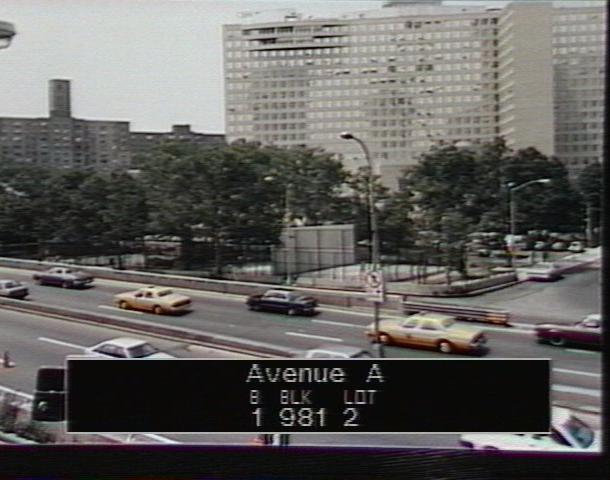
The city photographed every building for its tax records around 1940 and again in the 1980s. NYC Municipal Archives.
Written with AI from the source each entry cites, then fact-checked.
- 1903
The city sets aside Avenue A land for a free public bathhouse at East 23rd Street
Public baths grew out of a health campaign: an 1896 survey on the Lower East Side counted one bathtub for every 79 families, and a state law of 1895 told local health boards to build baths. In 1903 the Department of Docks and Ferries gave up land on Avenue A at East 23rd Street to the Manhattan Borough President for a new bathhouse. It opened in 1908 as the East 23rd Street Bathhouse.
Source: nycgovparks.org
- 1906
Brunner and Aiken give the public bathhouse a Roman-bath look with separate entrances for men and women
The one-story red brick bathhouse, designed by Arnold W. Brunner and William Martin Aiken as associated architects, is cross-shaped in plan on a limestone base. Four pairs of free-standing columns flank two doorways on Asser Levy Place, one for each sex, with a fountain in a niche between the central columns. The Landmarks Preservation Commission designated it on March 19, 1974.
“The Public Baths were built between 1904 and 1906 by the City of New York.”
- 1908
East 23rd Street Bathhouse opens with a borough president's ceremony and a swimming exhibition
The bathhouse opened on January 20, 1908, in a ceremony led by Manhattan Borough President John F. Ahearn, with competitive swimmers such as Charles Daniels racing in the indoor pool. Plans for separate men's and women's pools had been changed to a single shared one, so men and women used it on alternating days. Construction by Luke A. Burke & Sons had begun in June 1905.
“The bathhouse opened on January 20, 1908, with a ceremony led by borough president John F. Ahearn.”
Source: Wikipedia
- 1911
The 23rd Street bathhouse pool holds 70,000 gallons of filtered water, changed three times a week
By 1911 Manhattan had opened nearly a dozen public bathhouses, and the one at East 23rd Street was among those with a swimming pool. Its pool measured 66 by 25 feet and held 70,000 gallons of filtered water, with the water changed three times each week. City-run bathing had been promoted by reformers after cholera and typhoid epidemics swept crowded neighborhoods in the decades before.
Source: flatironnomad.nyc
- 1936
Outdoor swimming and diving pools open at the baths, with La Guardia and Moses at the dedications
In the hot summer of 1936 the bathhouse site added an outdoor swimming pool, a diving pool and a playground. The pools opened a few weeks apart. Mayor Fiorello La Guardia and Robert Moses, the parks commissioner, both came to dedications that drew crowds, and the city later described the pools as a relief to thousands of New Yorkers.
Source: flatironnomad.nyc
- 1954
The street beside the baths is renamed for Asser Levy, New Amsterdam's first Jewish citizen
In 1954 a local law named the street west of the bathhouse for Asser Levy, and the baths later took his name too. Levy fled Brazil in 1654 with a group of 23 Jews seeking refuge in New Amsterdam. When Governor Peter Stuyvesant tried to expel them, Levy became the colony's first Jewish citizen and pressed for rights such as citizenship, bearing arms and owning property. He served in the militia, sold kosher meat and helped found Shearith Israel.
Source: nycgovparks.org
- 1973
Mayoral candidate Albert Blumenthal jumps into the pool to open his 1973 campaign
Albert H. Blumenthal, the liberal who ran for mayor of New York in 1973, started his campaign season at the Asser Levy Bathhouse by jumping into the pool. By then the building had come to be known by the name of the street outside, renamed for Levy in 1954. The Landmarks Preservation Commission designated it a city landmark the following March.
“…visited the Asser Levy Bathhouse to mark the start of the "official" campaign season for that election, jumping into the pool there…”
Source: Wikipedia
- 1974
The Landmarks Commission designates the public baths after a hearing with one speaker in favor
On March 19, 1974, the Landmarks Preservation Commission made the Public Baths at East 23rd Street and Asser Levy Place a city landmark. At the previous November's hearing one witness spoke in favor and none against, and the parks agency that ran the building as an indoor pool backed the move. The report notes that the dense area between City Hall and 23rd Street was full of tenements with no bathing facilities, so public baths filled an important need.
- 1988
A rabbi, a Borscht Belt comedian and Second Avenue Deli pastrami mark the restoration groundbreaking
When work began on restoring the East 23rd Street baths in 1988, the groundbreaking ceremony featured a rabbi and a Borscht Belt comedian, and the Second Avenue Deli supplied pastrami and chopped liver, as New York Magazine reported on December 5, 1988. The facility then stayed closed to the public until 1990 while its indoor and outdoor pools were rebuilt.
Source: flatironnomad.nyc
- 1990
The baths reopen after a ruptured boiler and an $8 million restoration
By late 1978 the indoor pool went unheated in winter, and after its boiler ruptured in March 1979 it closed indefinitely. Manhattan Community Board 6 pressed the city for $5 million to $6 million for repairs. An $8 million renovation began on November 30, 1988, and the bathhouse reopened on June 28, 1990.
“After the indoor pool's boiler ruptured in March 1979, the indoor pool was closed indefinitely, while the outdoor pool remained operational.”
Source: Wikipedia
- 1993
Asser Levy Playground opens as one of Manhattan's first built for disabled children
In 1993 the Asser Levy Playground opened beside the bathhouse as one of the first playgrounds in Manhattan built for children with disabilities. Money came from the city and from two private groups, the Heckscher Foundation for Children and the City Parks Foundation. It has free-form game tables, accessible drinking fountains, tactile paving for visitors with visual impairments, and equipment such as pull-up bars, balance boards, ramps and chain ladders that all children can use.
Source: nycgovparks.org
- 1995
The city finds lead chips from the FDR Drive viaduct blowing into the outdoor pool area
In 1995 the city government found that lead chips flaking off the FDR Drive viaduct, which runs along the east side, were blowing into the recreation center's outdoor pool area. The finding meant extremely high lead levels there. The center stretches from East 23rd to East 25th Street.
“…lead chips from the FDR Drive viaduct, to the east, were blowing into the Asser Levy Recreation Center's outdoor pool area, resulting in extremely high lead levels…”
Source: Wikipedia
- 2013
Asser Levy Place is closed for good and added to the recreation center's playground
In 2011 the city agreed to turn Asser Levy Place, the former Avenue A, into an extension of the recreation center. It was part of a land swap in which the city sold the western end of the Robert Moses Playground to the United Nations for an office tower. The street was permanently closed in 2013, park work began that November, and the enlarged playground was completed in October 2014.
Source: Wikipedia
Further reading
- Asser Levy Recreation CenterWikipedia
Nearby
- United Nations International School2450 Franklin D Roosevelt Drive | 10 entries
- Peter Cooper Village370 1st Avenue | 7 entries
- Institute for the Crippled and Disabled400 1st Avenue | 6 entries
- Bellevue Hospital462 1st Avenue | 12 entries
- R & S Building492 1st Avenue | 4 entries
- Bellevue Psychopathic Hospital400 East 30th Street | 3 entries