Peter Cooper Village
370 1st Avenue | also 342 1st Avenue | Peter Cooper Village | built 1947
Open on the map7 entries

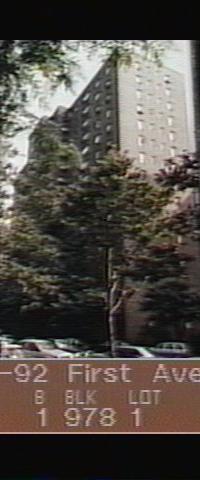
The city photographed every building for its tax records around 1940 and again in the 1980s. NYC Municipal Archives.
Written with AI from the source each entry cites, then fact-checked.
- 1946
The Gas House District is cleared to make room for Stuyvesant Town and Peter Cooper Village
Before the development, the site was the Gas House District, named for the gas storage tanks of the Consolidated Gas Company. Roughly 600 buildings on 18 blocks were torn down, displacing an estimated 3,000 families and 11,000 people. The last residents, the Delman family, left in May 1946, and a 1945 New York Times article had called the move the most significant mass movement of families in the city's history.
Source: Wikipedia
- 1947
Veteran families move into the new MetLife complex on August 1, 1947
MetLife had outlined Peter Cooper Village in January 1945 as an extension of Stuyvesant Town, set east of First Avenue between 20th and 22nd Streets for about 6,000 residents. On August 1, 1947, two veterans and their families moved into the first building to be finished in the Stuyvesant Town and Peter Cooper Village complex, with rents from $50 to $91 a month. By the time of first occupancy MetLife had received 100,000 applications, and veterans were given priority.
Source: Wikipedia
- 1947
A judge rules in July 1947 that MetLife may choose its tenants by race
MetLife barred Black New Yorkers from the complex, and a New York Supreme Court judge ruled in July 1947 that a private landlord could pick tenants as it wished. City College professor Lee Lorch, who petitioned for integration, lost his job under pressure from the company. Residents formed a committee of about 1,800 tenants to end discrimination, and a 1958 state law barred bias in publicly subsidized private housing, though enforcement stayed weak for decades.
Source: Wikipedia
- 2006
MetLife sells Stuyvesant Town and Peter Cooper Village for $5.4 billion
MetLife agreed in October 2006 to sell the complex for $5.4 billion to Tishman Speyer Properties and BlackRock's real estate arm, after dozens of prospective buyers showed interest. City Council member Daniel Garodnick, a lifelong Peter Cooper Village resident, organized a tenants' bid of $4.6 billion. Tishman Speyer put up only $56 million in cash and borrowed about $4 billion from Wachovia and $500 million from Merrill.
Source: Wikipedia
- 2010
Tishman Speyer defaults, the largest commercial mortgage default in U.S. history
Tishman Speyer defaulted on its mortgage in January 2010 and handed the complex to creditors, which avoided a bankruptcy filing. The property was by then valued at around $1.9 billion, under 40 percent of the 2006 price. The 2006 deal had assumed that income would triple by 2011, a projection described as extremely aggressive. Reporter Charles Bagli later told the story in a 2013 book.
Source: Wikipedia
- 2012
Hurricane Sandy floods the basements of Peter Cooper Village's buildings
Hurricane Sandy flooded the basements of 17 Peter Cooper Village buildings in 2012. A resident recalled that the storage and laundry spaces were drained and dried before Christmas, but repairs then stalled, and by September 2013 they were still closed because the owner, CW Capital, had trouble getting approvals from city agencies. Temporary laundry machines were installed, and in spring 2013 the tenants association filed a rent-reduction claim with the state housing agency over the lost services.
Source: dnainfo.com
- 2015
Blackstone buys the complex for about $5.3 billion with a city deal to keep 5,000 homes affordable
Blackstone and Ivanhoe Cambridge completed their purchase of the complex in December 2015, in a deal first reported at about $5.3 billion and completed at $5.45 billion. New York City added $225 million so that about 5,000 units would stay below market rent until at least 2035. By then about 45 percent of residents paid regulated rents, down from 71 percent in 2006.
Source: Wikipedia
Nearby
- Institute for the Crippled and Disabled400 1st Avenue | 6 entries
- Asser Levy Public Baths392 Asser Levy Place | 13 entries
- Church of the Epiphany373 2nd Avenue | 3 entries
- 326 East 18th Street3 entries
- Beth Israel Petrie Division10 Nathan D Perlman Place | 7 entries
- United Nations International School2450 Franklin D Roosevelt Drive | 10 entries