Hamilton-Holly House
4 St Marks Place | also 4A St Marks Place | East Village | built 1831
Open on the map12 entries

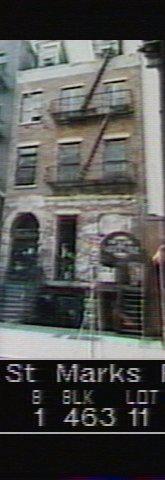
The city photographed every building for its tax records around 1940 and again in the 1980s. NYC Municipal Archives.
Written with AI from the source each entry cites, then fact-checked.
- 1831
Thomas E. Davis builds a row of Federal townhouses on the block
Developer Thomas E. Davis builds Federal-style townhouses for well-off buyers along St. Mark's Place between Second and Third Avenues in 1831. No. 4 has a 26-foot frontage, a red-brick front laid in Flemish bond with white marble trim, and parlor-floor windows that open onto a cast-iron balcony.
Source: Daytonian in Manhattan
- 1833
Alexander Hamilton's widow moves into No. 4 with her son
Col. Alexander Hamilton Jr. buys No. 4 St. Mark's Place from Davis in November 1833 for $15,500. His mother Eliza, the widow of Alexander Hamilton, lives there for nine years with her son, her daughter Eliza Hamilton Holly, and her son-in-law Sidney Augustus Holly. The building is now known as the Hamilton-Holly House.
Source: Wikipedia
- 1841
An insurance company forecloses on the house where Eliza Hamilton lives
In 1841 the Washington Marine Insurance Company foreclosed on 4 St. Mark's Place, though city directories still listed the Hamilton and Holly families there for 1842-43. By 1843-45 Eliza Hamilton and her widowed daughter Eliza Holly were living at 63 Prince Street. They then moved to Washington, D.C., where Eliza Hamilton lived to the age of 97.
- 1955
Julie Bovasso's Tempo Playhouse stages Genet's American premiere
Actress and director Julie Bovasso founds the Tempo Playhouse in the building in 1955, staging the American premiere of Jean Genet's "The Maids" along with works by Gertrude Stein. The first Obie Awards name Bovasso best actress and cite the Tempo as the best experimental theater.
Source: NYC LGBT Historic Sites Project
- 1959
The Key Theater opens in the building and stages early one-acts by Eugene O'Neill
In July 1959 Nils L. Cruz and Robert E. Judge established the Key Theater at No. 4. The Times described it as a 115-seat house with a proscenium stage. Among the plays staged there were three early short works by Eugene O'Neill, The Movie Man, Abortion and The Sniper, along with Strindberg's The Dance of Death, several Chekhov one-acts and a Lorca program.
“In July 1959, the Key Theater was established here by Nils L. Cruz and Robert E. Judge.”
- 1961
Theodora Bergery launches a Children's Circus and shares the upper floors with the circus animals
Theodora Colt Flynn Bergery, a poet, actress and painter descended from the Rhode Island Colts, bought the building in 1961 to stage a circus of her own. Her Children's Circus debuted that December and ran for two winters, with the Gangler Brothers Circus hired to perform. The Times reported that the Gangler and Bergery families lived together on the upper floors with the animals. She renamed the house the Bowery Theater.
“The Children's Circus, which debuted in December 1961 and ran for two winters. She hired the Gangler Brothers Circus…”
- 1964
The New Bowery Theater shows underground films, and the district attorney raids it over Flaming Creatures
The New Bowery Theater became a venue in March 1964, once the city had closed the Gramercy Arts Theater, for avant-garde films shown by the Film-Makers' Cooperative, headed by Jonas Mekas, who was then film critic of The Village Voice. The Kuchar Brothers' work first reached audiences there, including the premiere of Lust for Ecstasy. The district attorney's office raided the theater and confiscated Jack Smith's film Flaming Creatures, which was alleged to be obscene, and Mekas was arrested; he was arrested again for showing Genet's Un Chant d'Amour.
“The district attorney's office raided the theater, seizing Jack Smith's allegedly "obscene" film "Flaming Creatures" and arresting Mekas.”
- 1965
The Bridge Theater hosts Judson-circle dancers and midnight shows by Yoko Ono and The Fugs
In 1965-66 the building housed the Bridge Theater, which the light artist Rudi Stern later called the most exciting theater in New York at the time. Its 'Dance at the Bridge' program featured Lucinda Childs, Yvonne Rainer, Meredith Monk, Trisha Brown and Kenneth King. Yoko Ono and The Fugs performed in a series of midnight shows in 1965.
- 1966
The city charges the Bridge Theater over a flag-burning skit
In 1966, the city's Department of Licenses charges the Bridge Theater over an anti-Vietnam War skit called "LBJ" in which a flag is burned onstage, calling it immoral. A committee led by poet Allen Ginsberg denounces the charges as harassment, and they are eventually dropped. The building's use as a theater ends after this period.
Source: NYC LGBT Historic Sites Project
- 1975
The punk fashion store Trash and Vaudeville opens on the ground floor
Trash and Vaudeville, a punk fashion store, occupies the building's first floor and basement from 1975 until February 2016, more than forty years. The property is listed for sale in 2015, and an investment group buys it in April 2016 for $10 million.
Source: Wikipedia
- 2004
The Landmarks Preservation Commission designates the Hamilton-Holly House
On October 19, 2004, the Landmarks Preservation Commission designated the house at 4 St. Mark's Place a landmark under the name Hamilton-Holly House. At the public hearing on May 18, ten people spoke in favor of designation. The designation report was prepared by Jay Shockley of the commission's research department.
- 2016
An investment group buys the townhouse for $10 million and wins approval to restore its facade
After the retail space and four apartments were vacated, an investment group bought the building in April 2016 for $10 million. It had been listed the previous year at roughly $12 million. In November 2016 the Landmarks Preservation Commission approved parts of a renovation plan that included restoring the facade, rebuilding the grand curved first-floor balcony and adding a new entryway.
Source: Wikipedia
Further reading
- Hamilton-Holly HouseWikipedia
Nearby
- St. Marks Baths6 St Marks Place | 6 entries
- Surma Book and Music Company11 East 7th Street | 4 entries
- 13 East 7th Street1 entry
- German-American Shooting Society Clubhouse12 St Marks Place | 9 entries
- McSorley's Old Ale House15 East 7th Street | 14 entries
- Metropolitan Savings Bank Building59 Cooper Square | 3 entries