Chrysler Building
405 Lexington Avenue | also 135 East 42nd Street, 136 East 43rd Street, 132 East 43rd Street | East Midtown | built 1930
Open on the map20 entries

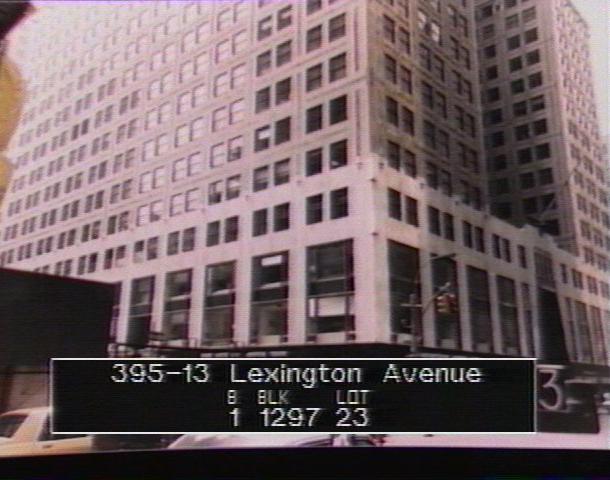
The city photographed every building for its tax records around 1940 and again in the 1980s. NYC Municipal Archives.
Written with AI from the source each entry cites, then fact-checked.
- 1927
Developer William Reynolds hires Van Alen to design a 67-story glass-domed office tower here
William H. Reynolds, a real-estate promoter and former state senator, took a long lease on the Cooper Union's corner at Lexington Avenue and 42nd Street in 1921. In 1927 he hired architect William Van Alen to design an office building called the Reynolds Building: 67 stories and 808 feet, topped by a glass dome that would glow like a jewel when lit from inside. Walter Chrysler took over the project the next year and reworked it.
“In 1927 architect William Van Alen was hired to design an office tower to be called the Reynolds Building for the site.”
- 1928
Walter Chrysler buys the site's lease and Van Alen's plans
Walter Chrysler purchases developer William H. Reynolds's 67-year lease on the Lexington Avenue site along with architect William Van Alen's plans for a skyscraper there. Demolition of the existing building begins that day and finishes within a month, and excavation for the new foundation starts in mid-November.
Source: Wikipedia
- 1929
Steelworkers raise the Chrysler Building's frame about four floors a week without a single death
Construction began on January 21, 1929, and the steel frame was finished by September, climbing roughly four floors every week. No worker died during the steelwork, a record Walter Chrysler praised publicly. The crews drove 391,881 rivets, and bricklayers later laid about 3.8 million bricks for the walls, which carry no load.
“Despite a frantic steelwork construction pace of about four floors per week, no workers died during the construction of the skyscraper's steelwork.”
Source: Wikipedia
- 1929
Walter Chrysler hires Margaret Bourke-White to photograph the tower from a scaffold 400 feet up
In December 1929 Walter Chrysler brought in the photographer Margaret Bourke-White to make publicity pictures from a scaffold about 400 feet above the street. She fell for the building's giant eagle-head ornaments, and several of her photographs ran in a 1930 skyscraper report in the new Fortune magazine. Her studio on the 61st floor, designed by John Vassos, lasted until 1934, when she was evicted.
Source: Wikipedia
- 1929
A hidden spire makes the Chrysler Building the world's tallest
Walter Chrysler took over the project in October 1928 and had architect William Van Alen push it higher in a race for the title of world's tallest building. The steel spire was built secretly inside the tower's frame and hoisted into place on October 23, 1929, days before the stock market crash, bringing the building to 1,046 feet.
Source: Wikipedia
- 1930
Chrysler builds his own subway entrance after the IRT tries to block it
The tower's basement connects by a staircase to the 42nd Street subway station. The Interborough Rapid Transit Company, then running the lines there, sued to stop the new entrance because of crowding fears, but the city's Board of Transportation pushed it through. Chrysler paid for the passage himself, and work began in March 1930, finishing about two months later, together with the building.
“Chrysler eventually built and paid for the building's subway entrance. Work on the new entrance started in March 1930 and it opened along with the Chrysler Building two months later.”
Source: Wikipedia
- 1930
Giant radiator caps and a racing-car frieze mark the 31st floor as Chrysler's own
At the 31st floor Van Alen pushed the corners outward and topped them with enormous radiator-cap ornaments of Nirosta steel, each spanning about 15 feet, partly to stop the tower looking wider at the top than at the base. A brick frieze of stylized racing cars with polished hubcaps runs across the same level. Nine-foot steel pineapples sit lower down, at the 24th floor.
- 1930
The new tower offers movable steel partitions, wiring under the floors and elevators faster than city law allowed
Chrysler pitched the tower as the best possible office environment. Soundproofed steel partitions came in interchangeable sections, so a suite could be rearranged quickly, and ducts under the floors carried telephone and electrical wiring. At his instruction the elevators could reach 1,000 feet per minute, though city code in 1930 capped speeds at 700, and three of the shafts were among the longest continuous runs in the world.
- 1930
The Chrysler Building opens, tallest in the world for 11 months
The building opened on May 27, 1930, and held the record as the world's tallest for about 11 months, until the Empire State Building passed it in 1931. The private Cloud Club occupied the 66th to 68th floors from 1930 until 1979. The city designated the building a landmark in 1978.
Source: Wikipedia
- 1930
The private Cloud Club opens for Manhattan's business elite
A men-only dining club opens across the Chrysler Building's 66th, 67th and 68th floors, its ceiling painted with clouds and a mural of Manhattan on the north wall. Executives and financiers lunch there for decades until the club closes in 1979, shortly after finally admitting women.
Source: Ephemeral New York
- 1932
City records list the Chrysler Building's completion date as February 1932, long after it opened
Tenants began moving into the tower in April 1930, before the work was finished, and the building was formally opened on May 27 of that year. It was considered complete by August 1930. Yet the Manhattan Building Department's records, which the Landmarks Commission consulted, give February 19, 1932 as the completion date, a discrepancy the commission's report calls curious.
“The building was considered finished in August, 1930, but curiously, the completion date recorded in the records of the Manhattan Building Department is February 19, 1932.”
- 1934
Charles Goeller paints the Chrysler spire rising beyond the Third Avenue El
In 1934 the precisionist painter Charles L. Goeller painted Third Avenue, a geometric street scene in which the gray tracks of the elevated railway lead the eye to the Chrysler Building's spire in the distance. Goeller lived a few doors east of the corner he depicted. The Smithsonian, which owns the work, notes that litter at the curb contrasts with the flawless tower, a vision of an ideal future.
Source: Ephemeral New York
- 1938
WCBS-TV begins broadcasting from the building's spire
Television station WCBS-TV starts transmitting from an antenna mounted on the Chrysler Building's steel spire. The station moves its transmission to the Empire State Building in 1951, ending the Chrysler Building's run as a broadcast tower.
Source: Wikipedia
- 1945
The star-themed Celestial observatory on the 71st floor closes to the public
The Chrysler Building once had a public observation deck, called Celestial, on the 71st floor, decorated with a star and planet theme. Visitors paid fifty cents to enter, and it closed in 1945. Untapped Cities describes the room as occupied by a private firm, and says a 2006 visitor found the leftovers of a bar, with stools and little tables.
Source: Untapped New York
- 1953
William Zeckendorf buys the Chrysler Building in what was then the biggest real-estate sale in city history
The Chrysler family sold the tower in 1953 to developer William Zeckendorf at its assessed value of $18 million. The deal also covered the building's annex and the nearby Graybar Building, and the three properties together fetched $52 million, reported as the largest sale in New York up to then. Zeckendorf's company, Webb and Knapp, held 75 percent, with the Graysler Corporation holding the rest. Four years later a syndicate led by Lawrence Wien paid $66 million, setting a new record.
Source: Wikipedia
- 1961
Ten workers polish the Chrysler Building's stainless-steel crown for the first time
In 1961, a year after Sol Goldman and Alex DiLorenzo bought the complex, the first polishing of the needle, crown, gargoyles and entrance doors took place. A crew of ten steam-cleaned the lower facade up to the 30th floor and washed the upper tower by hand, for about $200,000. Under the same owners the building later developed leaks and cracked walls, and piles of garbage built up in the basement.
“The next year, the building's stainless steel elements, including the needle, crown, gargoyles, and entrance doors, were polished for the first time.”
Source: Wikipedia
- 1978
The Landmarks Commission designates the Chrysler Building after three public hearings
The city's Landmarks Preservation Commission heard the proposal on March 14, May 9 and July 11, 1978, and designated the building on September 12. Thirteen witnesses spoke in favor and two against, and the commission received many letters of support. Its report called the tower the romantic essence of the New York skyscraper and named the lot, Block 1297, Lot 23, as the landmark site.
“Thirteen witnesses spoke in favor of designation. There were two speakers in opposition to designation.”
- 1981
A crown of fluorescent tubes lights the Chrysler spire for the first time
Jack Kent Cooke bought the building in August 1979 and finished a lighting scheme for the crown that had been part of Van Alen's original design but was never completed. Some 580 fluorescent tubes were placed inside the triangular windows of the top floors. The system was first switched on in September 1981.
“The lighting system, consisting of 580 fluorescent tubes installed within the triangular windows of the top stories, was first illuminated in September 1981.”
Source: Wikipedia
- 1997
Tishman Speyer and Travelers win the bidding for the Chrysler Building after 20 buyers compete
After Jack Kent Cooke died in April 1997, his lender Fuji Bank moved to foreclose, and 20 bidders came forward. Tishman Speyer and the Travelers Insurance Group won in November with a bid of about $220 million, and Tishman arranged a 150-year lease with the Cooper Union, the land's owner to this day. A $100 million restoration followed, including a restoration of the lobby ceiling mural.
Source: Wikipedia
- 2025
A judge ends RFR's ground lease and orders the developer out of the Chrysler Building
In January 2025 a Manhattan judge terminated the ground lease held by Aby Rosen's RFR Holding and ordered the company out, siding with the Cooper Union, which owns the land. RFR had fallen behind by more than $21 million in rent. It had bought the lease for $151 million in 2019 and agreed to pay about $32 million a year, and its predecessor, the Abu Dhabi Investment Council, had paid $800 million in 2008.
Source: 6sqft
Further reading
- Chrysler BuildingWikipedia
- “Victory gardens” bloom across the 1940s cityEphemeral New York
- A “dreamlike” vision of the Third Avenue ElEphemeral New York
- When New York power-lunched at the Cloud ClubEphemeral New York
- A faded subway sign under the Chrysler BuildingEphemeral New York
- The glorious East Side midtown skyline in 1935Ephemeral New York
Nearby
- St. Agnes Church143 East 43rd Street | 6 entries
- Socony-Mobil Building150 East 42nd Street | 11 entries
- Grand Hyatt New York109 East 42nd Street | 12 entries
- Chanin Building380 Lexington Avenue | 11 entries
- Graybar Building420 Lexington Avenue | 11 entries
- Bowery Savings Bank Building110 East 42nd Street | 12 entries