Chanin Building
380 Lexington Avenue | also 122 East 42nd Street, 117 East 41st Street, 123 East 41st Street | Murray Hill | built 1929
Open on the map11 entries

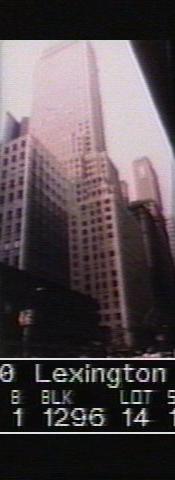
The city photographed every building for its tax records around 1940 and again in the 1980s. NYC Municipal Archives.
Written with AI from the source each entry cites, then fact-checked.
- 1927
Crews clear the Manhattan Storage Warehouse, whose five-foot walls were built against burglary, fire and assault
Before the tower, the site held the Manhattan Storage Warehouse, built in 1882. Its walls, five feet thick, were built to withstand burglary, fire and assault, which made the building hard to remove. Hauling away the debris took 7,500 truckloads of brick, plus 1,000 of scrap metal and 3,500 of dirt, and 60 percent of the warehouse was already gone when the tower's plans were filed in June 1927.
“The warehouse itself was difficult to clear, since its 5-foot-thick walls had been designed to protect against "burglary, fire and assault".”
Source: Wikipedia
- 1928
Two gold rivets mark the finished steel frame of the Chanin Building
The Chanins marked the finished steel frame on July 2, 1928 in their customary way, by driving two gold rivets into a column at the top floor. The tower was finished on January 23, 1929, a year to the day after Irwin S. Chanin set the first rivet in the frame, a pace the Landmarks Commission's report credits to the workmen's skill and the efficiency of the Chanin Construction Company.
“When the steel structure work was completed on July 2, 1928, the Chanins followed their traditional practice of driving two gold rivets into a column on the uppermost floor.”
- 1929
Irwin Chanin opens his 56-story Art Deco tower at Lexington and 42nd
Developer Irwin S. Chanin built this tower on the site of the Manhattan Storage Warehouse with the firm Sloan & Robertson, while Jacques Delamarre and sculptor René Paul Chambellan shaped its Art Deco ornament. It opened on January 29, 1929, at a cost of $12 to $14 million, and at 680 feet it became the third-tallest building in New York. It was designated a city landmark in 1978.
Source: Wikipedia
- 1929
A 200-seat theater opens on the tower's 50th floor
Chanin included a 200-seat auditorium on the 50th floor, decorated in black and silver. It was used for films, plays, concerts and radio broadcasts as well as tenant meetings and conventions. Two floors up, Chanin's own offices were entered through wrought-iron gates by Chambellan decorated with industrial motifs.
Source: Wikipedia
- 1929
Martin Lewis etches the lit Chanin tower glowing over tenement yards
In 1929 the artist Martin Lewis completed a drypoint etching called Glow of the City. It sets the dark steeple of a 19th-century church against the illuminated Chanin Building on East 42nd Street, which Ephemeral New York says would have been newly opened. A woman dressed in an Art Deco style looks up at the tower across tenement backyards and laundry lines, and the skyscraper casts its glow over her world.
Source: Ephemeral New York
- 1929
Critic Matlack Price hails the new Chanin Building as a lasting contribution to architecture
Once the tower was finished, the critic Matlack Price assessed it in the May 1929 Architectural Forum. He said it was a fine contribution to twentieth-century architecture, and, because its design was sound, to architecture of all time. He also credited it with working out the novel features of the new style. The Landmarks Preservation Commission later cited his praise in its 1978 designation report.
“…praised by Matlack Price as a splendid contribution to twentieth century architecture ... a splendid contribution to the architecture of all time because it is a good design…”
- 1929
A Baltimore and Ohio bus terminal with a revolving turntable fills the Chanin lobby
When the tower opened, its lobby space held a bus terminal run by the Baltimore and Ohio Railroad, fitted out with marble surfaces, waiting rooms and ticket offices. Buses drove onto a revolving turntable that took on boarding passengers on one side and let arriving ones off on the other. The railroad ended all its passenger service north of Baltimore in 1958, and the bus terminal closed after that.
“Buses would pull onto a revolving turntable within the terminal, which received boarding passengers on one side and deposited alighting passengers on the other.”
Source: Wikipedia
- 1939
Shipwreck Kelly stands on his head atop the Chanin Building for donut week
Endurance stuntman Alvin 'Shipwreck' Kelly performs a headstand on a ledge of the Chanin Building in 1939 as a publicity stunt for National Donut Dunking Week, while assistants feed him doughnuts during the pose. Kelly had built a career balancing atop flagpoles and skyscrapers across the country. The stunt turns Irwin Chanin's Art Deco tower into a promotional backdrop a decade after it opened.
Source: Ephemeral New York
- 1941
Radio station WQXR-FM begins broadcasting from the Chanin Building's roof
WQXR-FM starts transmitting from an antenna on the Chanin Building's roof on December 15, 1941, using the 56-story tower's height to extend its signal across the city. The station's classical-music format finds a home in a building already known for its Art Deco crown lighting, whose 212 lamps could be seen more than 40 miles away. The rooftop installation ties the tower to New York's early FM radio history.
Source: Wikipedia
- 1964
Barry Goldwater's presidential campaign sets up its New York state headquarters in the Chanin Building
In 1964 the Chanin Building became the New York state headquarters of Barry Goldwater's presidential campaign. Other postwar tenants included the firm Guest Keen and Nettlefolds and a Howard Johnson's restaurant, and the building hosted U.S. Chess Championships. Its owners were later charged with real-estate tax fraud, in 1974.
“…continued to attract tenants such as ... the Barry Goldwater 1964 presidential campaign's New York state headquarters. In addition, the building hosted U.S. Chess Championships.”
Source: Wikipedia
- 1978
The city designates the Chanin Building a landmark
New York City designates the Chanin Building an individual landmark on November 14, 1978, protecting Sloan & Robertson's Art Deco tower and Rene Paul Chambellan's bronze and terra-cotta ornament. The building is added to the National Register of Historic Places two years later, in 1980. The designation comes decades after Irwin Chanin's tower first opened at Lexington Avenue and 42nd Street.
Source: Wikipedia
Further reading
- Chanin BuildingWikipedia
- The glow of the city on a Depression-era summer nightEphemeral New York
- The Skyscraper Daredevil dangles over MidtownEphemeral New York
- A daredevil stuntman on a 42nd Street skyscraperEphemeral New York
- “The Glow of the City,” 1929Ephemeral New York
- A 42nd Street skyscraper’s leaf motifEphemeral New York
Nearby
- Bowery Savings Bank Building110 East 42nd Street | 12 entries
- Pershing Square Building125 Park Avenue | 13 entries
- Grand Hyatt New York109 East 42nd Street | 12 entries
- 101 Park Avenue9 entries
- Socony-Mobil Building150 East 42nd Street | 11 entries
- Chrysler Building405 Lexington Avenue | 20 entries