Manhattan Plaza
407 West 42nd Street | also 402 West 43rd Street, 411 West 42nd Street, 587 9th Avenue | Hell's Kitchen | built 1976
Open on the map14 entries

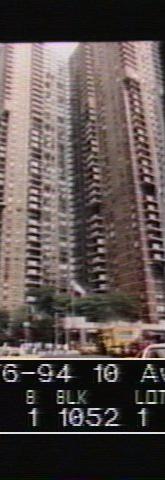
The city photographed every building for its tax records around 1940 and again in the 1980s. NYC Municipal Archives.
Written with AI from the source each entry cites, then fact-checked.
- 1974
Construction begins on Manhattan Plaza as market-rate towers
Developer Richard Ravitch's HRH Construction breaks ground on two 45-story towers, planned as middle- and upper-middle-class rentals under the state's Mitchell-Lama program with a $95 million city mortgage. A recession and the decline of the surrounding Times Square area make the market-rate plan unworkable, and the city can fund only $65 million of its pledged share.
Source: Wikipedia
- 1977
Manhattan Plaza opens as subsidized housing reserved mostly for performing artists
Begun in 1974 as middle- and upper-middle-class rentals, the project was upended by the city's fiscal crisis. Instead it opened in 1977 as Section 8 housing, with 70 percent of apartments reserved for people working in the performing arts. Residents have included Tennessee Williams, Samuel L. Jackson, Alicia Keys and Larry David. When AIDS struck, the complex lost many residents, and Rev. Rodney Kirk set up care programs with the Actors' Fund.
Source: Wikipedia
- 1977
The Board of Estimate approves performer housing at Manhattan Plaza, with a condition attached
On the night of February 3, 1977, the city's Board of Estimate voted to let most of the troubled Manhattan Plaza complex near Times Square become housing for people in the performing arts. In an unusual step, it made its approval depend on a favorable report from Comptroller Harrison J. Goldin on the city's effort to make sure the developers did not make major profits.
Source: The New York Times
- 1977
Ellington saxophonist Russell Procope gets his Manhattan Plaza apartment key from Mayor Beame
Russell Procope, who played saxophone with Duke Ellington's orchestra for 28 years and still worked, was one of the moving spirits behind the complex's Christmas celebration. He told the Times that Manhattan Plaza was the first place he had lived where he was the first to occupy the apartment, and that Mayor Beame had given him the key. The same article noted that the first tenant moved in on June 1.
Source: The New York Times
- 1978
Residents form an orchestra, choruses and a puppet workshop within months of moving in
By early 1978 all 1,688 units were rented, and residents had already started a chamber orchestra, two choral groups, a jazz ensemble, a children's puppet workshop and at least one acting company. Neighbors looked out for one another: after the snowstorm of January 19 and 20, younger residents phoned and shopped for elderly ones. Director Rodney Kirk said two networks had asked about a television series based on life in the towers.
Source: The New York Times
- 1981
Alicia Keys, born in 1981, grows up with her mother in a one-bedroom apartment
Alicia Keys was born on January 25, 1981 in Hell's Kitchen and raised during her formative years by her mother, Teresa Augello, a paralegal and part-time actress, at Manhattan Plaza. The two shared a one-bedroom apartment, and her mother often worked three jobs. Keys has said that growing up in the city, with its mix of hardship and opportunity, influenced her music.
“She was subsequently raised by her mother during her formative years at Manhattan Plaza in Hell's Kitchen.”
Source: Wikipedia
- 1983
Steve Olsen opens the West Bank Cafe's basement theater bar at the base of Manhattan Plaza
West Bank Cafe owner Steve Olsen opened the Downstairs Theater Bar in 1983 in the basement of the cafe, at the base of the Ninth Avenue tower. Bruce Willis was a bartender in the restaurant, and Tennessee Williams, Arthur Miller and Sean Penn were regulars. Playwright Lewis Black, Rand Foerster and Rusty Magee pitched putting on plays there, and the room has hosted over 1,500 one-act plays.
“The theater was opened in 1983 by the West Bank Cafe owner Steve Olsen.”
Source: Wikipedia
- 1997
Rodney Kirk retires after twenty years as the complex's first director
The Rev. Rodney Kirk, an Episcopal priest who had worked at the Cathedral of St. John the Divine, was Manhattan Plaza's first director and ran it until he retired in 1997. He rallied community support so that hundreds of older neighborhood residents could stay in their apartments, and he responded to the high rate of HIV and AIDS among tenants by starting the Manhattan Plaza AIDS Project. He died in 2001 at age 67.
Source: The New York Times
- 2002
The rent formula caps what a tenant pays even after a $1 million Hollywood year
The Times explained in 2002 how rents worked: because theater income swings, tenants pay according to projected annual income, and even a resident who earned $1 million in a year could not be charged more than the market rate. Just under 1,200 apartments drew $11 million in federal subsidies in 2001, and the lowest monthly rent paid in the previous year was $125. Applicants had to have earned 51 percent of their income in the business for the prior three years, but once admitted they could stay for life.
Source: The New York Times
- 2004
Tenants and new owner Related reach a deal to preserve the subsidized rents
After Related Companies contracted to buy the complex, hundreds of anxious residents packed tenant meetings, and officials including Representative Jerrold Nadler and Councilwoman Christine Quinn got involved. On September 13, 2004, the tenants and Related announced an agreement protecting the complex's subsidized rents. Under it, the roughly 170 apartments under Mitchell-Lama rules would face annual increases capped at 4.5 percent.
Source: The New York Times
- 2009
A new rooftop playground sponsored by Tiki Barber opens on the third floor
In mid-March 2009 the original playground on the third-floor rooftop was taken down to make way for a new one built by Kompan, with former football player Tiki Barber as sponsor. The new equipment has electronic settings and interactive virtual games built into it. The playground officially opened on June 8, 2009.
Source: Wikipedia
- 2014
Joan Rivers gives her last performance at the West Bank Cafe's theater
On August 27, 2014, Joan Rivers took the stage for the last time at the Laurie Beechman Theatre, the 90-seat basement dinner theater beneath the West Bank Cafe. The next day she suffered a cardiac arrest because of complications in a vocal-cord procedure, and she died on September 4. Rivers had often performed in the room.
“On August 27, 2014, Joan Rivers gave her final performance at the theater.”
Source: Wikipedia
- 2017
The documentary Miracle on 42nd Street premieres, with Alicia Keys and Larry David among former tenants
Alice Elliott's documentary about Manhattan Plaza, narrated by Chazz Palminteri, opened at the Doc NYC festival in November 2017. It features interviews with former residents including Alicia Keys, Larry David, Terrence Howard and Donald Faison, as well as Samuel L. Jackson, who worked at the complex as a doorman. The film later took the 2020 New York Emmy for best documentary.
“The film opened in November 2017 at the Doc NYC film festival…”
Source: Wikipedia
- 2020
The West Bank Cafe holds a Christmas telethon with Al Pacino and Matthew Broderick to stay open
On Christmas Day 2020 the cafe put on a telethon to raise money to keep its doors open. Performers included Matthew Broderick, Al Pacino, Betty Buckley, Nathan Lane, Andre De Shields, Pete Townshend and Manhattan Borough President Gale Brewer. The $250,000 target was reached within the first ninety minutes of the show.
“The telethon raised its target of $250,000 within the first ninety minutes of the show.”
Source: Wikipedia
Further reading
- Manhattan PlazaWikipedia
Nearby
- Westside Theatre407 West 43rd Street | 11 entries
- Playwrights Horizons416 West 42nd Street | 9 entries
- Stage 42420 West 42nd Street | 6 entries
- The Actors Studio432 West 44th Street | 12 entries
- The Orion350 West 42nd Street | 3 entries
- Holy Cross Church331 West 42nd Street | 4 entries