The Actors Studio
432 West 44th Street | Hell's Kitchen | built 1858
Open on the map12 entries

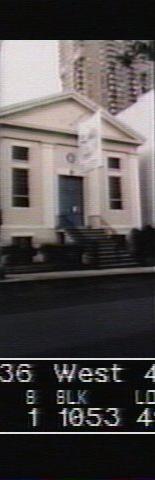
The city photographed every building for its tax records around 1940 and again in the 1980s. NYC Municipal Archives.
Written with AI from the source each entry cites, then fact-checked.
- 1859
The Seventh Associate Presbyterian Church builds a Greek Revival church on West 44th Street
The Greek Revival building at 432 West 44th Street was built in 1858 or 1859 for the Seventh Associate Presbyterian Church. Nearly a century later it became home to the Actors Studio, and the Landmarks Preservation Commission designated it a city landmark in 1991.
Source: Wikipedia
- 1900
The Seventh Associate Presbyterian congregation peaks at 225 members
The working-class congregation that built the church had 55 members in 1857 and 89 a year later, and it kept growing. Its largest roll, 225 members, came in 1900, during the long pastorate of H. H. Wallace, who held the post from 1886 to 1925, longer than any other minister. After 1900 the membership declined.
- 1944
The church congregation disbands two years after its last minister leaves
The Seventh Associate Presbyterian Church lost its last minister, J. C. White, in 1942, and the congregation was officially dissolved in 1944. It had met on West 44th Street since the late 1850s. Foreclosure on the property followed in 1945.
“The last minister, J. C. White, left in 1942 and the congregation was officially disbanded in 1944.”
- 1945
The former church becomes Antoinette Perry's acting school
After the Seventh Associate Presbyterian Church dissolved in 1944 and its building went to a bank in foreclosure, the American Theatre Wing leased the West 44th Street church in 1945 to run an acting school under director Antoinette Perry. A decade later the Actors Studio moved into the same building.
Source: Daytonian in Manhattan
- 1951
A foundation for disabled amputees buys the former church for a trade school
After a few years as an acting school, the building was sold in 1951 to the National Amputation Foundation. The foundation ran a school on the premises that taught trades to its disabled members. Four years later the property changed hands again, passing to the Actors Studio, which has used it ever since.
“In 1951 it was sold to the National Amputation Foundation, which also maintained a school on the premises, to teach trades to its disabled members.”
- 1955
The Actors Studio moves into the former church on West 44th Street
Founded in October 1947 by Group Theatre veterans Elia Kazan, Cheryl Crawford and Robert Lewis, the Actors Studio settled at 432 West 44th Street in 1955. Lee Strasberg directed it from 1952 until his death in 1982, and the studio became known for refining method acting, drawn from Konstantin Stanislavsky's teachings. Marlon Brando was among its first group of 50 members, chosen from about 700 actors who auditioned in its first year.
Source: Wikipedia
- 1955
A small brick stair wing is added beside the church in the year the Actors Studio buys it
A small brick addition on the east side of the church, with a steel doorway on the ground story, was built in 1955 to house a stairway. That was also the year the property was sold to the Actors Studio. The older part of the church keeps three bays defined by flat brick pilasters with Tuscan capitals under a low pediment, and the Landmarks Preservation Commission noted that the Studio uses it for classrooms.
“This section was built in 1955 to house a stairway.”
- 1967
Al Pacino gets into the Actors Studio on his second audition
Rejected once, Al Pacino reluctantly auditioned again in 1967 and, to his surprise, was accepted. He was so frightened that six months passed before he showed any work, and then he performed two monologues, one as Hickey and one as Hamlet. Lee Strasberg looked at his card, asked where he came from, and remarked that the Studio admitted all kinds. The Studio had been working out of the former church on West 44th Street since 1955.
Source: The New York Times
- 1982
Lee Strasberg, longtime Actors Studio director, dies
Lee Strasberg, who had led the Actors Studio since 1952 and turned Method acting into an American institution, died on February 17, 1982. Under his direction the West 44th Street studio trained performers including Marlon Brando, Marilyn Monroe, Paul Newman and Dustin Hoffman after it moved into the former church building in 1955.
Source: Wikipedia
- 1988
Frank Corsaro becomes the Actors Studio's first salaried artistic director
On April 7, 1988, Ellen Burstyn, the departing artistic director, and board president Paul Newman announced that Frank Corsaro, a New York City Opera director for more than two decades, would lead the Actors Studio. He became its first full-time, paid artistic director and was asked to emphasize new work. The choice followed turmoil that included canceled fall workshops, complaints of stagnation, and a court fight with Lee Strasberg's widow, Anna, over tapes of his workshops.
Source: The New York Times
- 1991
The city designates the Actors Studio building a landmark
New York City designated the former church at 432 West 44th Street a landmark on February 19, 1991, protecting the Greek Revival building the Actors Studio had occupied since 1955. The building started out in the 1850s as the home of the Seventh Associate Presbyterian Church before passing through use as a trade school for disabled workers.
Source: Wikipedia
- 2000
Pacino, Burstyn and Keitel become co-presidents of the Actors Studio
In June 2000 the Actors Studio named three board members, Al Pacino, Ellen Burstyn and Harvey Keitel, as co-presidents, all volunteering their services. They replaced Arthur Penn, who left to be executive producer of Law and Order and stayed on as president emeritus, while Estelle Parsons remained artistic director. Parsons said the aim was to pass to a younger generation a workshop free of commercial pressure, and the Studio then counted more than 900 members in New York and Los Angeles.
Source: The New York Times
Further reading
- Actors StudioWikipedia
- The Actor's Studio - 432 West 44th StreetDaytonian in Manhattan
Nearby
- Westside Theatre407 West 43rd Street | 11 entries
- Manhattan Plaza407 West 42nd Street | 14 entries
- Film Center Building630 9th Avenue | 4 entries
- Playwrights Horizons416 West 42nd Street | 9 entries
- Stage 42420 West 42nd Street | 6 entries
- MiMA570 10th Avenue | 3 entries