41 Worth Street Building
41 Worth Street | also 39 Worth Street | Tribeca | built 1915
Open on the map5 entries

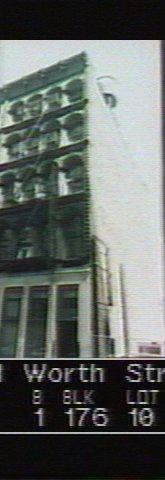
The city photographed every building for its tax records around 1940 and again in the 1980s. NYC Municipal Archives.
Written with AI from the source each entry cites, then fact-checked.
- 1821
The Eclipse House porterhouse opens in a frame house on the lot
A frame house went up on this lot sometime after 1802. In 1821 it became a porterhouse, first run by Jacob Rich and then, from about 1829, by Edward D. Cooper, who stayed until at least 1835. For part of that time it was called the Eclipse House, and Fifth Ward men held political meetings there. By the 1840s and 1850s the property had a mix of tenants, among them African Americans.
- 1865
Dry goods merchant Philo Laos Mills replaces two old buildings with a cast-iron store and loft
Philo Laos Mills, a New York-born dry goods merchant, took control of 41 Worth Street in 1862; his family had held it since 1841. In 1865 he and John Gibb founded the dry goods firm Mills & Gibb, and around then he replaced the two older buildings on the lot with a five-story store-and-loft building designed by Isaac F. Duckworth. By early 1866 Mills had sold it to the Brooklyn merchants Samuel and Abraham Wood, and the Wood family kept it until 1954.
- 1865
Isaac F. Duckworth gives 41 Worth Street a Venetian-style cast-iron front made by Badger's foundry
The facade of 41 Worth Street was cast by Daniel D. Badger's Architectural Iron Works. Duckworth's Venetian-inspired Italianate design stacks single-story arcades of round-arched windows, framed with rope moldings and keystones and carried on fluted columns. The spandrels were cast to look like rough-cut masonry, and a balustrade course marks the second story. The Landmarks Preservation Commission calls it, with 39 Worth next door, a rare survivor of an 1860s cast-iron loft building south of Canal Street.
- 1918
H. W. Baker Linen Company founder Hiram Baker dies a day after falling ill at the hotel men's exposition banquet
The H. W. Baker Linen Company took over the whole building at 41 Worth Street in 1911. Hiram Wilson Baker had bought out his partner in 1902 to establish the firm, which made commercial linens for hospitals and hotels. In December 1918 the firm had one of the biggest booths at the National Hotel Men's Exposition in Madison Square Garden. On December 20 Baker fell ill during the exposition's banquet at the Hotel Biltmore, and he died at home the next morning, aged 56.
Source: Daytonian in Manhattan
- 1981
The upper floors of 41 Worth Street become cooperative apartments
Textile firms kept leasing space at 41 Worth Street into the early 1970s, and Marcus Brothers, cotton goods converters, had rented the whole building from 1939 until at least 1954. As residents began moving into vacated lofts south of Canal Street, the upper floors were being lived in by 1975. The building was converted to cooperative residences in 1981 and was designated a city landmark in 2013.
Further reading
- Isaac F. Duckworth's 1865 41 Worth StreetDaytonian in Manhattan
- Isaac Duckworth's Cast Iron 39 Worth StreetDaytonian in Manhattan
Nearby
- 39 Worth Street Building39 Worth Street | 5 entries
- New York Law School52 Leonard Street | 6 entries
- 47 Worth Street5 entries
- 175 West Broadway Building (Harwood & Son)175 West Broadway | 7 entries
- 56 Leonard Street10 entries
- Cone Export Company Building57 Worth Street | 5 entries