175 West Broadway Building (Harwood & Son)
175 West Broadway | Tribeca | built 1877
Open on the map7 entries

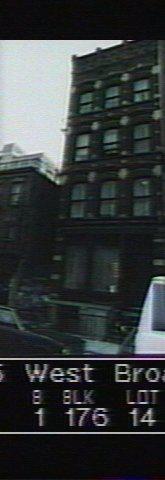
The city photographed every building for its tax records around 1940 and again in the 1980s. NYC Municipal Archives.
Written with AI from the source each entry cites, then fact-checked.
- 1802
Clockmaker Effingham Embree's tract is divided and a frame house stands at 175 West Broadway
The site was part of a sixteen-acre tract bought in 1795 by the clockmaker Effingham Embree, who began selling lots after 1797, when the city opened streets here. Carpenter Isaac Sharples bought eleven lots on the block and in 1802 sold numbers 175 and 177 to different buyers. A frame dwelling stood on number 175, with an outbuilding at the back, perhaps a stable, reached by an alley that survives today.
“In 1802, Sharples sold 175 and 177 West Broadway to separate owners. At that time there was a frame dwelling at 175 West Broadway…”
- 1869
Plaster dealer Jerome B. King buys 175 West Broadway
Jerome B. King acquired 175 West Broadway in 1869. Born in Saratoga County around 1805, he had run wood-planing businesses in Newark and Greenwich Village, begun dealing in plaster in 1843 and by 1850 founded the Knickerbocker Plaster Mill on West Street. He became one of the country's most successful cement and plaster dealers, handing the firm to his sons in the 1860s. After his death in 1875 his widow held a life interest in his real estate, including this property.
“It was in 1869, during this period of expansion, that Jerome B. King acquired the property at 175 West Broadway.”
- 1873
Samuel Harwood's awning firm leases the old frame house that stood on the lot of 175 West Broadway
The frame house that stood here before the present building had held a liquor store in the 1850s and a coal company's office in the 1860s. In 1873 it became the headquarters of Samuel A. Harwood's awning firm, which he had started on Chatham Street in 1860. Harwood leased it until 1877, when the owners decided to put up a new brick building, and he moved his retail division to a building across the street.
- 1877
Scott & Umbach build a polychrome brick office building for the King heirs
In 1877 the heirs of Jerome B. King hired the Newark firm Scott & Umbach to design a new building here. The brick facade uses contrasting stone to mark points of structural stress and window heads built up from several courses of dentils. The stepped, bracketed brick cornice is, in the Landmarks Commission's judgment, without parallel in New York architecture.
- 1905
Harwood & Son wins a city contract for 200 voting booth covers
In 1905 Harwood & Son, led by Warren Harwood since his father Samuel died in 1903, was the successful bidder to furnish the city with 200 voting booth covers. The job paid $312, or $1.56 a cover. From 175 West Broadway the firm also ran a mail-order business selling tents, tarpaulins and horse and cart covers, while three trunk makers rented space in the building.
Source: Daytonian in Manhattan
- 1909
Warren Harwood buys the building his family's firm had rented
In 1909 Warren Harwood bought 175 West Broadway, which his firm had been leasing from the King family. Harwood & Son stayed another half century, leaving in the 1950s, but the family kept the building until 1972, when a descendant sold it. By 2014 an architectural design firm occupied the space where striped canvas awnings were once shown.
Source: Daytonian in Manhattan
- 1991
The Landmarks Commission designates the building after nine witnesses speak in favor
On November 12, 1991, the Landmarks Preservation Commission designated the 175 West Broadway Building and its lot as a landmark. At the September 1989 hearing, nine people testified in support, two of them speaking for the owner, and no one opposed. The commission's summary called the small office building an exceptional example of polychromatic brick design from the late nineteenth century.
Further reading
- 175 West BroadwayWikipedia
Nearby
- 39 Worth Street Building39 Worth Street | 5 entries
- 41 Worth Street Building41 Worth Street | 5 entries
- New York Law School52 Leonard Street | 6 entries
- 47 Worth Street5 entries
- H. B. Claflin & Co. Annex71 Thomas Street | 3 entries
- 56 Leonard Street10 entries