Morrison & Boinest Co. Building
413 Greenwich Street | also 19 Hubert Street | Tribeca | built 1889
Open on the map6 entries

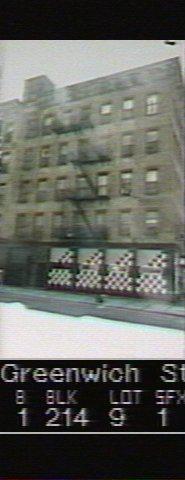
The city photographed every building for its tax records around 1940 and again in the 1980s. NYC Municipal Archives.
Written with AI from the source each entry cites, then fact-checked.
- 1883
J. A. Pilkington still runs a saloon in the old corner house in 1883, six years before it is replaced
Before the present building, the southeast corner of Greenwich and Hubert Streets held an old two-and-a-half-story house in the Federal style, converted to commercial use. As late as 1883 J. A. Pilkington ran a saloon in it. In 1889 the owner A. A. Shaw hired architect William B. Pope to replace it with a five-story brick store costing $25,000.
Source: Daytonian in Manhattan
- 1889
William B. Pope designs a plain cast-iron and brick store and loft building for Mrs. A. A. Shaw
The Landmarks Preservation Commission describes 413 Greenwich Street as a five-story store and loft building at the corner of Greenwich and Hubert Streets, commissioned in 1889 by Mrs. A. A. Shaw. Pope kept it utilitarian like its neighbors, with red brick, sandstone lintels and a sheet-metal cornice. In the 1890s it stored carpets, probably for the W. & J. Sloane Company next door or for a carpet dealer on Hubert Street.
“Commissioned in 1889 by Mrs. A.A. Shaw, the building was designed by William B. Pope to be utilitarian in appearance…”
- 1901
Morrison & Boinest forms to roast coffee and grind spices for other firms
After coffee roaster Frederick Akers died in 1901, two longtime employees, William J. Morrison and Walter B. Boinest, founded Morrison & Boinest Co. to continue the work. The company roasted imported beans and ground spices for the trade only. A 1904 advertisement said it neither bought nor sold coffee. Its painted signs on the brick walls can still be read.
Source: Daytonian in Manhattan
- 1928
One of the last coal-fired coffee roasting plants in the city is torn out for gas roasters
For nearly three decades, the roasting kilns at 413 Greenwich Street burned coal. In 1928 the Tea & Coffee Trade Journal reported that the plant, one of the last wholesale roasting operations in New York City still using coal, had been removed. Modern gas-fired roasters of the Jubilee Premix type took its place.
Source: Daytonian in Manhattan
- 1947
Police raid a printing shop here as part of a lottery ring said to take in $5 million a week
Gander Printing Company, a tenant at 413 Greenwich Street, was raided on April 19, 1947. Fifty plainclothes officers hit locations across the city at the same moment in a crackdown on an illegal lottery drawn in Italy each Friday. At the Greenwich Street shop they arrested seven men and seized 14,000 printed lottery results, plates and books.
Source: Daytonian in Manhattan
- 1972
The Front Porch opens in the butter and egg district with a Trucker's Special
The Front Porch restaurant opened on the ground floor in the fall of 1972, announcing itself as a newcomer to the Butter and Egg District. Its menu included meat pies for breakfast and a lunch special aimed at the many truckers still working in the area. Upstairs, a kitchen and bakery turned out soups, stews, breads and desserts. Manhattan South followed in 1983, and Sweetgreen occupies the space today.
Source: Daytonian in Manhattan
Further reading
- The Morrison & Boinest Co. Bldg - 413 Greenwich StreetDaytonian in Manhattan
Nearby
- 17 Hubert Street2 entries
- 407 Greenwich Street3 entries
- 11 Hubert Street3 entries
- 405 Greenwich Street2 entries
- 401 Greenwich Street3 entries
- 10 Hubert Street5 entries