Public School 39 (Henry Bristow School)
417 6th Avenue | Park Slope | built 1877
Open on the map5 entries

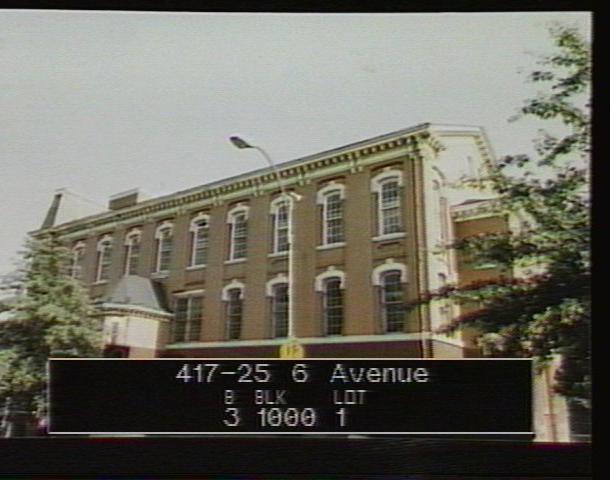
The city photographed every building for its tax records around 1940 and again in the 1980s. NYC Municipal Archives.
Written with AI from the source each entry cites, then fact-checked.
- 1877
Public School 39 opens with Harriet N. Morris as its first principal
The Board of Education bought the corner of Sixth Avenue and Eighth Street from George Riggs in March 1876 and began the school that year. It opened for classes in 1877 under its first principal, Harriet N. Morris, taking in pupils from Primary School 2, which had been meeting in Henry Bristow's house across the street. Enrollment grew from about 300 in the spring to roughly 840 in the fall of its first year.
“The school, which was begun in 1876, opened for classes in 1877 under the leadership of its first principal, Harriet N. Morris.”
- 1877
Public School 39 follows Public School 37's design and divides each floor with rolling doors
The Landmarks Preservation Commission believes the Board of Education's building superintendent, Samuel B. Leonard, designed the school. It was modeled on Public School 37, built a year earlier, and the two have nearly identical designs. Each floor held two open spaces that rolling doors could split into three classrooms apiece.
“It was modeled after Public School 37 which had been built the year before. Both buildings have nearly identical designs…”
- 1916
The school is named for local politician Henry Bristow
In 1916, as part of a citywide program honoring local civic leaders, the school took the name of Henry Bristow (1840-1906). Bristow served as president of the 22nd Ward, sat on the Brooklyn Board of Education in the 1880s and was elected to Congress from the 6th District in 1900. Primary School 2, whose pupils moved into the new building, had first been organized in his house.
“In 1916 the school was named after the late Henry Bristow ( 1840-1906), as part of a new citywide program to honor local civic leaders.”
- 1963
Fire code forces the school to remove its rolling classroom doors
Public School 39's rolling doors, which let each floor's open space be split into classrooms, had to come out in 1963 to meet fire code requirements. The landmark report notes that the idea of flexible classroom size became widely advocated in the 1960s.
“In 1963, Public School 39 was forced to remove its rolling doors in order to comply with fire code regulations.”
- 1977
Sixteen witnesses back landmark status for the school at its hearing
At the Landmarks Preservation Commission hearing on January 11, 1977, sixteen witnesses spoke in favor of designating Public School 39, among them the City Council's majority leader, Thomas Cuite, and a group of pupils, teachers and parents. No one spoke in opposition. The commission named it a landmark that year, calling it one of the few schools of its period still used for its original purpose.
“Sixteen witnesses, including City Council Majority Leader Thomas Cuite and a delegation of students, faculty, and parents from the school, spoke in favor of designation.”
Further reading
- Public School 39Wikipedia
Nearby
- Park Slope Library431 6th Avenue | 7 entries
- Greenwood Baptist Church461 6th Street | 2 entries
- NewYork-Presbyterian Brooklyn Methodist Hospital506 6th Street | 3 entries
- John Jay Educational Campus237 7th Avenue | 2 entries
- William B. Cronyn House271 9th Street | 5 entries
- Park Slope Community Church251 12th Street | 5 entries