Park Slope Library
431 6th Avenue | also 441 6th Avenue | Park Slope | built 1906
Open on the map7 entries

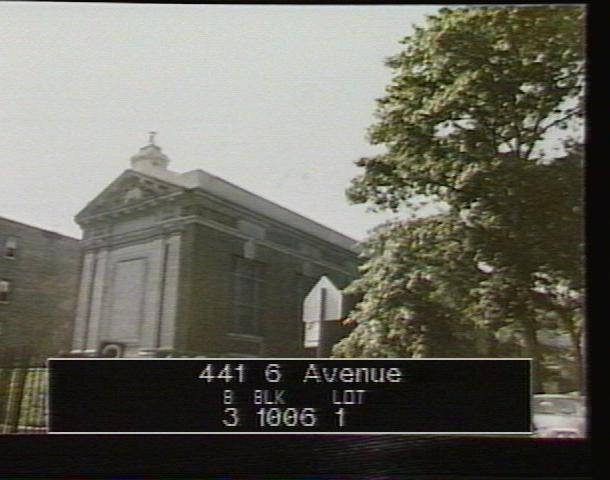
The city photographed every building for its tax records around 1940 and again in the 1980s. NYC Municipal Archives.
Written with AI from the source each entry cites, then fact-checked.
- 1904
The city buys a larger Sixth Avenue site after the South Brooklyn Board of Trade covers half the land
Two properties were first approved for Park Slope's Carnegie branch, one near Sixth Avenue and 7th Street and the larger lot between 8th and 9th Streets. The smaller one would have cost less, and its owner was politically well connected. The South Brooklyn Board of Trade arranged local contributions to cover half the larger lot's price, so the city bought it in 1904.
- 1906
Thousands crowd the opening of the Prospect Branch, the ninth Carnegie library in Brooklyn
The branch opened in July 1906 as the ninth of Brooklyn's Carnegie libraries, with David Boody of the Carnegie Committee presiding. A local paper reported that the building was crowded to overflowing and called it the most pretentious of the Carnegie gifts. The library had begun in 1900 as a traveling nature collection at Litchfield Villa in Prospect Park.
- 1906
Raymond Almirall gives the Park Slope library a Doric portico and torch-carved keystones
Raymond F. Almirall designed the T-shaped brick and stone library. Four Doric columns carry its entrance portico, whose parapet reads Brooklyn Public Library, Established 1897, and a transom is incised Prospect Branch. Torches, standing for the light of learning, are carved on the keystones, and each end pediment holds a carved open book.
- 1916
The library shuts for three months during a polio epidemic
In its early years the library was open every day of the year until 9 P.M. In 1916 it shut its doors from July through September, a precaution against a polio epidemic.
“During its early years it was open 365 days a year, until 9 P.M. each day. For health reasons, the building was closed from July through September 1916 during a polio epidemic.”
- 1948
Neglect forces the library to close for a year and a half of major repairs
Neglect in the 1940s left the library in need of major repairs, and it shut between January 1948 and July 1949. Earlier in that decade its entrance, steps and platforms had been rebuilt, and the iron fence around the building appears to date from the same period.
“Neglect to the building in the 1940s led to its closure for major repairs from January 1948 until July 1949.”
- 1978
The library is emptied for three years of total rehabilitation
After more repairs were put off in the 1970s, the building was badly deteriorated and was vacated from 1978 through 1981. New heating, cooling and plumbing systems went in, and the walls and roof were repaired. It reopened in June 1981 with new furnishings, keeping original fireplaces and wall paneling.
“From 1978 through 1981 it was vacated for total rehabilitation. ... In June 1981, the library was reopened with new furnishings…”
- 1998
The Landmarks Preservation Commission designates the Park Slope Branch a city landmark
The Landmarks Preservation Commission designated the library an individual landmark on October 13, 1998, after a public hearing on April 21. A representative of the library and three other speakers urged designation, and no one spoke against it. The report calls the building a focal point for the Park Slope community.
“On April 21, 1998, the Landmarks Preservation Commission held a public hearing ... A representative of the library spoke in favor of designation. There were three additional speakers in favor…”
Nearby
- Public School 39 (Henry Bristow School)417 6th Avenue | 5 entries
- Greenwood Baptist Church461 6th Street | 2 entries
- NewYork-Presbyterian Brooklyn Methodist Hospital506 6th Street | 3 entries
- William B. Cronyn House271 9th Street | 5 entries
- John Jay Educational Campus237 7th Avenue | 2 entries
- Park Slope Community Church251 12th Street | 5 entries