George Washington Bridge Bus Station
4211 Broadway | also 4201 Broadway | Washington Heights | built 1963
Open on the map8 entries

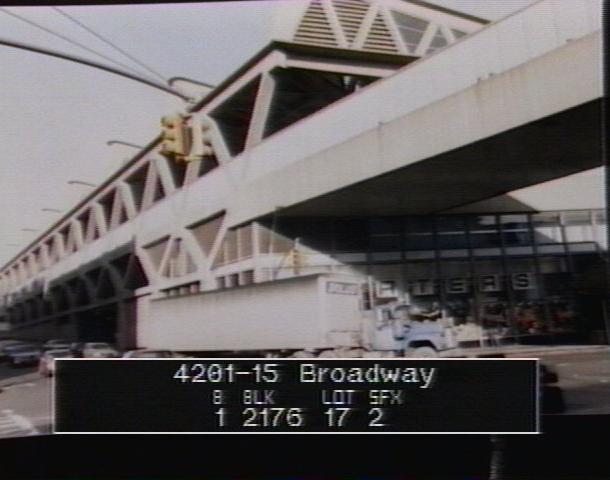
The city photographed every building for its tax records around 1940 and again in the 1980s. NYC Municipal Archives.
Written with AI from the source each entry cites, then fact-checked.
- 1957
The Port Authority announces a $12 million bus station and the 10,000 families it would displace
In February 1957 the Port Authority announced plans for a $12 million terminal at the bridge, able to handle 255 buses an hour and carry 70 percent more interstate buses over the crossing. Making room meant relocating 10,000 families for the terminal and its ramps, which drew objections from the local congressman, Herbert Zelenko. The city planning commission approved the plan in June 1957 on the condition that the terminal be enclosed.
“The Port Authority would have to relocate 10,000 families to make way for the bus terminal and connecting ramps, prompting opposition from the area's U.S. representative, Herbert Zelenko.”
Source: Wikipedia
- 1960
The Port Authority hires Pier Luigi Nervi to design the bus terminal
In March 1960 the Port Authority hires Italian architect-engineer Pier Luigi Nervi to design a three-story bus terminal spanning the new Trans-Manhattan Expressway. His scaffolding-like concrete roof structure, built under a $9.6 million construction contract awarded that December, becomes the terminal's signature feature.
Source: Wikipedia
- 1963
Riders complain of cold, so the Port Authority orders a $200,000 retractable plastic membrane
Riders found the open-air terminal too cold, and in August 1963 the Port Authority approved a retractable plastic membrane costing $200,000. Glass walls and louvers were also installed against strong westerly winds, along with heated glass-and-aluminum canopies over the ten departure platforms.
Source: Wikipedia
- 1963
Nervi's roof of 14 concrete peaks earns the Concrete Industry Board's award
Pier Luigi Nervi worked with Port Authority chief engineer John M. Kyle on a three-level station whose roof rises in 14 wedge-shaped peaks, seven along each side, carried on a central row of concrete pillars. Louvers cast into the trusses vent bus exhaust and draw fresh air in. When the station was finished, the Concrete Industry Board gave it an award.
Source: wp2.docomomo-nytri.org
- 1963
Pier Luigi Nervi's bus station opens over the Trans-Manhattan Expressway
The Port Authority's terminal, designed by Italian engineer-architect Pier Luigi Nervi, opened on January 17, 1963, and was dedicated the next day by Governors Nelson Rockefeller of New York and Richard Hughes of New Jersey. Its roof of 26 triangular concrete sections rests on 14 cantilevered trusses; critic Ada Louise Huxtable called it "a work of the first rank."
Source: Wikipedia
- 2013
The long-promised renovation is put on hold again after the contractor changes
In July 2013 the Port Authority said the $183 million renovation was on hold after it and its development partner, GWB Development Venture LLC, switched contractors, with Tutor Perini hired to build it. Work had been slated to begin earlier that year, and Hurricane Sandy had pushed the start back further. The agency gave no new timeframe.
Source: dnainfo.com
- 2017
The bus station reopens after a long and costly renovation
A renovation approved in 2008 grew to $183 million. The station reopened on May 16, 2017, two years behind schedule and still unfinished. It handles about 20,000 passengers a day on roughly 1,000 buses.
Source: Wikipedia
- 2019
The bus terminal's renovation developer files for bankruptcy
Two years after the long-delayed renovation reopens the terminal, its developer, GWBBS Development Venture LLC, files for Chapter 11 bankruptcy in October 2019, following lawsuits over the project's cost overruns and construction delays. Aurora Capital Associates and Bridges Development Group later acquire the retail leasehold in December 2022.
Source: Wikipedia
Further reading
- George Washington Bridge Bus StationWikipedia
Nearby
- Holyrood Episcopal Church715 West 179th Street | 9 entries
- United Palace4140 Broadway | 13 entries
- Fort Washington Presbyterian Church21 Wadsworth Avenue | 5 entries
- K'hal Adath Jeshurun85 Bennett Avenue | 9 entries
- Highbridge Play Center and Pool2301 Amsterdam Avenue | 4 entries
- Fort Washington Avenue Armory216 Fort Washington Avenue | 11 entries