Holyrood Episcopal Church
715 West 179th Street | Washington Heights | built 1910
Open on the map9 entries

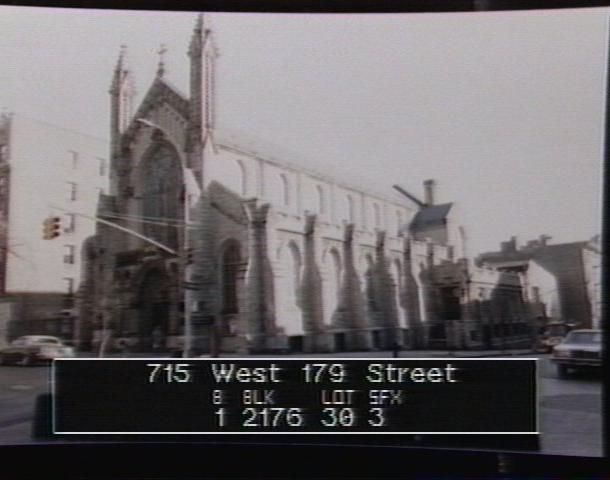
The city photographed every building for its tax records around 1940 and again in the 1980s. NYC Municipal Archives.
Written with AI from the source each entry cites, then fact-checked.
- 1893
The Rev. William Oliver Embury founds Holyrood parish, holding its first service in a rented storefront
The Rev. William Oliver Embury founded the Holyrood parish in 1893, which made it Manhattan's northernmost Episcopal parish. He knew the area as resident chaplain of the House of Refuge for Problem Girls in Inwood, an institution later called the Episcopal House of Mercy and run by the Community of St. Mary. The congregation's first service was on April 9, 1893, in a rented storefront at 182nd Street. In its early years the name was sometimes written Holy Rood, using the Old English word for cross.
- 1910
Holyrood's trustees agree to sell their Broadway church and plan a Gothic one on Fort Washington Avenue
Only fifteen years after the first church opened, apartment buildings had engulfed its Broadway and 181st Street site. On June 4, 1910, the Record & Guide reported that the trustees had voted to accept an offer for the property reported to exceed $200,000; the site had cost $30,000 fifteen years earlier. With the proceeds the congregation planned an English Gothic church, in the perpendicular manner, at the corner of 179th Street and Fort Washington Avenue. By September 1911 two-story brick buildings covered the old churchyard.
Source: Daytonian in Manhattan
- 1911
Bannister & Schell draw up a freestanding Gothic church patterned after England's Hereford Cathedral
In January 1911 the architects Bannister & Schell submitted plans to the rector, Stuart Crockett, and the trustees for an Early English Gothic church with an attached parish house and a chapel to follow on the lot to the north. Building began only in part, and a later parish vote to finish the nave and parish house, at a cost of about $55,000, called for a church seating 1,000. Its facade was to follow that of the cathedral at Hereford, England.
“…the facade being patterned after that of the Cathedral of Hereford, England…”
- 1912
The congregation holds its first service in the half-built church, in the chancel and transept
Holyrood's new building rose in stages. On April 28, 1912, the first service took place in a half-built church that had only its chancel, with the apse and transept, plus the parish house. By 1910 the congregation had outgrown its 15-year-old church on Broadway, which held only 200 people. When it moved, it carried along a wooden cross that had been part of the old sanctuary's furnishings.
“The first service was held April 28, 1912 in a partially constructed building consisting of the chancel (apse and transept) and parish house.”
- 1917
Holyrood Church is dedicated on All Saints Day, after construction drags on for years
The building was finally completed in 1916, and the church was formally dedicated on All Saints Day, November 1, 1917. The Gothic design follows the Decorated, or Geometric, phase of English medieval architecture, and the report likens it to the cathedral at Hereford. The architects chose glazed terra cotta over carved stone for the trim and sculptural features.
- 1919
Rector Gustav Carstensen, pushed out of a Bronx church for welcoming Black orphans, leads Holyrood
Gustav Carstensen became Holyrood's rector in 1919 and served until 1927, remaining at the parish with the title of rector emeritus until he died in 1941. At Christ Church in the Bronx he had let children from a nearby orphan asylum for Black children attend services, which caused an outcry and led the vestry to ask for his resignation. At Holyrood his liberal positions drew wide publicity, and he opposed Prohibition when many clergy backed it. He defended the parish's young people in the church and community.
- 1987
The Rev. Juan E. Irizarry, vicar from 1987, starts a homeless shelter at the parish
Holyrood began outreach to Spanish speakers in the 1960s under the Rev. Nicholas H. Holt, and regular Spanish-language services became part of parish life in the 1970s. The Rev. Juan E. Irizarry, from Puerto Rico, served as priest-in-charge and then vicar from 1987 to 1990 and started a homeless shelter at the church. In 1988 he chaired the Hispanic Commission's committee on mission and strategy for the Diocese of New York.
“He was the priest-in-charge and later the vicar at Holyrood from 1987 to 1990 during which time he also started a homeless shelter at the parish.”
- 2017
Rev. Luis Barrios begins leading Holyrood, which runs a food pantry and a bilingual, multiethnic congregation
The Rev. Luis Barrios, originally from Cuba, has led Holyrood Episcopal Church, also known as Iglesia Santa Cruz, since 2017. The parish describes itself as multicultural, multiracial, multiethnic and multigenerational. It has added neighborhood programs for young people, the elderly, LGBTQ people and those facing drug addiction or homelessness. Its food pantry expanded from one day a week to five, and the church now serves as a gathering place for young musicians.
- 2017
Holyrood grants sanctuary to a Guatemalan woman facing deportation
In 2017 Holyrood, a Washington Heights church founded in 1893, agreed to give sanctuary to a Guatemalan refugee facing deportation. Federal immigration authorities regard the woman as a fugitive. The building at 715 West 179th Street was designated a New York City landmark in 2021.
Source: Wikipedia
Further reading
- Holyrood Episcopal ChurchWikipedia
Nearby
- George Washington Bridge Bus Station4211 Broadway | 8 entries
- United Palace4140 Broadway | 13 entries
- Fort Washington Presbyterian Church21 Wadsworth Avenue | 5 entries
- K'hal Adath Jeshurun85 Bennett Avenue | 9 entries
- Highbridge Play Center and Pool2301 Amsterdam Avenue | 4 entries
- Fort Washington Avenue Armory216 Fort Washington Avenue | 11 entries