Poirier Building
429 Broome Street | SoHo | built 1859
Open on the map5 entries

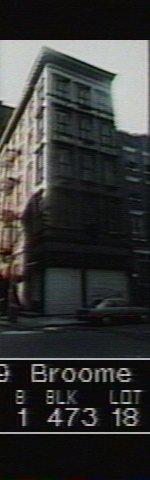
The city photographed every building for its tax records around 1940 and again in the 1980s. NYC Municipal Archives.
Written with AI from the source each entry cites, then fact-checked.
- 1859
Euphraisme Poirier replaces his family's house with a marble-fronted store at Broome and Crosby
Poirier family bought the 25-foot-wide residence around 1842, and Euphraisme Poirier tore it down in 1859 to put up a five-story commercial building. The Broome Street front is marble over a cast-iron storefront, while the Crosby Street side is plain brick. The city clerk misspelled his name as Posier, and the architect's name has been lost.
Source: Daytonian in Manhattan
- 1873
A trusted janitor is caught stealing furs from the Brush Brothers shop he was hired to protect
Sylvester Brush asked his janitor, John Rademacher, to find who was stealing furs from the shop. Rademacher accused clerk after clerk, yet the losses went on. In March 1873 Brush hired a private detective, who watched Rademacher leave with a bag and followed him to a Broome Street home, where police found 16 parcels of furs. Rademacher confessed to two years of thefts and got three months in the penitentiary.
Source: Daytonian in Manhattan
- 1963
James Rosenquist moves his studio to the third floor and later paints F-111 here
In fall 1963 Rosenquist relocated his studio from Coenties Slip to the building's third floor. In 1964 he began painting F-111, a canvas that would grow to ten by eighty-six feet, and artists from the art world visited to watch it take shape while he photographed them with a Polaroid. He kept the studio after moving his family's main home to East Hampton in 1967.
Source: jamesrosenquiststudio.com
- 1968
Cerebrum opens, a nightclub where guests change into robes and lie on white pillows
Cerebrum was run by underground theater artists, including Ruffin Cooper Jr., lighting designer Richard Currie and set designer Bobjack Callejo. Guests surrendered their clothes for a hooded robe and entered a white room of projections, music and scented fog, with no liquor, only water and marshmallows. Time magazine covered it, but the club closed in early summer 1969. Its designer, John Storyk, later designed Jimi Hendrix's Electric Lady Studios.
Source: The Bowery Boys
- 1996
A judge orders a produce wholesaler and SoHo neighbors to keep the peace after a $10 million lawsuit
After the building was converted to artists' lofts in 1995, wholesale produce dealer World Farm took the ground floor and basement. The SoHo Alliance and 24 other plaintiffs sued it for $10 million, saying it had turned a quiet neighborhood into a truck depot. In December 1996 Justice David B. Saxe ordered a compromise: clear sidewalks, limited truck idling, and monthly meetings with a City Hall representative.
Source: Daytonian in Manhattan
Further reading
- The Marble-Fronted 1859 Poirier Building - 429 Broome StreetDaytonian in Manhattan
Nearby
- 431 Broome Street5 entries
- 433 Broome Street5 entries
- 435 Broome Street5 entries
- 425 Broome Street3 entries
- Roosevelt Building478 Broadway | 4 entries
- 37 Crosby Street2 entries