433 Broome Street
SoHo | built 1827
Open on the map5 entries

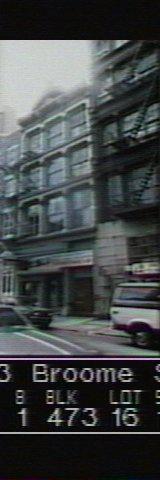
The city photographed every building for its tax records around 1940 and again in the 1980s. NYC Municipal Archives.
Written with AI from the source each entry cites, then fact-checked.
- 1830
Lambert Suydam's grapes from a vine planted three years earlier win praise at the Horticultural Society
Lambert Suydam, from a Knickerbocker family in America since 1663, planted a grapevine in the garden of his new house in 1827. At the New-York Horticultural Society's festival on September 7, 1830, he submitted a basket of White Sweet-water grapes. The New-York Farmer noted that the vine had produced over a hundred clusters that year.
Source: Daytonian in Manhattan
- 1846
William O'Brien, an Irish earl who lost his title, dies in the house he filled with Broome Street receptions
O'Brien was born in 1768 and was Earl of Inchiquin at the time of the 1798 Irish rebellion, but as a Catholic lost his title and estate. In 1810, aged 42, he married the 15-year-old Eliza West, whom he met on the voyage to America. He became a ship insurer and was remembered for weekly receptions with the best wines in the country. He died here on August 31, 1846, aged 78.
Source: Daytonian in Manhattan
- 1869
The O'Brien family converts the old house into a loft with a cast-iron front
After a stretch as the Broadway House Hotel, the O'Brien family began converting the house to a loft building in 1869. The attic was raised to a full story, and a cast-iron front took the place of the Federal facade. The new front has engaged Corinthian columns and an arched pediment, and the ground-floor storefront survives.
Source: Daytonian in Manhattan
- 1894
A cook at the building's ground-floor restaurant is found murdered with a woman's coat over him
Gottlieb Grob, a restaurant cook earning $7 a week, was found dead in his rented rooms on the night of May 3, 1894. Police thought the killer entered by the fire escape, and the only missing item was his watch. A woman's coat was draped over the body, which puzzled investigators because he had no known enemies.
Source: Daytonian in Manhattan
- 1996
Artist-owner David Novros tells the Times that produce wholesalers don't belong in an artists' neighborhood
David Novros bought the building around 1965, when the neighborhood was full of small factories, and had converted the upper floors to artists' studios by 1994. In April 1996 he told the New York Times that at least a dozen produce firms had moved onto the street. He described the dispute as "the bourgeois butting heads with new immigrants."
Source: Daytonian in Manhattan
Further reading
- Grapes, Murder and Artists -- No. 433 Broome StreetDaytonian in Manhattan
Nearby
- 435 Broome Street5 entries
- 431 Broome Street5 entries
- Poirier Building429 Broome Street | 5 entries
- Roosevelt Building478 Broadway | 4 entries
- 484 Broadway1 entry
- 486 Broadway4 entries