Holland Plaza Building
431 Canal Street | also 1 Hudson Square, 75 Varick Street, 73 Watts Street | Hudson Square | built 1930
Open on the map7 entries

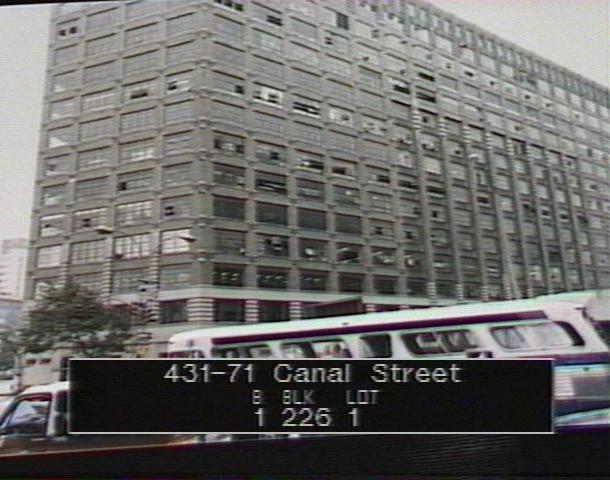
The city photographed every building for its tax records around 1940 and again in the 1980s. NYC Municipal Archives.
Written with AI from the source each entry cites, then fact-checked.
- 1927
The Holland Tunnel opens at Canal Street, the building's future front door
Construction of the Holland Tunnel began with a large public ceremony in October 1920 and it opened in November 1927. The report calls it the longest and largest vehicular tunnel in the world, with the first ventilation system designed for motor traffic. Canal Street was chosen as the Manhattan end partly because five busy ferry terminals already stood nearby, and the surrounding blocks soon filled with industrial and office buildings.
“The project turned out to be much more complicated than predicted, but when it did open in November, 1927…”
- 1929
Small rowhouses give way to the Holland Plaza on land leased from Trinity Church
Small rowhouses had occupied the block bounded by Varick, Canal and Watts Streets. Trinity Church owned the land and had just begun releasing some of its holdings for development, a first since colonial days. The developers, called York Investing Corporation in the report, took a long-term lease. By 1929 fourteen new industrial buildings of 100,000 to 350,000 square feet had risen in the vicinity.
- 1930
Russian-born hat maker Abe Adelson turns developer and hires Ely Jacques Kahn for the Holland Plaza
By 1909 Adelson and Edmond Uhry were making hats in a Broadway factory near Houston Street. In 1920-21 he joined seventeen other manufacturers to build the Garment Center Capitol, then left manufacturing to develop buildings, many designed by Kahn, including the Film Center Building and 2 Park Avenue. Kahn valued him as a client with no wish for a formal classical image, who left the architect to his own resources.
“By 1909 he and Edmond Uhry had formed a partnership to manufacture hats…”
- 1930
Kahn designs an industrial block with loading bays and a tan-brick grid facing the tunnel
On a nearly triangular lot, Kahn produced what the report calls unequivocally an industrial building, with floors able to carry heavy loads. Freight loading bays line the Watts Street side and pedestrian entrances open on Canal and Varick. The facade is fifteen stories of tan brick and stone with few setbacks, a grid of piers and windows with no applied ornament, as Kahn wrote that year that ornament came down to solid and void.
“…unequivocally an industrial building, with interior floors able to carry large loads…”
- 1930
Printers, bookbinders and Montgomery Ward fill the new Holland Plaza Building
Early tenants came largely from the printing and related trades. Royal Typewriter took a large space to consolidate its operations, and other early tenants included the American Book Bindery, the Chesterfield Press, Macmillan, a lithographer and an ink maker. Montgomery Ward leased several floors for New York offices, showrooms and distributing stations.
“…the American Book Bindery, the Chesterfield Press, The MacMillan Company, the National Process Company (lithographers)…”
- 1933
A bank failure leaves Adelson's company in default and the lease passes to Lortray
Adelson's York Investing Company belonged to the Bank of the United States, which financed many garment district projects. The bank was closed in 1930 over improper use of funds, involving its executive vice president Saul Singer and Adelson. Adelson's company defaulted, and in 1933 the lease passed to the Lortray Corporation. Lortray defaulted in 1940, and Trinity Church repossessed the building.
“In 1930, the Bank of the United States was closed due to improper use of funds…”
- 2013
The Landmarks Commission designates the Holland Plaza Building after a hearing with two supporters
At the June 11, 2013 hearing two speakers favored designation: the owner and a Historic Districts Council representative. The commission's report, dated September 24, 2013, calls the building one of Ely Jacques Kahn's great masterpieces and notes that it emphasizes the structural grid without applied ornament, an unusual look in a district of utilitarian warehouses.
Further reading
- One Hudson SquareWikipedia
Nearby
- 12 Vestry Street3 entries
- Holland Tunnel Administration Building4 Vestry Street | 2 entries
- 17 Vestry Street2 entries
- 11 Vestry Street1 entry
- 19 Vestry Street2 entries
- 28 Laight Street2 entries