Richard Cunningham House
44 Horatio Street | West Village | built 1848
Open on the map6 entries

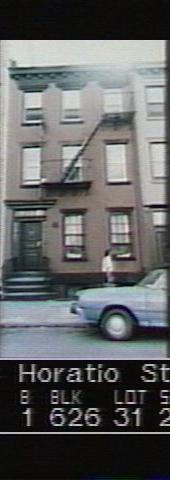
The city photographed every building for its tax records around 1940 and again in the 1980s. NYC Municipal Archives.
Written with AI from the source each entry cites, then fact-checked.
- 1848
Bricklayers Richard Cunningham and Cornelius Lacost build near-twin houses at 44 and 46 Horatio
Bricklayers Richard Cunningham and Cornelius Lacost bought adjoining lots on Horatio Street, Nos. 44 and 46, from John B. Ireland in 1847 and built homes for themselves. Cunningham's No. 44 is a three-story, 20-foot-wide brick house with a doorway above a shallow stoop, flanked by pilasters and sidelights, under a modillioned cornice; the two houses nearly match. A boarding house by 1855, it passed through the Mallaby family before later owners.
Source: Daytonian in Manhattan
- 1855
Two firemen who ring the Jefferson Market fire bell lodge in the boarding house
By 1855 No. 44 took boarders, among them William Yonge Tufft and John W. Stinman. Both volunteered with an Exempt Engine Company on Centre Street and worked as bell-ringers in the Jefferson Market cupola, the wooden fire lookout where three men took shifts. Stinman had served as a fire foreman and a police patrolman; Tufft later changed his surname to Taft and joined the Metropolitan Police.
Source: Daytonian in Manhattan
- 1856
A blind boarder's friends raise money for him, and the councilman collecting it is charged with keeping it
Joseph Perkins, a boarder who had lost his sight and could not work, had friends start a collection in April 1855. Councilman Thomas Cooper gathered the donations but, by Perkins's account, kept the money. Perkins sued in October 1855 and a warrant was issued, but Cooper vanished until January 1856, when he was found and charged with breach of trust. He was held on $500 bail.
Source: Daytonian in Manhattan
- 1857
Resident William Taft, a Metropolitan policeman, fights in the clash with Mayor Wood's police
William Y. Taft, a resident for more than twenty-five years, was among the first men appointed to the new Metropolitan Police in 1857. When Mayor Fernando Wood's loyal municipal police barred the new street commissioner from his office, the two forces fought in the bloodiest clash since the Astor Place Riots. At an inquest Taft said Bowery Boys helped his men and many were wounded. He died in the house on July 28, 1880.
Source: Daytonian in Manhattan
- 1941
Radio news commentator Mark Hawley buys No. 44 and returns it to a single-family home
Mark A. Hawley, a radio news commentator, and his wife Adelaide bought the house in 1941, making it a single-family home for the first time in almost a century. They finished renovations that September but sold in October 1942 after leasing a duplex at 77 Park Avenue. Buyer William Rubin kept it a one-family house until 1966, when it was divided into two duplexes.
Source: Daytonian in Manhattan
- 1971
Foreign Policy managing editor John Franklin Campbell, a resident, dies at 31
John Franklin Campbell, managing editor of Foreign Policy magazine, lived in one of the apartments with his wife Brenda Lee Hughes. A former State Department Foreign Service officer, he wrote The Foreign Affairs Fudge Factory. He died on November 6, 1971, at St. Vincent's Hospital, aged 31, of an obstruction in his throat.
Source: Daytonian in Manhattan
Further reading
- The 1848 Richard Cunningham House -- No. 44 Horatio St.Daytonian in Manhattan
- Then & Now photos: 44 Horatio StreetVillage Preservation: Greenwich Village Then & Now
Nearby
- 46 Horatio Street1 entry
- Perry Hose Company No. 23 firehouse48 Horatio Street | 8 entries
- Hugh King & Co. building630 Hudson Street | 5 entries
- George Little House53 Jane Street | 6 entries
- Edison Illuminating Company Station30 Horatio Street | 5 entries
- John Radway House55 Jane Street | 5 entries