John Street Methodist Church
44 John Street | Financial District | built 1841
Open on the map12 entries

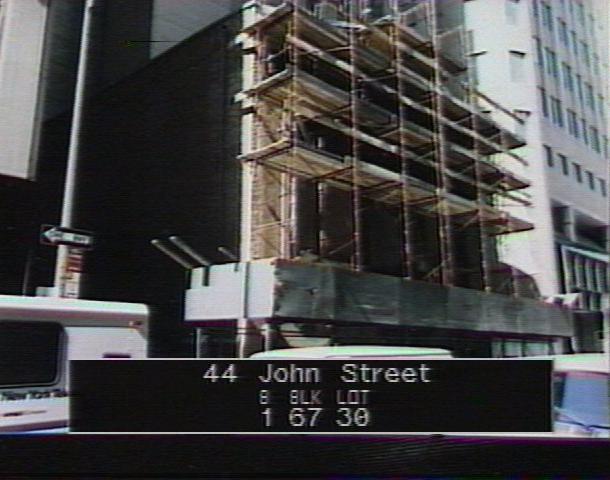
The city photographed every building for its tax records around 1940 and again in the 1980s. NYC Municipal Archives.
Written with AI from the source each entry cites, then fact-checked.
- 1766
Philip Embury organizes America's first Methodist congregation nearby
Irish-born carpenter Philip Embury, who had been converted to Methodism years earlier by John Wesley, gathered five followers into America's first Methodist congregation in 1766, meeting first at his own home and then in a rented loft on William Street. The group bought the John Street lot two years later, in 1768, to build a permanent chapel.
Source: Daytonian in Manhattan
- 1768
The congregation dedicates its first chapel, built to dodge an anti-dissenter law
Needing 400 pounds but raising only half that, the congregation relied on gifts from merchant William Lupton and Captain Thomas Webb to finish a stone chapel, adding a fireplace so it could be classified as a dwelling and skirt laws against dissenting worship. Wesley Chapel opened on John Street on October 13, 1768.
Source: Daytonian in Manhattan
- 1776
British occupiers turn the chapel into a theater
During the Revolutionary War, British forces seized the John Street chapel and used it as a theater, where Major John Andre, later hanged as a spy, performed on stage.
Source: Daytonian in Manhattan
- 1841
The congregation builds its third chapel, the one still standing today
Worship in the original 1768 chapel continued until 1837, after which the congregation raised an Anglo-Italianate building on the site in 1841, with tall arched windows and a Palladian window above the entrance.
Source: Daytonian in Manhattan
- 1856
Rival congregation factions lock themselves in the church and police use clubs to reach the doors
A dispute between uptown members, who wanted to sell the church and move, and downtown members, who wanted to keep it, turned violent in 1856. After the uptown group paid William Thompson $500 to put hired men in the pews, police were locked out on the night of July 25. A crowd held them back from the doors until they drove it off with nightsticks, and inside they found clubs and liquor bottles. The papers then reported the church in the hands of the downtown worshipers.
Source: Daytonian in Manhattan
- 1881
Benjamin Weymouth, a trustee famous as President Lincoln's double, has his funeral in the church
Benjamin F. Weymouth, born in Portland, Maine, succeeded in the grocery and real estate businesses and served as a trustee of the church, which he kept faith with even as the neighborhood declined. Strangers often mistook him for Abraham Lincoln, and after the president's assassination he sat for pictures and statuettes. He died on August 10, 1881, aged 75, and his funeral was held in the church. The Times headlined his obituary "President Lincoln's Double."
Source: Daytonian in Manhattan
- 1888
The pastor is struck silent in the pulpit during the 'Boy Preacher' revival
Revivalist Harrison, called the Boy Preacher, led meetings at the church in July 1888. On July 14 the pastor, Rev. Dr. Wellesley W. Bowdish, lost the power to speak near the end of his sermon, threw up his arms and fell back into a chair. A doctor found no physical cause. Harrison called it an outpouring of the Spirit, while The Times was skeptical, and the publicity was good for attendance and collections.
Source: Daytonian in Manhattan
- 1900
After the 132nd anniversary service, the pastor shows off the congregation's earliest relics
On October 28, 1900, after services marking the congregation's 132nd anniversary, Rev. W. C. Blakeman invited worshipers to look at the church's collection of relics from its earliest days. The display held the Bible of Philip Embury, a clock that had belonged to John Wesley, a gavel fashioned partly from timbers of the old John Street church, and an old oil painting of the original building.
Source: Daytonian in Manhattan
- 1931
Plans for a 19-story church and office tower on the site are approved, the latest in a series of replacement schemes
Trustees had won permission to replace the church with a commercial building in 1916, and a skyscraper was proposed again in 1928. On September 2, 1931, the plans of architect Arthur G. Smith won approval for a 19-story church and office building projected to cost $2 to $3 million. The Times said the sanctuary would be reproduced on the lower floors and the exterior copied in bas-relief. The tower was never built.
Source: Daytonian in Manhattan
- 1963
Excavation for a neighboring skyscraper leaves the church in danger of collapse
In the summer of 1963 the church was threatened by an engineer's oversight. When foundations were dug for a neighboring skyscraper, inspectors realized the old building could collapse. Engineers rushed to prop up its walls and foundations before a catastrophe. The church was designated a landmark two years later.
Source: Daytonian in Manhattan
- 1965
Someone hurls a dye-filled egg at the sanctuary wall, and a twin attack follows at St. Paul's Chapel
At about 11:25 on the morning of January 21, 1965, a person came up the left aisle by the chancel and hurled a dye-filled egg. The blue-black fluid splattered a white wall and dripped onto the red carpet. The next day an identical attack at St. Paul's Chapel on Broadway splashed dye across three religious statues. Police suspected "a religious crank."
Source: Daytonian in Manhattan
- 1965
The city designates the church a landmark, ending decades of demolition threats
Demolition had loomed over the church in 1916, 1928, and again in 1963, when construction next door threatened its foundation. In 1965 the Landmarks Preservation Commission designated the building a landmark, citing its "simple dignity" amid the surrounding financial district skyscrapers.
Source: Daytonian in Manhattan
Further reading
- John Street Methodist ChurchWikipedia
- The John Street Methodist Church - 44 John StreetDaytonian in Manhattan
Nearby
- Home Insurance Plaza59 Maiden Lane | 5 entries
- 63 Nassau Street3 entries
- Federal Reserve Bank of New York33 Liberty Street | 12 entries
- 14 Maiden Lane4 entries
- Liberty Tower53 Liberty Street | 12 entries
- 19 Dutch19 Dutch Street | 3 entries