Federal Reserve Bank of New York
33 Liberty Street | also 19 Liberty Street | Financial District | built 1924
Open on the map12 entries

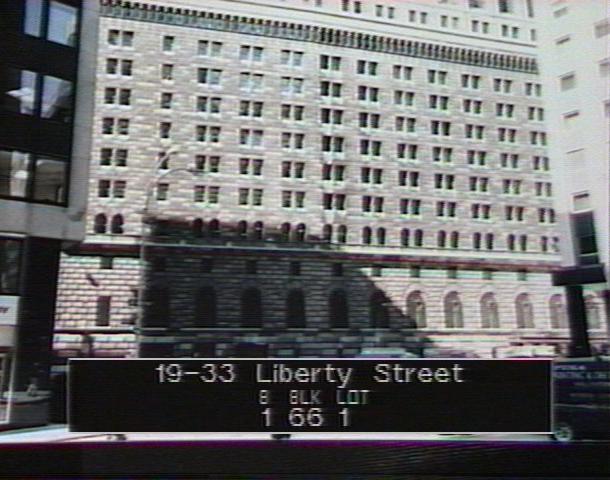
The city photographed every building for its tax records around 1940 and again in the 1980s. NYC Municipal Archives.
Written with AI from the source each entry cites, then fact-checked.
- 1919
York & Sawyer win the Fed's design contest with a 14-story palazzo, to the press's surprise
The New-York Tribune reported on November 7, 1919 that the bank had picked a fourteen-story design. Observers had assumed the building would be no more than four stories, since the competing architects were never given a height limit. The directors asked only for something dignified rather than sensational, and York & Sawyer answered with a modified Florentine scheme borrowed heavily from Florence's Palazzo Strozzi.
Source: Daytonian in Manhattan
- 1924
The Federal Reserve Bank of New York moves into its new Liberty Street headquarters
Architects York and Sawyer designed the Florentine Renaissance-style building, with ornamental ironwork by Samuel Yellin of Philadelphia. The cornerstone was laid on May 31, 1922; employees began occupying offices in June 1924, and that September the bank moved three billion dollars in cash and securities into its new vault.
Source: Wikipedia
- 1925
A bronze tablet on the new bank tells passersby the history of the site and its street names
In 1925 the Maiden Lane Historical Society sat down with bank officials and the architects York & Sawyer to write the wording for a bronze plaque for the facade. It was unveiled on March 28. The inscription gave anyone willing to stop on the sidewalk a short account of the block's past and of how the surrounding streets got their names.
Source: Daytonian in Manhattan
- 1927
The bank's vault comes to hold a tenth of the world's official gold reserves
Built eighty feet below street level on Manhattan bedrock, the vault held gold on deposit for foreign central banks in such quantity that by 1927 it contained roughly ten percent of the world's official gold reserves. The vault is sealed by a 90-ton circular door set into a 140-ton frame.
Source: Wikipedia
- 1931
Financial reporters use handkerchiefs and raised hands to relay the bank's weekly rate decisions
Each Thursday at 3:30 pm the doors to the executive offices on the tenth floor opened and the rediscount rate was announced. The building's only two phone booths sat several hundred feet away, so rival ticker services posted one man at each end of the corridor. A waved handkerchief meant no change, a raised hand meant half a percent, and both hands meant a full point. The New York Times joked that a rise of two percent would call for falling to the floor and kicking.
Source: Daytonian in Manhattan
- 1933
Depositors rush to return hoarded gold before a criminalizing order takes effect
Amid the Depression-era banking panic, New Yorkers had been hoarding currency and gold. Just before Executive Order 6102 made gold hoarding a crime, thousands lined up outside the bank on March 10, 1933, to turn theirs back in, with $20 million collected in a single day and $85 million over the week.
Source: Daytonian in Manhattan
- 1934
The Fed buys and demolishes the Montauk Building, the last holdout on its block
When the bank assembled the block in 1919 it could not agree on a price for the Montauk Building on William Street, the only structure it failed to acquire. By January 1934 it bought the building for less than $400,000. The last tenants left that June and demolition began, clearing the lot for an eastern annex by York & Sawyer. The annex's executive offices opened in December 1935.
Source: Wikipedia
- 1944
A name sign goes up over the entrance after war bondholders get lost looking for the bank
Nicknamed the Old Lady of Liberty Street, the building had no name sign over its main entrance at first, because the bank believed it was distinctive enough to need none. That changed in 1944, when war bondholders complained that they had wandered the Financial District for hours without finding it. The bank had also outgrown its quarters by then and rented extra space on Pine Street and Maiden Lane.
“A name sign was installed in 1944 after numerous war bondholders complained that they had gotten lost for several hours in the Financial District.”
Source: Wikipedia
- 1944
York & Sawyer return to add five more floors to the headquarters
The building's original architects came back in 1944 to add five additional stories to the Liberty Street headquarters, a project estimated to have cost about $750,000.
Source: Daytonian in Manhattan
- 1965
The city landmarks the Fed's building over the bank's objection that it is a federal instrumentality
At the Landmarks Preservation Commission's October 19, 1965 hearing, one witness spoke in favor, while a letter from the bank's owner asked that the building not be designated, arguing that a federal instrumentality is not subject to local laws. The same letter said the bank was proud of the building. On December 21 the commission designated it anyway, saying the city needed to state officially that it wanted the building preserved.
“…a Federal instrumentality is not subject to regulation by local laws…”
- 1995
Die Hard with a Vengeance imagines a robbery of the bank's gold vault
The 1995 film Die Hard with a Vengeance builds its plot around a fictional heist of the gold held here. The real vault sits on bedrock 80 feet below street level, behind a circular door weighing 90 tons, and as of 2018 it had never had a successful break-in. Nearly all of the gold belongs to the central banks of foreign nations, which the Fed holds as a guardian rather than an owner.
“Nearly 98 percent of the building's gold is owned by the central banks of 36 foreign nations.”
Source: Wikipedia
- 2012
A man parks a fake 1,000-pound bomb near the bank and is arrested trying to detonate it
In October 2012 Quazi Mohammad Rezwanul Ahsan Nafis, a Bangladeshi student, assembled with an undercover agent what he believed was a bomb able to crumble the fortress-like bank. They placed it in a van parked near the building, and he tried several times to set it off by remote control before agents arrested him. The device was a fake, and in August 2013 a judge sentenced him to 30 years in prison.
Source: The New York Times
Further reading
- Federal Reserve Bank of New York BuildingWikipedia
- The Federal Reserve Bank Bldg -- No. 33 Liberty StreetDaytonian in Manhattan
Nearby
- One Chase Manhattan Plaza28 Liberty Street | 12 entries
- Home Insurance Plaza59 Maiden Lane | 5 entries
- John Street Methodist Church44 John Street | 12 entries
- Liberty Tower53 Liberty Street | 12 entries
- Chamber of Commerce Building59 Liberty Street | 12 entries
- 63 Nassau Street3 entries