Prospect Tower, Tudor City
45 Tudor City Place | also 45 1/2 Tudor City Place, 351 East 42nd Street, 350 East 43rd Street | Murray Hill | built 1927
Open on the map7 entries

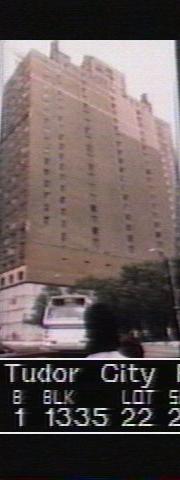
The city photographed every building for its tax records around 1940 and again in the 1980s. NYC Municipal Archives.
Written with AI from the source each entry cites, then fact-checked.
- 1927
Fred F. French puts a 30-by-50-foot electric 'Tudor City' sign on Prospect Tower's roof
To sell apartments in a district few New Yorkers had ever looked at, Fred F. French builds framing for an electric sign about 30 by 50 feet on top of Prospect Tower, reading 'Tudor City' and visible as far west as Lexington Avenue. French's slogan for the complex was 'A city within a city.' A 1927 photograph in the company magazine The Voice shows the sign, and the matching sign on Tudor Tower was gone by 1933.
Source: Internet Archive
- 1927
Prospect Tower and the Manor are 90 percent rented by November 1927
By November 1927, about 90 percent of the apartments in Prospect Tower and the Manor, the first two buildings of Tudor City, have been rented. The figure climbs to 99 percent by May 1928, and the complex's later towers also fill soon after they are completed.
“By November 1927, ninety percent of the apartments in the Manor and Prospect Tower had been rented, a figure that had increased to 99 percent by May 1928.”
Source: Wikipedia
- 1927
Prospect Tower opens as one of the first buildings of Fred F. French's Tudor City
The Fred F. French Company began Tudor City in 1926 on the old Prospect Hill, an area by then crowded with tenements and noxious industries such as slaughterhouses and meatpacking plants. Prospect Tower, at 45 Tudor City Place, and the Manor opened on September 30, 1927, the first of the complex's buildings. The towers on Tudor City Place were built as apartment hotels with very few windows facing east toward the industrial plants across First Avenue.
Source: Wikipedia
- 1927
Tudor City's towers end up with few windows facing First Avenue
When Fred F. French built Tudor City starting in 1926, slaughterhouses and other industrial buildings already lined the blocks east of First Avenue toward the East River. Because of that industrial strip, the complex's towers, including Prospect Tower, ended up with very few windows facing east.
Source: Wikipedia
- 1949
A storm knocks the Tudor City sign off Prospect Tower, and a replacement goes up
The rooftop sign, first built from incandescent bulbs and retrofitted with neon in 1939, falls during a September 1949 storm and is replaced. It became the last survivor of the two big advertising signs that the French Company once put on Tudor City roofs. The sign on Tudor Tower had come down around 1933.
Source: Wikipedia
- 1988
Tudor City is landmarked after residents save its private parks
Harry Helmsley bought most of Tudor City in 1970 and proposed replacing its two private parks with luxury apartments. Residents fought the plan for about a decade through lawsuits and activism, and the parks survived; Tudor City Greens was formed in 1987 to look after them. The Landmarks Preservation Commission designated the complex on May 17, 1988.
Source: Wikipedia
- 1995
The city refuses to let Prospect Tower remove its rooftop sign
In 1995 Prospect Tower's co-op asked the Landmarks Preservation Commission for permission to remove the illuminated "Tudor City" sign from the tower's roof. The commission refused the request, and the sign stayed up.
Source: Wikipedia
Further reading
- Tudor CityWikipedia
Nearby
- Dag Hammarskjöld Library750 1st Avenue | 5 entries
- Ford Foundation Building320 East 43rd Street | 15 entries
- One United Nations Plaza1 United Nations Plaza | 9 entries
- Two United Nations Plaza323 East 44th Street | 3 entries
- United Nations Secretariat Building762 1st Avenue | 10 entries
- United Nations General Assembly Building48 1st Avenue | 13 entries