The Crimson Beech (Cass House)
48 Manor Court | Lighthouse Hill | built 1959
Open on the map7 entries

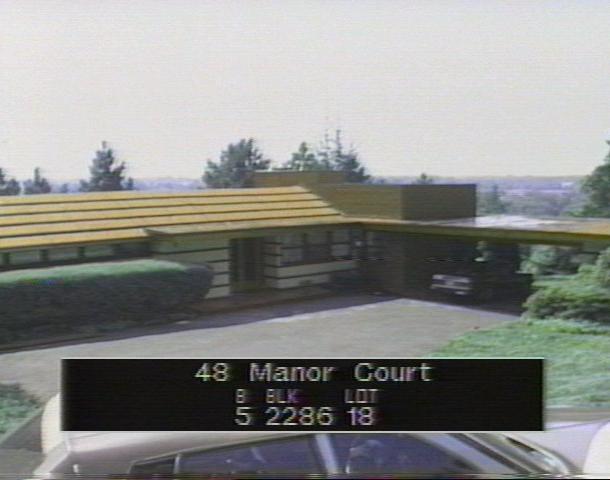
The city photographed every building for its tax records around 1940 and again in the 1980s. NYC Municipal Archives.
Written with AI from the source each entry cites, then fact-checked.
- 1957
William Cass sees Frank Lloyd Wright on television and writes asking for a house
William and Catherine Cass, then living in Corona, Queens, already admired Wright's work when Mr. Cass watched him on Mike Wallace's TV interview in September 1957. He wrote asking whether Wright could give him a house on his Staten Island land for about $35,000. Wright sent him to the Madison builder Marshall Erdman, who said a prefab could save 30 to 40 percent, and Cass pressed a reluctant Erdman until he agreed.
“It all started when I saw Mr. Wright on Mike Wallace's TV interview [September 1957].”
- 1958
Trucks from Wisconsin deliver a Wright-designed prefab house to Lighthouse Hill
Construction of the Casses' Prefab No. 1 house began in 1958 with parts trucked from Madison; the shell went up in four or five days and the house was done four months later. The house and shipping cost $20,000, but local contractors added another $35,000. The hilltop lot, once part of the Platt estate, overlooked historic Richmondtown, and publicity brought a donation of terne metal roofing from Follansbee Steel.
“…the shell of the house took only four or five days to erect, although completion was four months later…”
- 1959
Frank Lloyd Wright dies without ever seeing his only New York City house
Wright had planned to visit the Staten Island site in 1958 but called the trip off because he was ill, and he died in April 1959 before he could go. Apart from the Guggenheim Museum, the house is the only complete building by Wright in New York City, and his only residence there.
- 1959
The Casses open their new Wright house to the public before moving in
Marshall Erdman and Wisconsin Governor Gaylord Nelson came to the opening ceremony, and William and Catherine Cass held a public open house through July 1959. They named the house The Crimson Beech for the centuries-old copper beech in the front yard. It was the first of only two Erdman prefabs built on the East Coast.
“…the casses invited the public to view it in an "open house" during the month of July, 1959, prior to their moving in…”
- 1967
A storm destroys the copper beech that gave the house its name
The several-hundred-year-old copper beech in the front yard, which had drawn the Casses to the lot and named their house, was destroyed in a storm in 1967 and later replaced. The steep rear slope had already been replanted with pines and other landscaping, especially after a hillside fire in 1963.
- 1990
The Crimson Beech becomes a New York City landmark
The Landmarks Preservation Commission called the Cass House an example of the Erdman prefabs, Wright's last major effort at well-designed houses of moderate cost. It noted that the exterior had stayed essentially unchanged since 1959 apart from a swimming pool, stairs and brick walls that supervising architect Morton H. Delson added at the rear in 1970.
“…has had no major alterations since its completion, except for the addition of a swimming pool and adjacent stairs and brick walls by Mr. Delson in 1970…”
- 1999
The original owners sell the Crimson Beech after four decades
William and Catherine Cass, who had ordered the kit house from Marshall Erdman in Madison, Wisconsin, for assembly on Staten Island in 1959, lived there until 1999, when the house was sold. It is one of eleven Marshall Erdman prefabs and remains privately owned.
Source: Wikipedia
Further reading
- The Crimson BeechWikipedia
Nearby
- Staten Island Lighthouse418 Edinboro Road | 5 entries
- Moore-McMillen House3531 Richmond Road | 4 entries
- Jacques Marchais Museum of Tibetan Art338 Lighthouse Avenue | 6 entries
- Stephens-Prier House3672 Richmond Road | 5 entries
- Guyon-Lake-Tysen House3737 Richmond Road | 5 entries
- Britton Cottage1001 Richmond Hill Road | 6 entries