Jacques Marchais Museum of Tibetan Art
338 Lighthouse Avenue | also 336 Lighthouse Avenue | Lighthouse Hill | built 1931
Open on the map6 entries

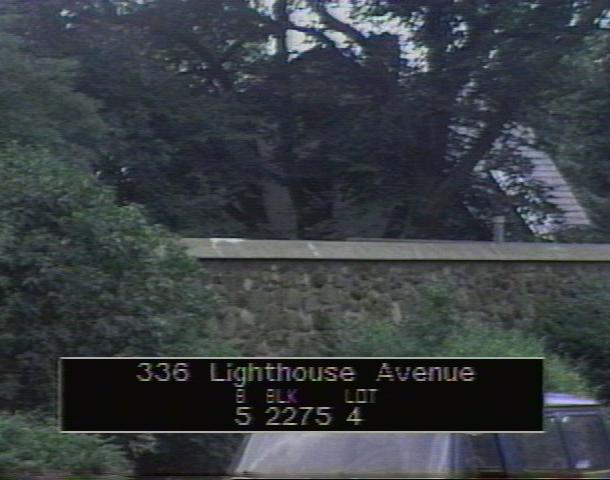
The city photographed every building for its tax records around 1940 and again in the 1980s. NYC Municipal Archives.
Written with AI from the source each entry cites, then fact-checked.
- 1920
Jacques Marchais marries Harry Klauber and turns to collecting Central Asian art
Jacques Marchais had helped support her family as a child entertainer after her father died, and had eloped with her first husband at 16. In 1920 she married the entrepreneur Harry Klauber, her partner for the rest of her life. Over the following years she built up her collection of Central Asian art and planned a building she called the "Potala of the West."
Source: atlasobscura.com
- 1945
Marchais opens a research library beside her Staten Island home
Born in Cincinnati in 1887, Marchais had moved to rural Staten Island with her husband, a chemical factory owner, and collected there for years without ever visiting Tibet or the Himalayas. She added a research library beside the house in 1945 while she looked for a lasting place for her collection. She died in 1948, the year after the museum formally opened.
“In 1945 she opened a research library next to her home in Staten Island.”
Source: Wikipedia
- 1947
A hillside stone complex modeled on the Potala at Lhasa opens to the public
Marchais hired local stone mason Joseph Primiano, and the two gathered fieldstone around still-rural Staten Island for the building. They worked from photographs of the Potala, the old seat of the Dalai Lamas, and other monasteries, though neither had been to Tibet. The terraced complex, which opened in 1947, holds a library, chanting hall, meditation cells and a lotus pond, with a flat roof topped by a pagoda and trapezoidal doors and windows.
Source: atlasobscura.com
- 1991
The Dalai Lama visits the museum and praises its authenticity
In 1991 the Dalai Lama came to the museum on Lighthouse Hill, built to resemble a rustic Himalayan monastery with terraced gardens and a fish and lotus pond, and praised it for its authenticity. The museum holds one of the most extensive collections of Himalayan objects in the United States.
Source: Wikipedia
- 2009
The Tibetan museum is listed on the state and national historic registers
In 2009 the Jacques Marchais Museum was added to both the New York State Register and the National Register of Historic Places. The museum has stayed somewhat hidden among the city's cultural institutions: without its own parking lot it could not benefit from a Department of Transportation signage program meant to steer visitors to the borough's cultural sites, though cycling clubs make it a stop.
“In 2009, the site was listed on the New York State Register and National Register of Historic Places.”
Source: Wikipedia
- 2026
The museum begins selling objects that fall outside its collecting focus
In 2026 the Jacques Marchais Museum started to sell items that did not fit the scope of its collection. Its collection and its history on Staten Island had earlier been the subject of a book and a 60th anniversary exhibition.
“In 2026, the museum started selling off items that did not fit the collection's scope.”
Source: Wikipedia
Further reading
Nearby
- Staten Island Lighthouse418 Edinboro Road | 5 entries
- Moore-McMillen House3531 Richmond Road | 4 entries
- The Crimson Beech (Cass House)48 Manor Court | 7 entries
- Nathaniel J. and Ann C. Wyeth House190 Meisner Avenue | 5 entries
- Stephens-Prier House3672 Richmond Road | 5 entries
- St. Patrick's Church256 Center Street | 3 entries